





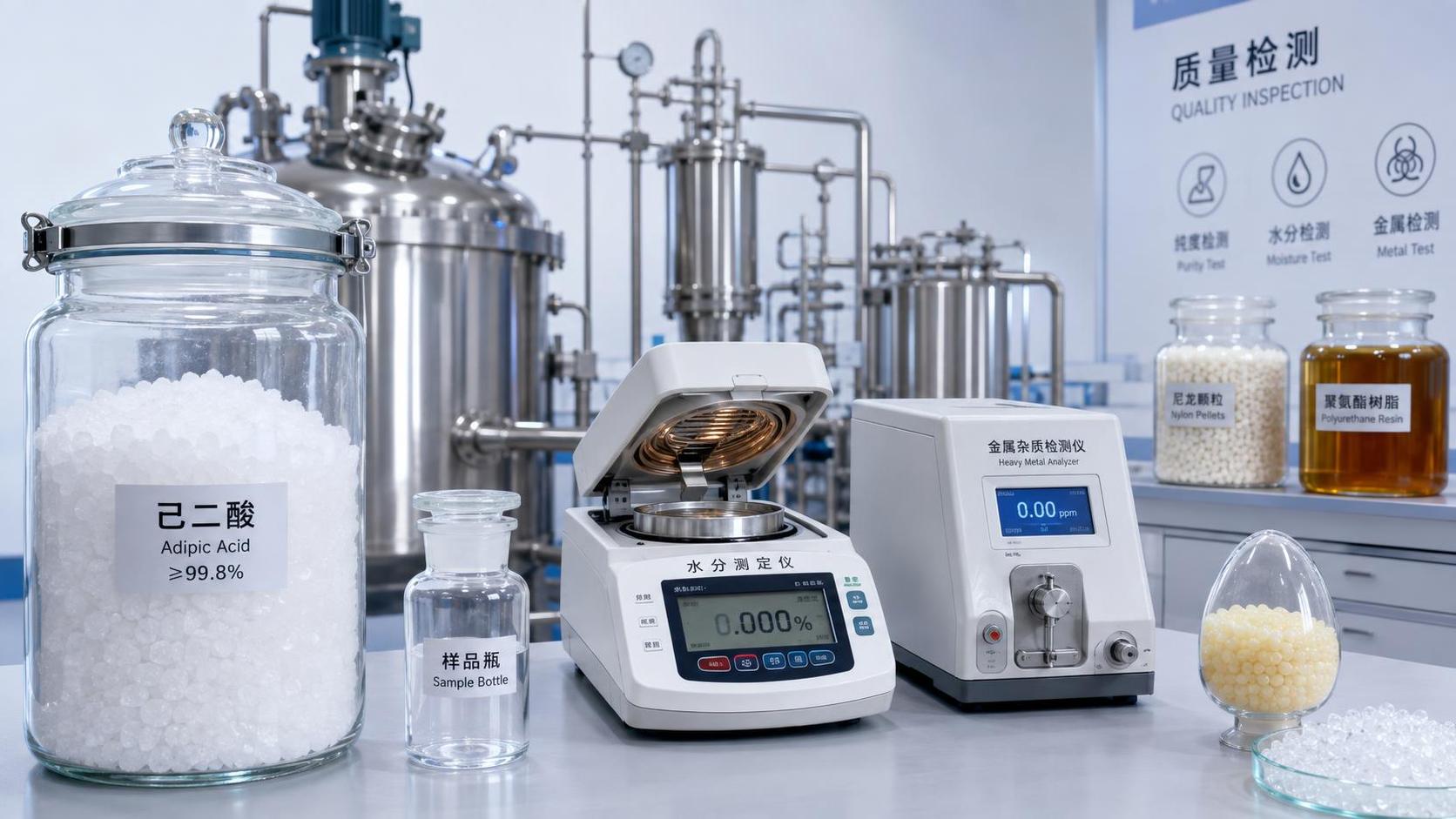
In nylon and polyurethane production, Adipic Acid should not be judged by assay alone. A material can meet a high purity claim and still create problems if its moisture, color, metal content, insoluble matter, or organic impurity profile differs from the process baseline. The critical question is whether the supplied grade will behave consistently in salt formation, esterification, polycondensation, filtration, and final-product appearance.
For quality and safety control, the most useful specification is therefore not a generic “industrial grade” description, but a parameter set tied to the intended polymer route. Nylon 6,6 production is especially sensitive to stoichiometric balance and color-forming contaminants, while polyester polyols for polyurethane depend heavily on water control, acid value management, and reliable removal of reaction by-products.
Purity is necessary, but it does not define polymer suitability
Adipic Acid is a six-carbon dicarboxylic acid used principally to form nylon 6,6 salts with hexamethylenediamine and to produce adipate-based polyester polyols with glycols. In both routes, the functional-group balance determines polymer architecture. The assay result indicates the proportion of the target acid, but it does not explain what occupies the remaining fraction or how that fraction behaves under reaction conditions.
For nylon 6,6, a reduction in effective dicarboxylic acid content can shift the carboxyl-to-amine balance. Even a relatively small stoichiometric deviation may alter molecular weight, end-group distribution, melt viscosity, and the consistency of downstream spinning or molding behavior. The issue is not simply whether the material passes a purity threshold; it is whether each lot gives the same active-acid contribution used in the plant’s salt calculation.
For polyurethane applications, Adipic Acid is commonly reacted with diols such as ethylene glycol, diethylene glycol, 1,4-butanediol, or neopentyl glycol to make polyester polyols. Here, non-target acids can affect acid value, hydroxyl number, molecular-weight distribution, and esterification time. A high assay result does not eliminate the need to understand related acids, monocarboxylic acids, and non-reactive residues.
Certificate-of-analysis review should therefore distinguish between assay by the stated method and the full impurity profile. Comparing figures from different suppliers without confirming the analytical method, reporting basis, and sample condition can produce a misleading equivalence.
Moisture affects reaction control long before it becomes visible
Water is one of the most consequential quality parameters because it changes process control rather than merely product appearance. During polyester polyol manufacture, esterification already generates water as a reaction by-product. Additional water introduced through raw material increases the water-removal burden and can delay achievement of the required acid value. It may also complicate the interpretation of batch-endpoint data where acid value, viscosity, and hydroxyl value are monitored together.
The risk continues into polyurethane manufacture. Isocyanates react with water to form carbon dioxide and urea structures. Moisture entering through a polyester polyol system can therefore contribute to foaming irregularity, voids, viscosity drift, or changes in cured-material properties. The original Adipic Acid may no longer be present as free acid at that stage, but its incoming moisture can still influence the chemistry of the polyol batch.
For nylon salt preparation, moisture may be less chemically disruptive when the material is deliberately dissolved, but variable water content can still affect mass-balance calculations, handling behavior, and storage stability. Hygroscopic pickup during transport or warehouse storage can cause caking, poor flow, and inconsistent feeder performance.
Moisture limits should be matched to the process, not copied from an unrelated specification. The receiving procedure also matters: a sample taken from a dry surface layer of a partly compacted bag may not represent the condition of the full package. Closed sampling, prompt testing, and protection from ambient humidity reduce this source of uncertainty.
Color is an early warning signal, not only an aesthetic requirement
Color is often reported as an APHA/Hazen value for an aqueous solution or melt, depending on the supplier’s method. The method must be specified because values obtained under different preparation conditions are not automatically comparable. A low initial color is valuable, but color stability during heating is often more relevant for polymer producers.
In nylon 6,6, color-forming impurities can become more apparent during high-temperature polymerization and melt processing. The resulting polymer may exhibit yellowing, uneven shade, or reduced suitability for light-colored compounds and fibers. In polyester polyols, initial color can increase during esterification, particularly when trace metals or oxidizable organic residues are present. The color of the final polyurethane system is then influenced not only by pigments and additives but also by the inherent color of the polyol.
Color should be interpreted alongside iron content, oxidation-sensitive impurities, storage duration, and thermal history. A single low color result from a fresh sample does not prove that the material will remain color-stable during a prolonged high-temperature reaction. Where appearance is critical, a small controlled process trial or thermal color-stability evaluation can be more informative than an incoming color value alone.
Iron and other metal contamination can have disproportionate effects
Iron is routinely monitored because trace metal contamination can promote discoloration and oxidation reactions in organic systems. It can enter through upstream production equipment, storage tanks, transfer lines, packaging contact, or contamination during handling. Iron is not the only relevant metal: the suitability of a grade may also depend on the limits and reporting practices for copper, manganese, chromium, or other metals where the downstream formulation is sensitive.
The practical concern is consistency. A plant may tolerate a defined low metal level without measurable impact, while intermittent excursions create unexplained lot-to-lot color changes or reduced stability. For this reason, a supplier’s stated maximum should be reviewed together with its batch-history consistency rather than treated as a one-time qualification item.
Iron analysis is also a useful indicator of broader contamination control. A result within limit does not prove the absence of all processing contaminants, but an unexpected increase can justify additional review of packaging integrity, transfer equipment, and lot segregation.
Related organic acids affect molecular-weight control
Commercial Adipic Acid can contain related dicarboxylic acids formed in oxidation-based production routes, including succinic acid and glutaric acid. These compounds are also difunctional, so their presence does not necessarily stop polymer formation. However, they change the average molecular structure and may influence crystallization behavior, melting characteristics, polymer viscosity, and the reproducibility of end-use performance.
More problematic are monocarboxylic acids or other mono-functional organic impurities. In a condensation polymerization system, a mono-functional component can act as a chain terminator, reducing attainable molecular weight. The effect depends on concentration and the process’s tolerance for molecular-weight variation, but the mechanism is important: “total organic impurities” is less useful than knowing whether impurities are di-functional, mono-functional, inert, volatile, or color-forming.
Residual solvents, oxidation intermediates, nitrate-containing residues, or other process-specific compounds should be assessed according to the supplier’s manufacturing route and the polymer application. A broad impurity specification without identified components may be insufficient where the material is used in high-performance engineering plastics, transparent coatings, or tightly controlled polyurethane elastomers.
Insolubles, ash, and packaging contamination are process risks
Insoluble matter is frequently underestimated because it may represent only a small mass fraction. Yet particles that do not dissolve or react can obstruct filters, create gel-like defects, increase equipment cleaning frequency, or appear as visible contamination in light-colored polymer products. Ash content provides another indication of inorganic residue, though it should not be used as a substitute for particle inspection or metal analysis.
The condition of bags, liners, pallets, and loading equipment matters as much as the laboratory result. Torn inner liners, damp outer packaging, foreign particles, and powder leakage can invalidate an otherwise acceptable batch. Incoming inspection should connect package condition with laboratory release rather than treating them as separate controls.
Warehouse segregation also reduces avoidable identification and cross-contact errors. Acids with different downstream uses may appear similar as white crystalline solids or powders; for example, Salicylic Acid has a distinct specification and use profile and should never be substituted or co-handled on the assumption that all organic acids are operationally interchangeable.
Thermal properties support identity checks, but do not replace full testing
Melting point or melting range is useful for confirming material identity and detecting substantial contamination. Pure Adipic Acid has a characteristic melting behavior, while a depressed or broadened melting range may indicate moisture, impurities, or mixed material. However, melting-point testing is not sufficiently sensitive to establish suitability for polymer-grade use on its own.
A lot can exhibit an acceptable melting range while still containing enough trace contaminants to influence polymer color, end-group balance, or filtration performance. Thermal data should be treated as a rapid supporting check alongside assay, water, color, metals, insolubles, and impurity analysis.
Release criteria need to reflect the manufacturing route
A meaningful incoming control plan typically links each parameter to a defined production risk. Assay supports stoichiometric calculations; moisture supports esterification and isocyanate control; color and iron support appearance stability; related acids and mono-acids support molecular-weight consistency; insolubles and ash support filtration and cleanliness. This connection prevents the common mistake of accepting a technically compliant lot that is unsuitable for a specific process window.
Lot traceability is equally important. Batch number, production date, supplier certificate, packaging condition, retained sample, test method, and any deviation from the approved grade should remain linked through use in production. When a polymer batch shows unexpected color, viscosity, acid value, or mechanical-property variation, that record is what allows the raw-material contribution to be investigated rather than assumed.
Adipic Acid quality control is ultimately a matter of controlling variation, not merely confirming identity. The most reliable specification is one that recognizes how a particular impurity or physical property travels through the process and becomes a measurable risk in nylon or polyurethane production.
Leave A Message
If you are interested in our products and want to know more details, please leave a message here, we will reply you as soon as we can.