





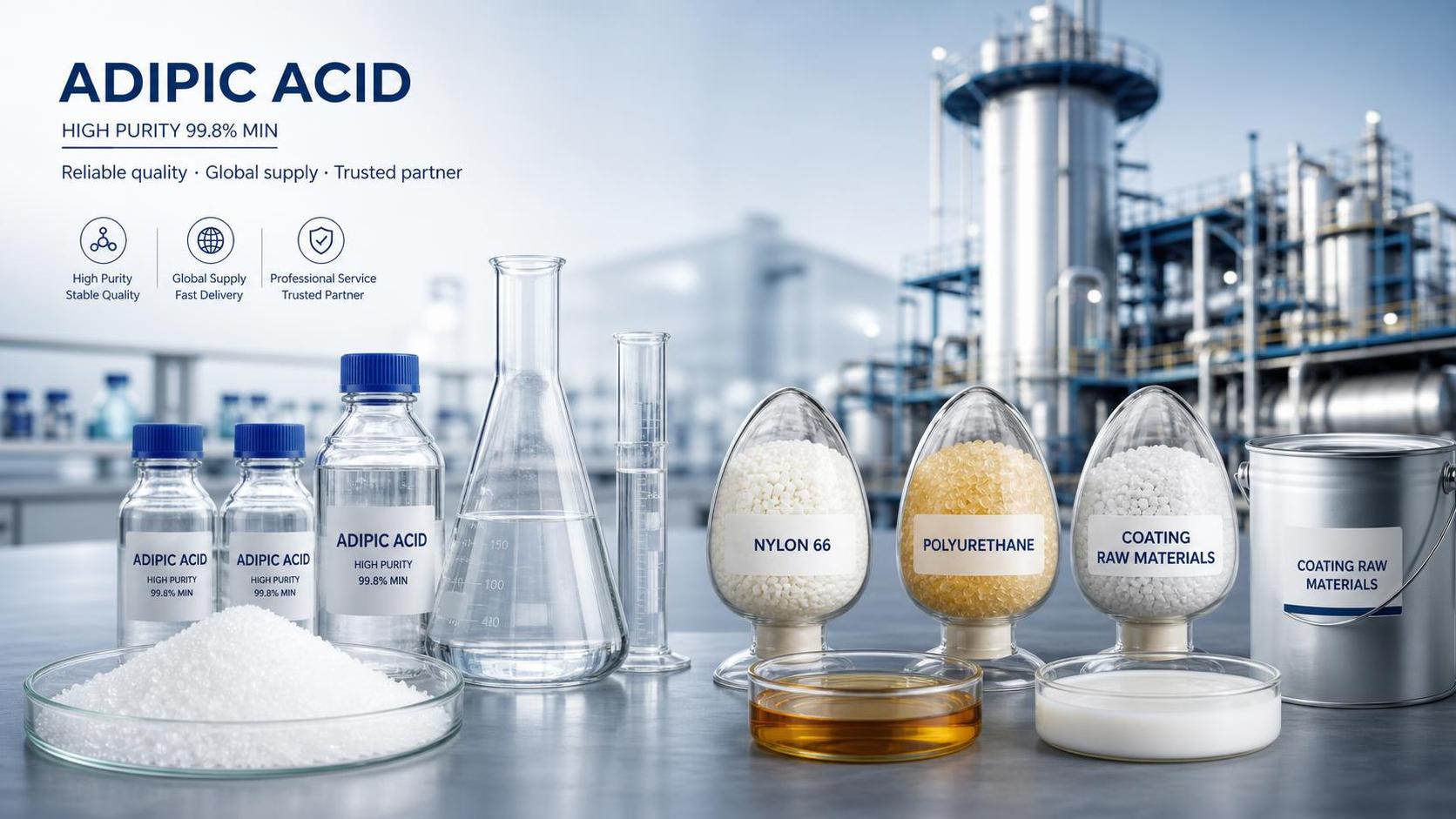
Where does Adipic Acid actually show up in industrial formulations?
Most people first hear about Adipic Acid in connection with nylon, and that is still one of its most important uses. It is a key intermediate in nylon 6,6 production, where consistency matters because small raw material variations can affect polymer behavior downstream. But that is only part of the picture.
In practical formulation work, Adipic Acid is also used in polyester polyols for polyurethane systems, plasticizer production, coatings raw materials, adhesives, and other chemical intermediates. Buyers looking at industrial grades usually care about three things at once: whether the material fits the reaction route, whether purity is stable enough for the end use, and whether the supply can stay consistent lot after lot.
Is Adipic Acid mainly a polymer raw material, or does it matter in smaller specialty formulations too?
It matters in both. In large-volume polymer production, Adipic Acid is valued as a building block. In smaller specialty formulations, it can still be important because the acid component influences reactivity, viscosity development, final mechanical properties, and sometimes storage stability.
For example, when used in resin or polyurethane-related systems, formulators are not just buying “an acid.” They are buying a predictable input for a reaction. If impurities, moisture, or color are outside the expected range, the result may be slower conversion, unwanted side reactions, or off-spec appearance in the finished product.
What do people mean by “purity grade” for Adipic Acid?
Purity grade usually refers to how much of the product is actually Adipic Acid and how tightly related impurity levels are controlled. In real purchasing decisions, that includes more than a single purity percentage on a sheet.
Typical checks include:
- Assay or main content
- Moisture content
- Color or appearance
- Ash or residue level
- Presence of trace metals or other by-products, if the process is sensitive
A high-purity grade is not automatically necessary for every application. The right grade depends on what happens next in the process. If the material is going into a high-performance polymer route, tighter control usually has real value. If the downstream formulation is less sensitive, paying for a higher grade than required may only raise cost.
Which quality indicators should a buyer check before choosing a grade?
Start with the technical data sheet and certificate of analysis for the exact lot or production standard being offered. The most useful review is not “Is this good?” but “Is this good enough for my reaction and product target?”
When does purity have a visible effect on formulation performance?
Usually when the formulation window is tight. Nylon intermediates, engineered polyurethane systems, and appearance-sensitive coatings are common examples. In those cases, even small variation in water content or trace impurities can show up as processing instability, lower reproducibility, haze, color shift, or differences in physical performance.
In less sensitive industrial uses, the effect may not be visible immediately, which is why buyers sometimes underestimate grade selection. The problem often appears later as wider batch variation, more adjustment during processing, or higher reject rates.
Can the wrong grade increase cost even if the price per ton looks lower?
Yes, and this is a common purchasing mistake. A lower unit price can be offset by higher dosing corrections, more lab testing, longer processing time, or scrap risk. For reaction-based products, raw material consistency often matters more than a small price gap.
A useful way to compare offers is to review not only quoted purity, but also lot-to-lot stability, packaging condition, storage history, and delivery reliability. For chemical buyers managing several solvents and intermediates in the same production chain, this is the same logic used when choosing materials such as Diethylene Glycol Butyl Ether Acetate for coatings, cleaning, polymerization, or ink applications: the technical fit and consistency of the material matter as much as the listed price.
What documents should be reviewed before approving Adipic Acid for a formulation?
At minimum, review the technical data sheet, safety data sheet, and a recent certificate of analysis. If the formulation is sensitive, ask for the product specification standard used by the supplier and compare that with your internal acceptance limits.
If the intended use involves regulated downstream sectors, the review should also include the fields that affect product classification, impurity control, and transport handling. The key point is to compare the paperwork to your actual use case, not just file it away.
What are the most common mistakes when sourcing Adipic Acid for industrial use?
One mistake is assuming all industrial Adipic Acid is interchangeable. Another is approving a grade based only on headline purity without checking moisture, appearance, or impurity profile. A third is skipping a small-scale validation run before switching supplier or grade.
There is also a logistics side to this. Material that meets spec on paper can still create trouble if packaging is compromised, storage is poor, or delivery timing forces extended warehousing in unsuitable conditions. For stable production, procurement and technical review need to work together.
So what is a practical way to choose the right grade?
Match the grade to the sensitivity of the application, then verify the supplier can hold that quality consistently. If Adipic Acid is feeding a performance-critical polymer or intermediate, tighter control is usually justified. If the use is more tolerant, a standard industrial grade may be enough, provided the core specification matches your process.
A sound selection sequence is simple: define the end use, identify the quality indicators that affect that use, review lot documents, and confirm the material through a trial under your own process conditions. That approach prevents overbuying on purity and underbuying on reliability.
Leave A Message
If you are interested in our products and want to know more details, please leave a message here, we will reply you as soon as we can.