





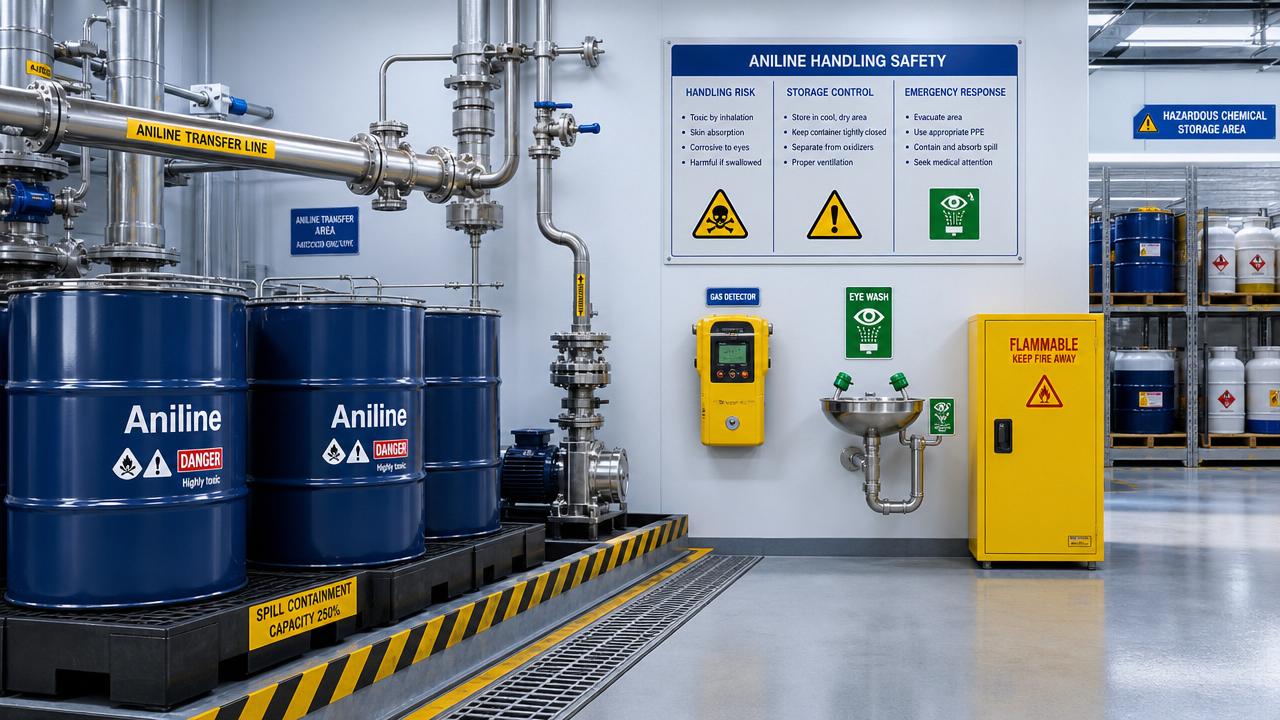
Aniline is a vital industrial chemical, but its handling risks should never be underestimated. For quality control and safety management professionals, understanding exposure hazards, storage requirements, and emergency response measures is essential to protecting workers, maintaining compliance, and ensuring product integrity. This article highlights the key Aniline handling risks that demand close attention in daily chemical operations.
In chemical trading and plant-side procurement, Aniline safety is not only an operational issue but also a supply-chain quality issue. For teams responsible for incoming inspection, storage control, transfer safety, and incident prevention, even 1 weak control point can affect worker health, batch consistency, and regulatory compliance.
With 10 years of experience in chemical distribution, Shandong JunTeng Chemical Co., Ltd. supports industrial buyers with stable sourcing, coordinated logistics, and practical product handling guidance. For quality control personnel and safety managers, reliable upstream supply and clear risk communication are essential when dealing with hazardous aromatic amines such as Aniline.
Why Aniline Requires Strict Handling Control
Aniline is widely used in dyes, rubber chemicals, pharmaceuticals, pesticides, and intermediates, but it presents multiple workplace hazards. Exposure can occur through inhalation, skin absorption, or accidental ingestion. In routine operations, the highest risks usually appear during 3 stages: unloading, sampling, and drum-to-tank transfer.
Main exposure hazards
One major concern is systemic toxicity after skin contact. Unlike some corrosive chemicals that show immediate visible damage, Aniline may be absorbed without dramatic early warning signs. This makes glove selection, splash prevention, and exposure-time control especially important during shifts of 8–12 hours.
Another key issue is vapor exposure in poorly ventilated areas. Although handling temperatures may vary by process, enclosed sampling rooms, pump stations, or storage corners can increase the risk of localized vapor accumulation. For many facilities, ventilation checks every 1–3 months are a practical control interval.
Common operational risk points
- Opening drums without confirming internal pressure condition
- Manual sampling without splash shields or face protection
- Using incompatible hoses, seals, or transfer containers
- Storing near oxidizing agents, acids, or ignition sources
- Delayed decontamination after minor leaks under 5 liters
The table below summarizes core Aniline handling risks that quality and safety teams should review during daily inspections, pre-job audits, and supplier assessments.
The most important takeaway is that Aniline risk is rarely limited to one exposure route. Effective control depends on combining PPE, engineering controls, inspection discipline, and supplier-side packaging integrity rather than relying on only one preventive measure.
Storage, Packaging, and Transfer Requirements
Safe Aniline management starts before the material enters the production area. Receiving inspection should verify label clarity, seal condition, lot traceability, and transport damage. For drums or bulk containers, safety managers should check at least 4 items before unloading: leakage, deformation, contamination, and documentation consistency.
Storage conditions that reduce incident probability
A cool, dry, and ventilated warehouse is the standard baseline. Storage zones should be segregated from incompatible chemicals and protected from direct heat. In practical warehouse management, many operators set inspection frequency at 1 time per shift for active storage and 1 time per day for reserve inventory.
Containers should remain tightly closed, with secondary containment sized for realistic spill events. Even where no specific local volume rule is given internally, plants often prepare for at least one damaged drum scenario, such as 200 KG packaging, to improve spill response readiness.
Transfer and handling checklist
- Confirm transfer line identity and valve position before connection.
- Use grounded, compatible equipment and sealed sampling tools.
- Keep eyewash and emergency shower access clear within the work area.
- Record batch number, time, operator, and abnormal observations.
- Clean and isolate contaminated tools immediately after use.
In some chemical operations, support solvents and process aids are stored nearby. For example, Arcosolv TPM is used in coatings, inks, cleaners, pesticide formulations, and metal working fluids. As a high-boiling solvent with a flash point of 118°C and purity of ≥99.0%, it should still be managed under separate compatibility and labeling rules rather than being placed casually alongside Aniline.
That comparison matters because mixed chemical storage errors often begin with convenience-driven decisions. Even relatively stable solvents with low volatility should not weaken segregation discipline for more hazardous substances. Quality and safety teams should audit not just individual products, but the logic of the whole storage layout.
Emergency Response and Quality Impact
When an Aniline incident occurs, response speed directly affects both personnel safety and material control. A delayed reaction of even 5–10 minutes can increase skin exposure severity, expand contamination zones, and complicate product isolation. Emergency plans should therefore be concise, practiced, and visible at the point of use.
What safety managers should prepare in advance
Preparation should include spill kits, absorbents compatible with organic chemicals, PPE replacement stock, isolation tags, and contact escalation lists. Emergency drills conducted every 6–12 months are common good practice, while high-risk transfer stations may justify more frequent scenario-based training.
The following table helps connect incident type with immediate action and quality control follow-up, which is often overlooked after first response is completed.
From a quality perspective, Aniline incidents can trigger broader consequences than the visible spill area suggests. Cross-contact, wrong-line transfer, or poor resealing may affect sample validity, downstream reaction performance, and customer acceptance. That is why safety response and QC documentation should be integrated into one workflow rather than managed as separate functions.
Supplier and procurement considerations
For procurement teams supporting safety and QC goals, supplier selection should include more than price and delivery time. Ask for packaging specifications, routine batch consistency controls, transport coordination details, and document readiness. In many cases, 4 procurement factors matter most: source reliability, packaging integrity, delivery stability, and traceable documentation.
Shandong JunTeng Chemical works with established upstream partners and an organized logistics network to support stable supply, timely delivery, and source-based quality assurance. For buyers managing hazardous materials, this reduces avoidable uncertainty in receiving, scheduling, and compliance review.
Aniline handling demands consistent attention to exposure prevention, storage segregation, transfer discipline, and emergency readiness. For quality control personnel and safety managers, the best results come from combining 3 elements: dependable supply, clear operating procedures, and regular on-site verification. If you need practical support for chemical procurement, packaging coordination, or product handling details, contact us today to discuss a suitable sourcing solution and learn more about related products such as Arcosolv TPM.
Leave A Message
If you are interested in our products and want to know more details, please leave a message here, we will reply you as soon as we can.