





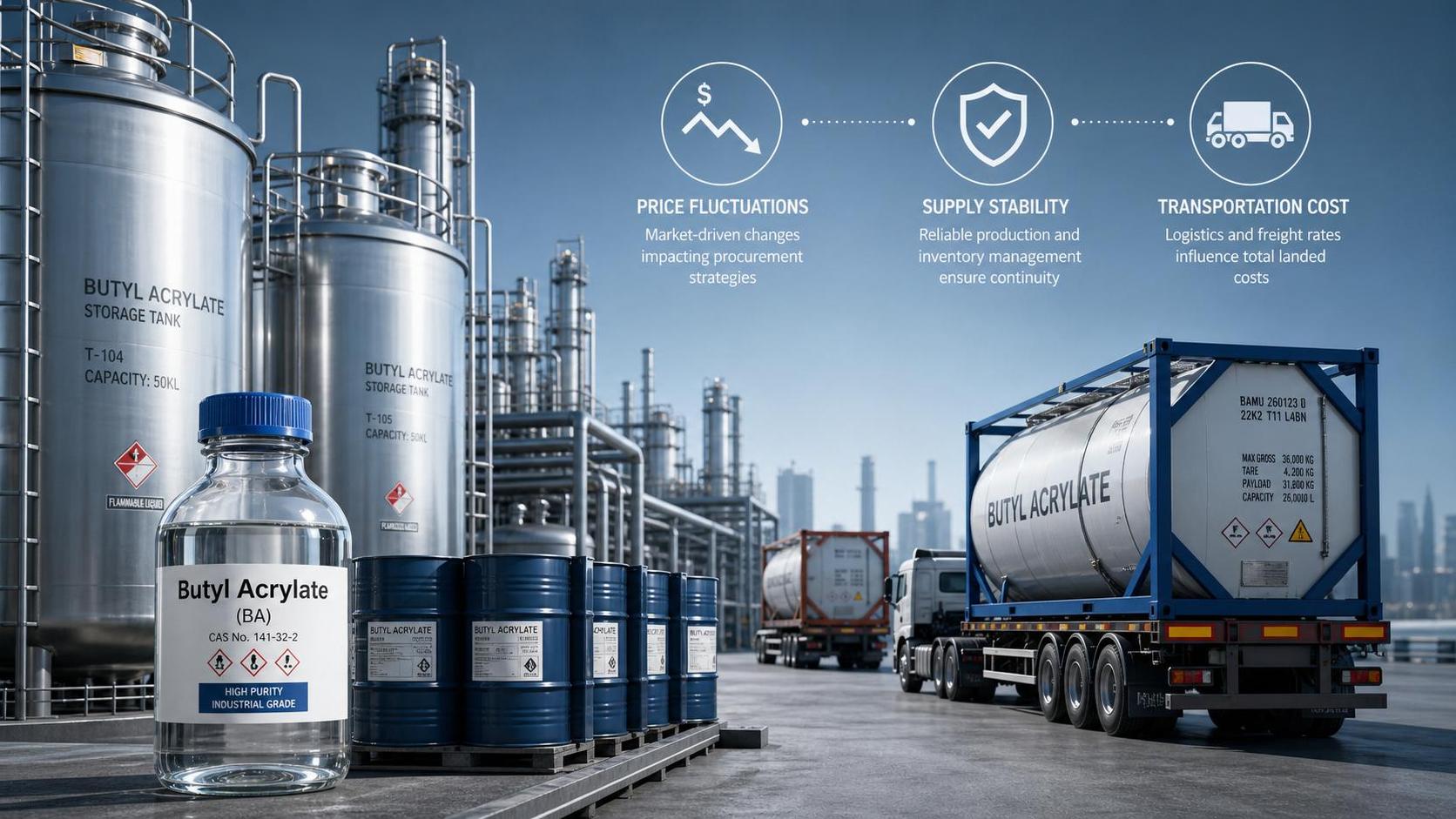
Tracking a dependable Butyl Acrylate quotation in 2026 has become part of financial planning, not just routine sourcing. Price movement now reflects feedstock pressure, freight swings, operating rates, and supplier stability, so a quotation often signals broader cost risk across adhesives, coatings, textiles, and plastics.
Why the 2026 market deserves closer reading
Butyl acrylate is a key acrylic ester used in pressure-sensitive adhesives, architectural coatings, sealants, and emulsion systems. Because it sits midstream in the chemical chain, its pricing reacts quickly when upstream or logistics conditions change.
That is why a Butyl Acrylate quotation should be read as a moving indicator, not a fixed number. A low offer may reflect short-term inventory pressure, while a higher one may include stronger delivery assurance or more reliable origin control.
The main forces behind a Butyl Acrylate quotation
The first driver is feedstock cost. Butyl acrylate pricing is closely linked to acrylic acid and n-butanol, both of which respond to crude oil trends, refinery conditions, and downstream demand shifts.
Energy is another major factor. Electricity, steam, and plant utility costs can move sharply, especially when environmental controls or seasonal production limits tighten operating margins.
Capacity utilization also matters. When plant maintenance overlaps with strong demand from coatings or adhesive producers, available spot volume can contract quickly, pushing any fresh Butyl Acrylate quotation upward.
Freight and storage should not be treated as minor add-ons. Inland trucking, port congestion, drum or tank availability, and warehousing terms can materially change the landed cost behind the same nominal quotation.
A practical way to separate price from real cost
Why quotation quality matters as much as price
A usable Butyl Acrylate quotation should explain more than the unit price. It should clarify origin, specification, tax status, packaging, Incoterm or delivery basis, lead time, and validity period.
Without those details, budget approval can be distorted. What appears competitive on paper may become expensive once urgent freight, delayed unloading, or off-spec handling costs are added.
In chemical trading, credibility lowers hidden cost. Shandong JunTeng Chemical Co., Ltd., based in Jinan, has built its model around supply chain control, established supplier access, and efficient logistics coordination.
Its long-term cooperation with producers and large industrial groups, including BASF Germany and Sinopec-related resources, supports traceable sourcing and steadier delivery performance. That structure can matter when markets turn volatile.
What influences approval decisions in real transactions
In practice, a Butyl Acrylate quotation is often reviewed against three questions: whether the price is timely, whether the supply is dependable, and whether the total delivered cost can stay within plan.
- Check whether the quotation is linked to current feedstock conditions or based on older market assumptions.
- Confirm whether the supplier can support repeated shipments, not only one spot lot.
- Review the payment term impact on cash flow, especially when prices are moving weekly.
- Assess whether quality claims, replacement terms, and documentation are clearly defined.
These checks help explain why two offers with similar numbers may carry very different risk profiles.
Reading cross-product signals across the chemical portfolio
Price judgment improves when it is placed in a wider chemicals context. For example, products serving surfactants, gas treatment, agrochemicals, and pharmaceuticals often reveal how demand is shifting across adjacent sectors.
A good example is Monoethanolamine(ETA), which is used in gas purification, corrosion inhibition, cement grinding aids, and intermediate synthesis. Material behavior across these segments can offer clues about broader procurement pressure.
When a supplier can cover products with different demand cycles and technical requirements, it often indicates stronger sourcing depth. That is relevant when evaluating whether a Butyl Acrylate quotation is backed by operational capability rather than short-term trading opportunity.
How to build a more reliable quotation benchmark
A stronger benchmark starts with comparison discipline. Collect offers from consistent packaging terms, the same quality grade, similar delivery windows, and a common tax basis.
Then track them against a short list of market signals.
- Upstream acrylic acid and butanol movement
- Domestic operating rates and planned maintenance
- Export or import flow changes
- Regional logistics tightness
- Supplier performance across recent deliveries
This approach turns a Butyl Acrylate quotation from a static price check into a decision tool. It also improves internal communication because each approval can be tied to visible market logic.
A sensible next step for 2026 planning
The most useful next step is to build a simple quotation file that records price date, source, specification, delivery basis, and actual landed outcome. Over time, that history makes future Butyl Acrylate quotation reviews faster and more accurate.
Where supply continuity matters, it is worth pairing market tracking with suppliers that offer source transparency, stable relationships, and coordinated logistics. In 2026, that combination will usually matter more than chasing the lowest visible number.
Leave A Message
If you are interested in our products and want to know more details, please leave a message here, we will reply you as soon as we can.