





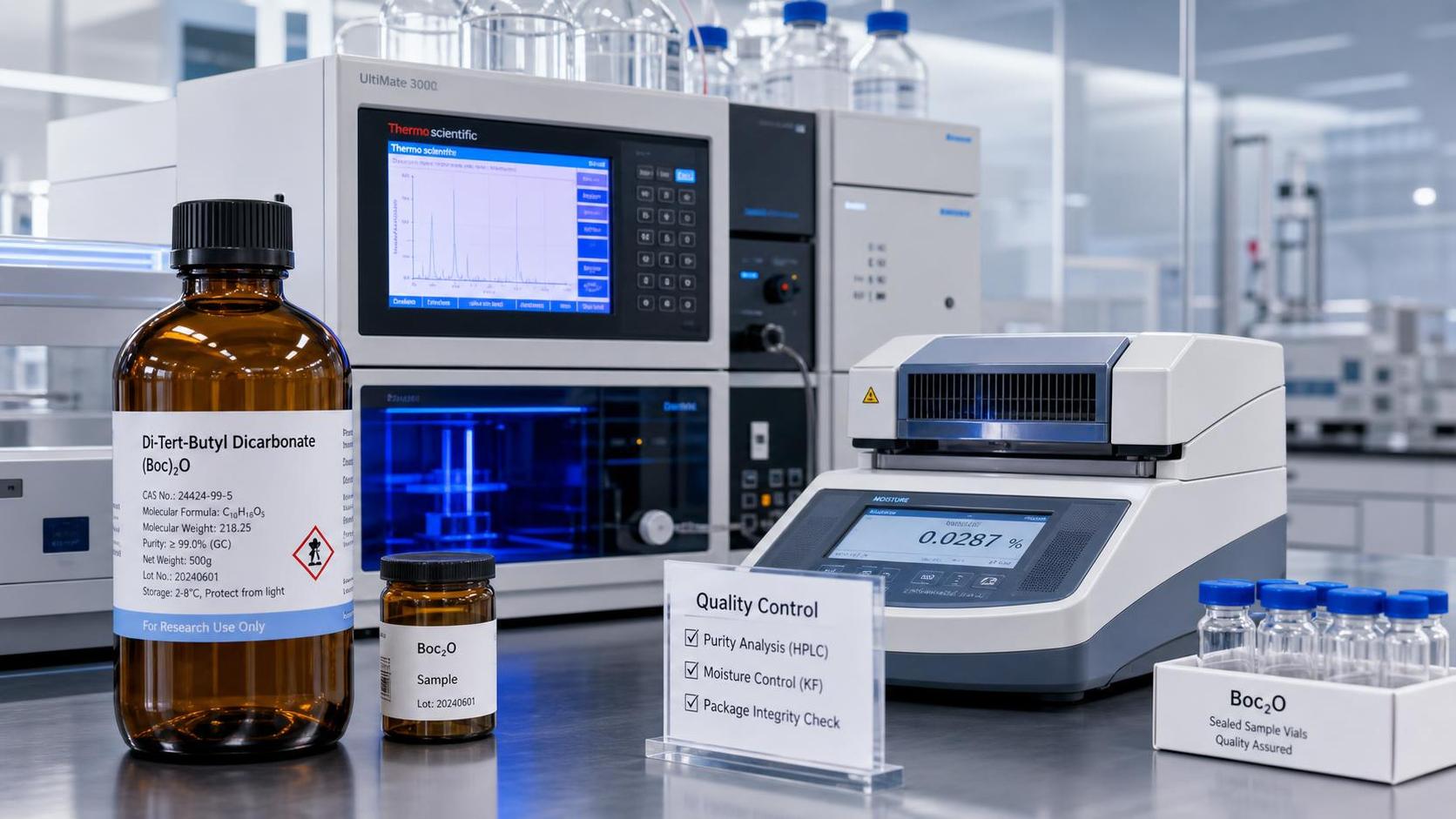
Di-Tert-Butyl Dicarbonate Purity Checks Before Peptide Synthesis Use
Before Di-Tert-Butyl Dicarbonate is charged into a peptide process, the real question is not whether the label says “high purity,” but whether that purity profile matches the reaction, storage conditions, and control strategy of the site using it. In peptide synthesis, Boc chemistry is valued because it gives predictable amino protection and deprotection behavior. That predictability starts to erode when the incoming material contains excess moisture, acidic residues, decomposition products, or solvent carryover that are still technically within a supplier’s broad release range but are not suitable for a tighter process window.
This is why purity verification for Di-Tert-Butyl Dicarbonate is better understood as a risk-screening exercise rather than a box-ticking test. A certificate of analysis is necessary, but not sufficient. Quality teams usually need to ask a more practical set of questions: Is the assay method appropriate for this material? Does the water level create a realistic hydrolysis risk? Is the batch appearance consistent with normal storage history? Are impurity limits aligned with peptide-grade expectations, or only with general industrial handling?
One common misunderstanding is to treat assay percentage as the whole story. A high assay value can still sit beside impurity patterns that create trouble downstream. Di-Tert-Butyl Dicarbonate is moisture-sensitive and can degrade during storage or transport, especially if packaging integrity or temperature control has been uneven. In peptide synthesis, even a small shift in decomposition state may show up later as slower conversion, side reactions, filtration issues, or inconsistency between lots that appears at first to be a process problem rather than a raw material problem.
What QC Usually Needs to Confirm
For incoming control, the most useful review is not a long list of generic tests, but a short group of checks tied directly to synthesis performance and safe handling. In many procurement and release settings, the following points deserve early attention:
- Assay or content, verified by a method suitable for organic reagent purity rather than by overly simplified identity-only screening.
- Water content, because hydrolysis risk is not theoretical for this reagent.
- Appearance and color, which can give an early signal of storage stress or contamination.
- Residual solvents or volatile impurities where the process or site standard requires tighter control.
- Packaging condition, seal integrity, and transport history, especially for longer international supply routes.
Identity testing still matters, but in practice it is rarely the main point of failure. Most problems come from material that is chemically the right substance but operationally the wrong batch. For safety managers, this distinction matters because decomposition and contamination can change not only reaction behavior but also exposure profile, pressure development in storage, and waste-stream handling characteristics.
Purity Is Also a Storage Question
A surprising number of purity deviations do not originate at manufacture. They emerge between release and use. Di-Tert-Butyl Dicarbonate should be evaluated in the context of shelf life, warehouse conditions, humidity control, and the number of packaging-opening events before final consumption. If a site buys in bulk but uses the reagent intermittently, purity management becomes partly an inventory discipline. Repeated drum opening, warm storage, or extended hold times after sampling can undermine batch stability even when the original specification was acceptable.
That is why experienced teams do not isolate QC from logistics. Shandong JunTeng Chemical Co., Ltd., working through a supply model built on stable upstream partnerships and coordinated delivery, reflects a practical point that many labs learn the hard way: a reagent specification only has value if supply continuity, packaging reliability, and transport execution preserve that specification until the material reaches the reactor or dispensing room.
In some purchasing environments, buyers compare peptide-related inputs with other common solvents and intermediates to benchmark supplier discipline. For example, a product such as Benzyl alcohol, widely used in pharmaceuticals, coatings, cosmetics, and chemical intermediate applications, is often judged not only by purity but by water content, APHA color, and packaging consistency. The same mindset applies here: for sensitive synthesis steps, a clean specification sheet is useful only when paired with stable lot-to-lot execution.
Where Safety Review Should Intervene
Safety review before use should not be limited to SDS filing. If there is a change in source, manufacturing route, inhibitor practice, or package size, the material may warrant a fresh compatibility review. For Di-Tert-Butyl Dicarbonate, this means checking whether current handling procedures still fit the delivered form and impurity profile. Ventilation, sampling method, transfer equipment, and emergency response planning may all need adjustment if the receiving team notices unusual odor, pressure behavior, discoloration, or analytical drift.
Another weak point is assuming that a pass result from one batch justifies lighter scrutiny on the next one. In peptide manufacturing, lot-to-lot consistency often matters more than the single best batch a supplier can provide. A robust release decision therefore tends to combine document review, selective confirmatory testing, and trend comparison against prior accepted lots. When deviation appears, the right question is not merely “Does it still meet the written limit?” but “Does it still behave like the material our process was developed around?”
A Practical Threshold for Acceptance
For technical and standard-driven purchasing, acceptance of Di-Tert-Butyl Dicarbonate before peptide synthesis should rest on three layers. The first is formal conformity: identity, assay, and documented specification. The second is condition integrity: water, appearance, packaging, and storage history. The third is process fit: whether the material aligns with the sensitivity of the actual peptide route, not just with a generic commercial grade description.
When these three layers are reviewed together, purity checking stops being a routine incoming task and becomes a control point that protects reaction reproducibility, operator safety, and compliance confidence at the same time. That is usually the more accurate way to read this material in practice: not as a simple reagent with a single purity number, but as a reactive input whose acceptable quality is defined by how it will really be used.
Leave A Message
If you are interested in our products and want to know more details, please leave a message here, we will reply you as soon as we can.