





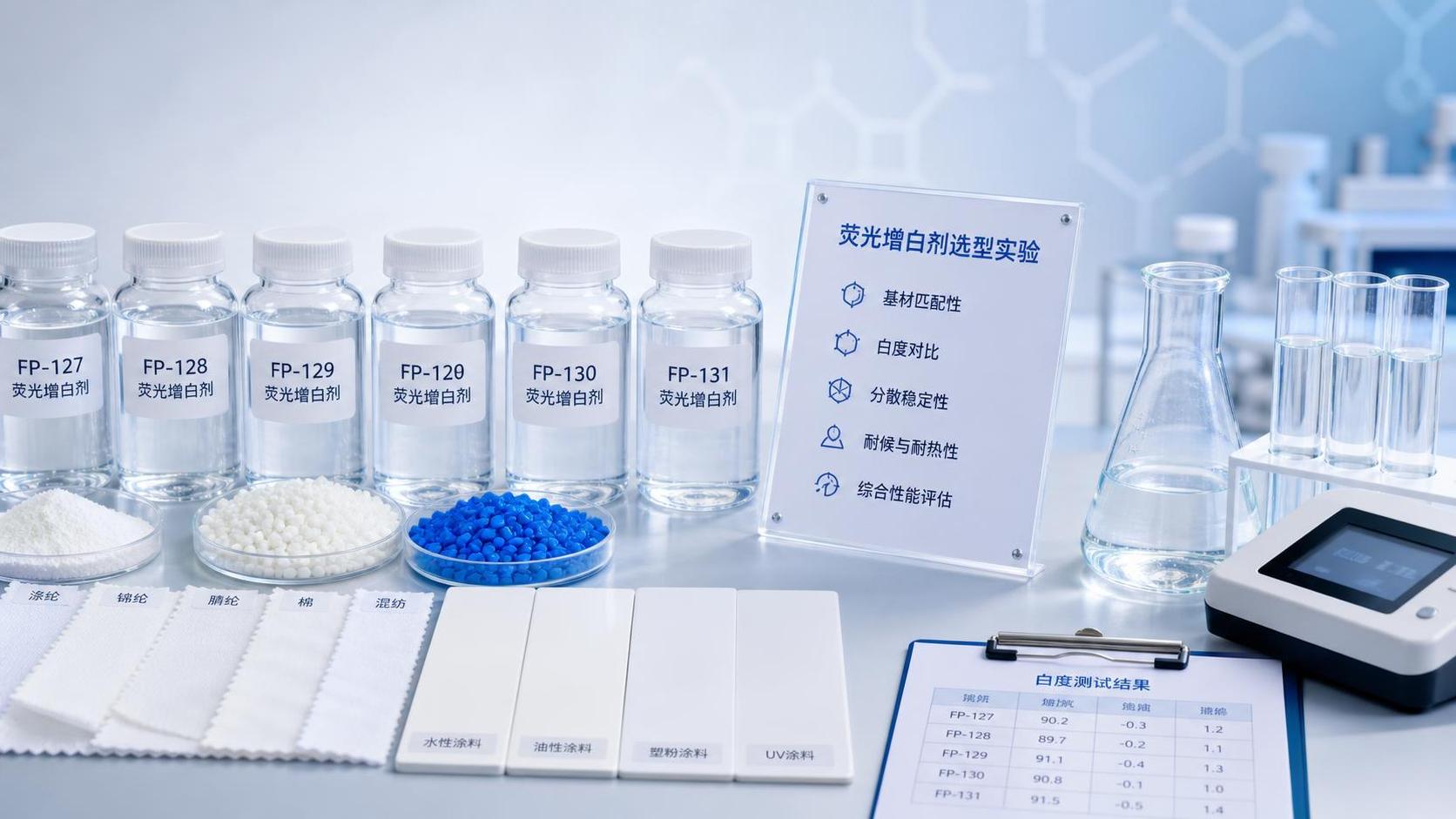
Start with the substrate, not the brightness claim
When a Fluorescent Whitening Agent underperforms, the root cause is often simple: the product was selected around a target whiteness number, while the substrate chemistry was treated as secondary. In practice, the substrate decides most of the outcome. Cellulosic fibers, synthetic fibers, plastics, coatings, and detergent systems do not respond the same way, even when the visual goal sounds identical.
For technical evaluators, the first check is whether the brightener matches the material family and the process route. A whitening agent that performs well in an aqueous textile finish may give poor dispersion in a polymer melt. One that looks strong on paper stock may shift shade or lose efficiency in a detergent matrix. Before comparing suppliers or dosage levels, lock down four basics: substrate type, processing medium, temperature exposure, and the stage where the brightener is introduced.
What to check before shortlisting a grade
- Substrate polarity and affinity: Ask whether the brightener is designed for hydrophilic or hydrophobic systems. This affects exhaustion, distribution, and wash fastness.
- Processing temperature: High-temperature molding, extrusion, or curing can damage some optical brighteners. If the process includes sustained heat, thermal stability has to be screened early.
- pH window: In textiles, detergents, and paper chemicals, pH can change fluorescence intensity and solubility. A lab drawdown at the wrong pH can point you toward the wrong product.
- Carrier system: Water-based, solvent-based, and melt systems behave differently. Solubility or dispersibility problems usually show up as haze, spots, uneven tone, or lower-than-expected whiteness.
- End-use exposure: Indoor packaging, outdoor plastic parts, and laundered textiles need different resistance profiles. Light, residual oxidants, and repeated washing all matter.
This sounds obvious, but teams still lose time by screening three or four samples that were never suitable for the process in the first place.
Substrate-specific selection points
Cellulosic substrates such as cotton, paper, and some regenerated fibers usually need strong affinity in water-based application. Here, uniform uptake matters more than chasing the highest fluorescence peak on a datasheet. If the base material already has variable natural color, a brighter grade can exaggerate inconsistency instead of hiding it.
Synthetic fibers are less forgiving. Polyester and similar substrates often require products built for higher-temperature application or heat-setting conditions. The common mistake is evaluating only initial whiteness. If shade moves after heat exposure, the “best” sample from the first trial may fail production.
Plastics and rubber demand attention to dispersion and thermal history. In polymer systems, agglomeration is just as damaging as low activity. Check whether the brightener survives compounding temperature, whether it affects transparency, and whether it interacts with stabilizers, fillers, or recycled content.
Coatings, inks, and surface finishes add another layer: the resin and solvent package. In these systems, compatibility can be the deciding factor. For example, when a formulation depends on a solvent with complete water and organic solvent miscibility, medium volatility, and consistent purity, the solvency package can influence how uniformly whitening additives are carried through the film. That is where a solvent such as Ethylene glycol methyl ether may be relevant in formulation work, especially in coatings, printing, or chemical synthesis environments. It should be treated as a formulation component, not as a substitute for proper Fluorescent Whitening Agent selection.
Define the whiteness target in a usable way
“Higher whiteness” is not a complete specification. Technical evaluation gets cleaner when the target includes three things: the visual expectation, the measurement method used internally, and the acceptable variation after processing. Without that, lab comparisons tend to mix appearance, instrument reading, and operator preference into one loose judgment.
A practical check is whether you need a neutral white, a bluish white, or simply a cleaner appearance over an off-white base. Many failures come from selecting an aggressive brightener for a substrate that only needed mild correction. Overdosing can push the shade into an unnatural blue cast, and once that happens, reducing dosage may still leave unevenness if distribution was poor from the start.
Run dosage trials for shape, not just peak performance
Do not judge a candidate from a single dosage point. Build a small curve. You want to know:
- Where the whiteness gain starts to flatten
- At what level the shade begins to drift
- Whether the application window is wide enough for production variation
- How sensitive the system is to slight underfeed or overfeed
The best commercial choice is often not the sample with the highest top-end reading. It is the one with a stable operating window and predictable behavior when line conditions move a little.
Watch the processing conditions that usually distort lab results
Do not separate technical fit from supply fit
For evaluation teams, a workable grade is not just about performance. It also needs stable sourcing, consistent batch quality, and packaging that matches plant consumption. In chemical purchasing, those details become technical issues very quickly. A whitening agent with a narrow dosage window is harder to control if supply consistency moves from batch to batch.
This is one reason buyers often prefer suppliers with established upstream relationships and reliable logistics rather than chasing a marginally lower quoted price. The same logic applies when adjacent formulation materials are being sourced. If a solvent grade is part of the process, details such as purity, water content, appearance, and pack size matter operationally. For instance, Ethylene glycol methyl ether is commonly supplied as a colorless clear liquid with purity of at least 99.5% and low water content, and it is available in both drum and IsoTank formats. Those are procurement checks, but they affect production stability all the same.
A workable decision sequence
If the goal is to reach a decision without running unnecessary trials, use this order: define the substrate family, lock the process conditions, describe the visual target in operational terms, eliminate candidates that do not fit the application medium, then run dosage curves on the short list. After that, test the top options under the actual heat, pH, and additive conditions of production.
That sequence usually tells you enough to make a sound Fluorescent Whitening Agent selection. It keeps the evaluation tied to how the material will really be used, which is where most wrong decisions could have been avoided in the first place.
Leave A Message
If you are interested in our products and want to know more details, please leave a message here, we will reply you as soon as we can.