





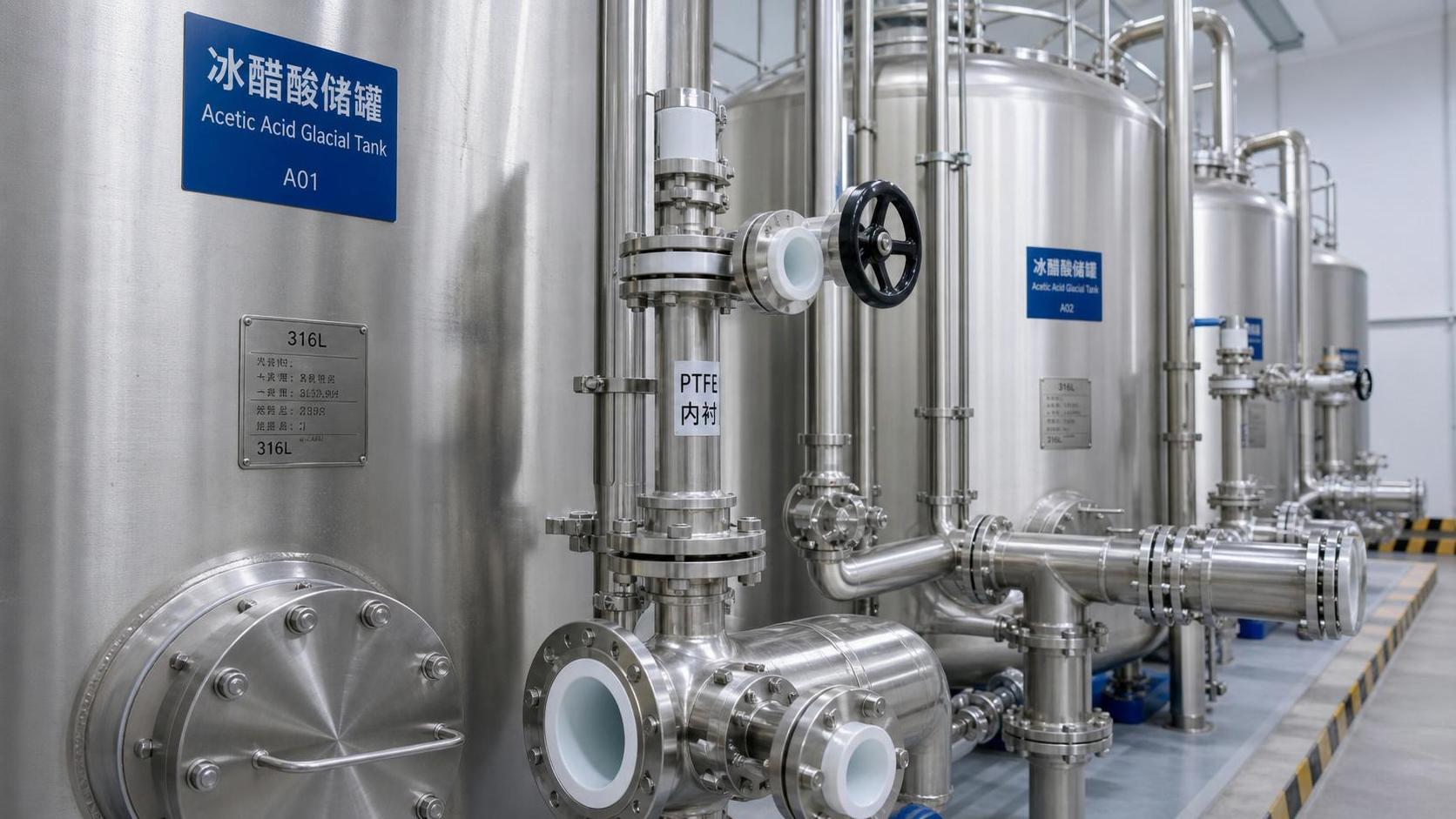
Why does Glacial Acetic Acid storage create such a high corrosion risk?
Glacial Acetic Acid looks manageable on paper, yet storage failures often begin with small material mismatches.
The issue is not only acid strength. Water content, temperature, contamination, and stagnation all change corrosion behavior.
In practical terms, a tank that performs well in one plant may fail early in another.
That is why Glacial Acetic Acid storage should be treated as a system decision, not a single tank purchase.
Common trouble points include weld zones, nozzle connections, gaskets, transfer lines, and low-flow sections where residues accumulate.
Once corrosion starts, the result is rarely limited to metal loss. It can affect purity, maintenance frequency, shutdown planning, and delivery stability.
For companies handling multiple chemical streams, the storage decision also needs to fit broader sourcing and logistics plans.
Shandong JunTeng Chemical works within this kind of supply environment, where stable quality, verified sources, and on-time distribution matter alongside material selection.
Which tank materials are usually considered first?
The short answer is stainless steel, certain lined systems, and in some cases specialty alloys.
But the better answer depends on concentration, operating temperature, vent design, and whether trace chlorides may enter the system.
304 stainless steel is often reviewed early because it is widely available.
Still, many operators move cautiously with 304 when moisture and contaminants are not tightly controlled.
316 stainless steel usually offers a more comfortable margin, especially when the service environment is less predictable.
Rubber-lined or fluoropolymer-lined tanks can also work well, particularly when metal contamination must be minimized.
The tradeoff is that lining integrity becomes a maintenance priority, especially at seams and fittings.
For aggressive conditions, higher-grade alloys may be justified, but only after lifecycle cost is compared with inspection and replacement schedules.
A quick comparison helps narrow the first choice
Is the tank material enough, or do piping and seals change the answer?
They absolutely change the answer.
Many Glacial Acetic Acid storage issues come from the secondary parts, not the shell itself.
A well-chosen tank can still underperform if the piping metallurgy, valve seats, gasket materials, or pump seals are incompatible.
PTFE-based gasket and seal materials are commonly favored because they handle chemical exposure more reliably than many general elastomers.
For transfer lines, the design should reduce dead legs, allow drainage, and avoid local overheating.
This is especially important when the same facility also manages intermediates used in pharmaceuticals, dyes, or organic synthesis.
For example, products such as Benzyl Chloride are handled in value-sensitive chemical chains where contamination control and dependable packaging matter just as much as bulk storage design.
What mistakes make Glacial Acetic Acid storage more expensive than expected?
The biggest mistake is choosing by purchase price alone.
Lower initial cost can disappear quickly if inspection intervals shorten or unplanned replacement affects production schedules.
Another common mistake is assuming published compatibility charts tell the whole story.
They are a starting point, not a complete engineering basis.
- Ignoring trace water, chlorides, or process carryover from upstream handling
- Using mixed materials across tank, pipe, and fittings without galvanic review
- Skipping inspection access for nozzles, bottoms, and welds
- Underestimating lead time for upgraded alloys or replacement linings
- Treating storage as isolated from supply continuity and product quality planning
More often, the better financial decision is the one that reduces intervention frequency over several years.
How should material selection be reviewed before a project is approved?
A useful review starts with service reality, not with a catalog list.
That means confirming actual concentration, expected temperature range, unloading method, residence time, and cleaning procedures.
It also helps to compare normal operation with upset conditions.
A tank that survives routine service may still struggle during startup, hot weather, or off-spec deliveries.
Where supply reliability is important, it also makes sense to align storage design with supplier consistency and logistics planning.
That is one reason experienced chemical traders with stable upstream partnerships can support better project decisions beyond price comparison alone.
So what is the most practical next step?
Start by defining the real operating envelope for Glacial Acetic Acid, including normal, upset, and maintenance conditions.
Then compare tank material, lining, piping, and sealing choices as one package.
The strongest option is usually the one that balances corrosion resistance, inspection access, supply lead time, and long-run operating stability.
If multiple chemicals share infrastructure, include cross-contamination and cleaning compatibility in the review.
That applies whether the site stores bulk acids or synthesis intermediates such as Benzyl Chloride in 200 KG/drum logistics flows.
A careful Glacial Acetic Acid storage decision usually pays back through fewer failures, steadier quality, and more predictable project execution.
Leave A Message
If you are interested in our products and want to know more details, please leave a message here, we will reply you as soon as we can.