





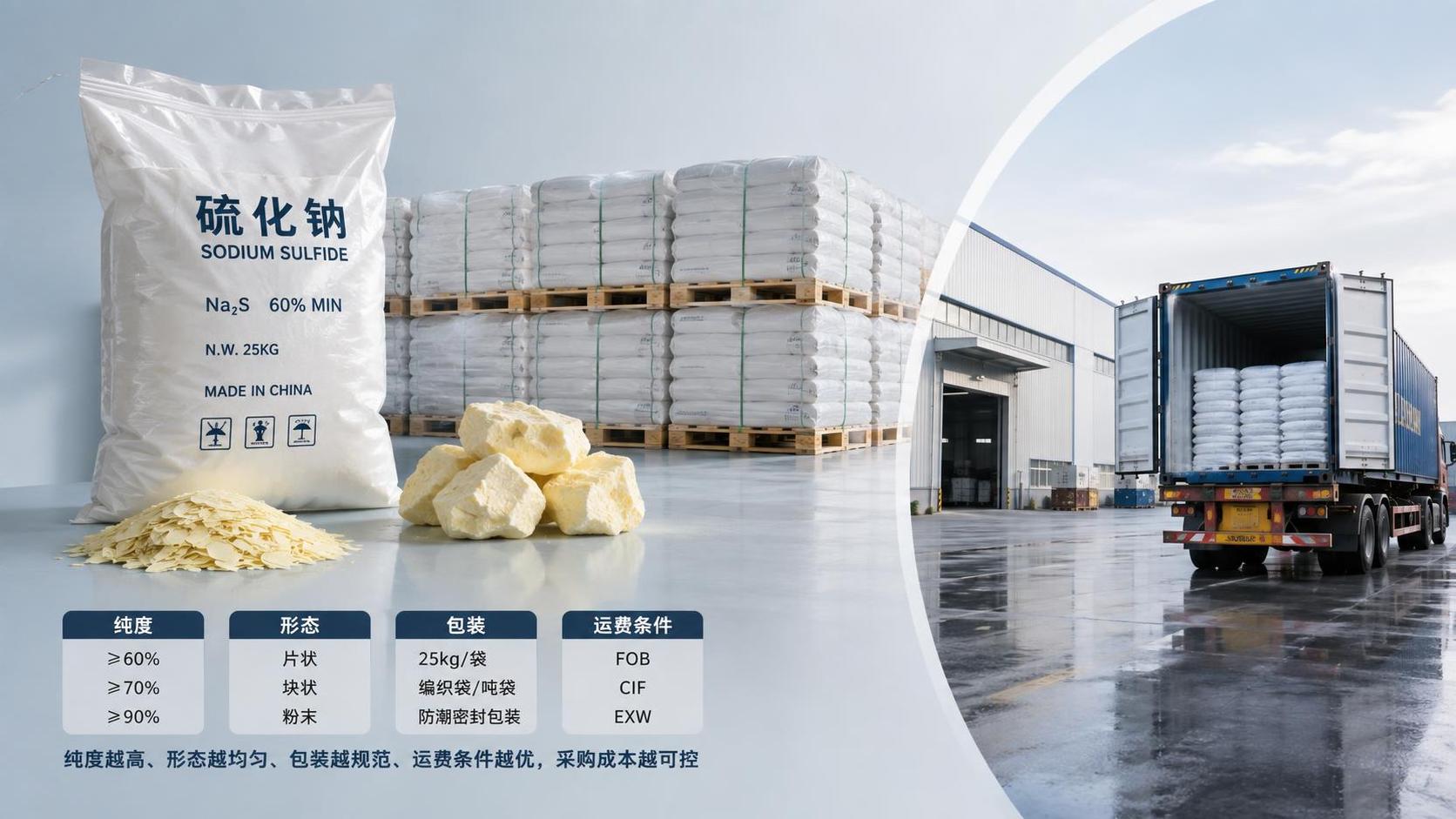
A finance approval can look straightforward when two suppliers quote different unit prices for the same material. With sodium sulphide, that comparison often fails once the purchase order reaches the warehouse. A lower quoted figure may relate to a lower active-content grade, a different physical form, smaller packaging, or freight that excludes handling requirements. The result is an apparent saving at quotation stage and an unplanned variance in landed cost later.
The practical rule is to compare cost per unit of usable sodium sulphide delivered to the required site, not simply the price per tonne shown on a quotation. Purity, form, packaging, order size, shipment route, and the allocation of freight risk all influence the Sodium Sulphide price. Before approving spend, finance teams should require each supplier to quote against the same technical and commercial basis.
Purity changes the real cost of active material
Sodium sulphide is commonly purchased against a stated purity or active-content specification. A quotation for a lower-content product can appear attractive because the nominal price is lower, but production may need more material to achieve the same process effect. This matters in applications such as wastewater treatment, dye processing, mineral flotation, leather processing, and chemical manufacturing, where dosing is tied to available sulphide content rather than purchased weight alone.
For a clean comparison, ask for the assay basis and calculate the cost of active content. The basic method is:
Delivered price per tonne ÷ stated active-content fraction = indicative cost per tonne of active material.
For example, a product quoted on a 60% basis should not be compared tonne-for-tonne with a higher-grade alternative without adjusting for active content. The calculation is only a starting point. The buyer should also verify whether the certificate of analysis reports sodium sulphide content, whether the declared figure is a minimum or typical value, and whether impurities or insoluble matter can affect dosing, filtration, equipment cleaning, or product quality.
A finance reviewer does not need to replace technical approval. However, a quotation should not be approved until the operating team confirms that the quoted purity matches the existing process specification. A cheaper grade is not a saving if it requires a process change, higher consumption, or additional treatment of residues.
Flakes, lumps, and hydrated forms are not interchangeable on price alone
Physical form affects both the supplier’s production cost and the buyer’s handling cost. Sodium sulphide may be supplied in forms such as flakes, lumps, or hydrated material. Each option can have a different moisture level, packing method, storage behavior, dissolution rate, and loading density.
Flakes may be easier to portion and dissolve in some operations, while larger pieces may require more time or controlled handling before use. Hydrated products contain water as part of the delivered material, so their apparent mass price must be assessed carefully against active content. There is no universally “best” form; the appropriate choice depends on the site’s feed method, storage capacity, exposure controls, and consumption rate.
Questions that help prevent a misleading comparison include:
- Is the quoted material anhydrous, hydrated, or specified by active sodium sulphide content?
- What physical form is included in the offer, and is that form acceptable for the current dosing or production system?
- Is the stated net weight based on product only, excluding pallets and packaging?
- Will the receiving site need extra labor, enclosed transfer equipment, or a dissolution step?
These questions have budget relevance. A product that is technically usable but slower to prepare may add indirect labor costs. A more convenient form can justify a higher purchase price when it reduces handling complexity or avoids disruption to a controlled process.
Packaging is part of the delivered-cost calculation
Packaging is often treated as a minor line item, yet it can materially affect the delivered Sodium Sulphide price, especially on smaller orders. Bagged material offers flexibility for sites with limited storage or intermittent usage, but it can increase packaging cost, manual handling, waste disposal, and the number of receiving checks. Larger shipment configurations may reduce packaging cost per tonne but require suitable unloading facilities and dry, secure storage.
Request clarity on bag size, palletization, liner arrangement, net weight tolerance, and whether packaging is included in the quoted price. The receiving team should also confirm whether the site can safely accept the proposed configuration. An offer based on a full vehicle load can lose its advantage when the buyer lacks space to store it without raising moisture exposure, handling, or inventory-control risks.
Where procurement covers multiple chemical inputs, it is useful to separate product-specific packaging assumptions rather than applying one rule to every line. For instance, a liquid material such as Acetic acid solution 45%/55%/65%/75%/80%/90% may be supplied in PE drums, IBCs, or an ISO tank, while sodium sulphide requires its own form- and moisture-sensitive packaging review. Consolidating purchasing administration may be sensible, but transport and receiving calculations should remain specific to each chemical.
Freight terms can reverse the ranking of two quotations
Freight is not simply the cost of moving goods from point A to point B. For chemical purchases, the scope may include collection, loading, route restrictions, insurance, export documentation, port charges, customs-related services, local delivery, and unloading arrangements. A quotation that says “freight included” still needs a defined delivery point and a statement of what happens if delivery conditions change.
The finance risk is greatest when one supplier quotes ex-works or FOB-style pricing and another quotes delivered pricing. These are not directly comparable. An ex-works offer may exclude transport from the supplier’s facility, while a delivered offer may include a specific destination but not waiting time, remote-area delivery, special equipment, or charges caused by an unsuccessful delivery attempt.
Freight conditions also affect inventory decisions. Buying a larger volume can reduce transport cost per tonne, but the financial benefit should be weighed against working capital, storage limits, and the consequence of holding product longer than planned. The lowest freight rate is not necessarily economical when it forces an order quantity that exceeds safe or practical inventory levels.
Volume discounts need a total-cost test
Suppliers may offer a better unit price at a higher quantity threshold. That discount should be evaluated against consumption forecasts and the site’s ability to store and use the material within its internal controls. Financial approval should distinguish between a genuine scale benefit and a discount that merely shifts cost into inventory, storage, or operational risk.
Use the expected consumption rate to test how long the ordered quantity will remain on site. Then add the likely effect of capital tied up in stock, storage preparation, receiving labor, and potential reordering delays if the larger shipment does not arrive as planned. A moderate order with a reliable replenishment schedule can be preferable to a larger purchase with an attractive headline price but limited flexibility.
Build a comparable quotation sheet before negotiating
The most useful procurement document is a normalized comparison sheet. It should place every offer on the same basis: active-content specification, physical form, net quantity, packaging, delivery point, freight inclusion, payment terms, price validity, and expected dispatch period. Commercial teams can then negotiate from a clear position instead of asking suppliers to match an incomplete competitor price.
Keep technical and commercial exceptions visible. If one offer has a different purity, product form, or delivery condition, mark it as non-comparable until the difference is converted into a cost impact or accepted by the operating team. This avoids approving a lower number that is not actually a lower landed cost.
For recurring purchases, retain the normalized sheet with the purchase record. It provides a practical reference when later invoices differ from initial expectations and helps identify whether changes came from product specification, shipment configuration, freight conditions, or the underlying market price. That discipline makes sodium sulphide purchasing more predictable without reducing the evaluation to a single quoted figure.
Leave A Message
If you are interested in our products and want to know more details, please leave a message here, we will reply you as soon as we can.