





How Trixylyl Phosphate Improves Flame Retardant Plasticizer Systems
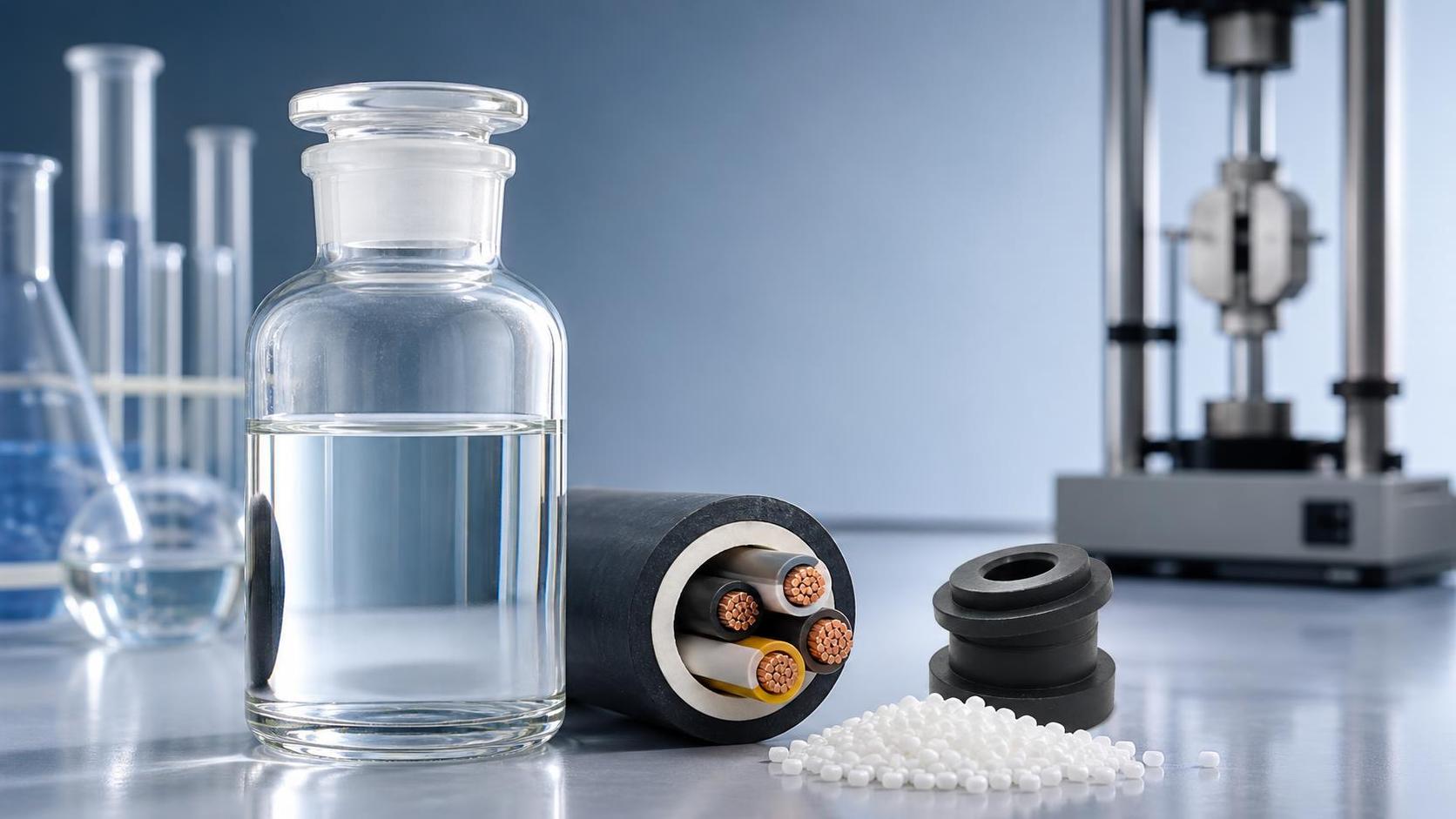
The point where Trixylyl Phosphate becomes worth serious discussion is not in a generic “flame retardant additive” list. It shows its value when a compound has to stay processable, keep enough flexibility after aging, and still meet a tighter fire-performance target than a standard plasticized formulation can handle. That combination comes up often in cable compounds, industrial rubber parts, flexible PVC components, and specialty molded materials where the plasticizer is no longer just there to soften the polymer. It also becomes part of the fire-performance strategy.
In practical formulation work, the first mistake is to treat flame retardancy and plasticization as two separate decisions. On the plant floor, they interact immediately. A system can look good in a lab sheet, then become difficult during mixing because viscosity climbs, fusion behavior shifts, or migration concerns appear after heat exposure. Trixylyl Phosphate is often evaluated because it can contribute flame retardant behavior while still functioning as a plasticizer, which means the formulator is not building the entire fire-performance package from high-loading solid flame retardants alone. That matters when processing windows are already narrow.
One of the more common decision points is flexible PVC for wire and cable insulation or sheathing. In those systems, the compound has to balance softness, electrical reliability, and heat history during extrusion. If the formulation relies too heavily on filler-like flame retardants, output can drop and surface quality can suffer. If it relies only on conventional plasticizers, the fire-performance margin may be too thin. Trixylyl Phosphate is often considered in this middle ground because it can help maintain workable flexibility while supporting the flame retardant package. The real evaluation, however, is never just “does it pass a flame test.” Processors usually need to check compatibility with the resin, interaction with stabilizers, and whether the finished compound still behaves acceptably after thermal aging.
Rubber applications raise a different set of questions. In some flame-retardant rubber compounds, especially those used near heat sources or enclosed electrical assemblies, the concern is less about obtaining extreme softness and more about preserving mechanical balance. A plasticizer that improves low-temperature flexibility but weakens heat resistance too much can create trouble later in service. Trixylyl Phosphate is therefore more useful where the compounder needs some plasticizing effect without giving away too much thermal stability. That does not make it universal. Cure system compatibility, extraction resistance, and the effect on hardness drift over time still need close review. Experienced buyers usually ask for those observations early, because replacing a plasticizer after scale-up is expensive and slow.
Where It Tends to Fit Better
The best fit is usually not the lowest-cost formulation. It is the formulation where a single additive is expected to solve two pressures at once: fire behavior and processing balance. That is why Trixylyl Phosphate is more relevant in engineered flexible systems than in commodity compounds built only around raw material price.
Another practical point is that not every project needs the same kind of flame retardant behavior. Some compounds are trying to reduce flame spread in finished parts. Others are built to improve the likelihood of meeting a customer’s internal screening test before formal qualification work begins. The role of Trixylyl Phosphate can differ in those cases. In one project, it may be a supporting additive inside a broader synergistic package. In another, it may be the change that allows a formulator to reduce reliance on a less process-friendly component. That is why experienced technical sourcing teams usually ask not only for product identity, but also for supply consistency and batch-to-batch quality control. A formulation that is sensitive to additive variation will show it quickly in torque, viscosity, or finished appearance.
Supply reliability matters more here than some buyers expect. Flame retardant plasticizer systems are often qualified over time, not in a single trial. Shandong JunTeng Chemical Co., Ltd., with its supplier network and established cooperation with large domestic and international producers, is positioned for projects where stable sourcing is part of the technical decision rather than a purchasing afterthought. That matters when a converter has already tuned processing conditions around a specific additive profile and cannot afford unexplained variation in incoming material.
What Buyers and Formulators Often Misjudge
A common misjudgment is to compare plasticizers only on initial softness or only on price per ton. In flame retardant systems, that is too narrow. The better question is what happens after compounding, after heat history, and after the part sits in service. Migration tendency, volatility under processing conditions, and influence on secondary properties can all matter more than the first lab reading. If the end use involves enclosed spaces, electrical housings, or repeated thermal cycling, these details move from “nice to know” to decision-critical.
There is also a tendency to assume that adding a phosphorus-containing plasticizer automatically resolves compliance concerns. It does not. Actual acceptance depends on the finished formulation, target market, and customer specification. Technical evaluators usually need to review the whole formulation context, not just the additive category. That is especially true for export-oriented products or applications tied to customer-specific restricted substance requirements.
In broader manufacturing environments, companies buying flame retardant additives are often sourcing other intermediates for adjacent production lines at the same time. For example, a processor serving both plastics and rubber customers may also handle water-treatment chemicals, corrosion inhibitors, or accelerator intermediates. In that procurement model, products such as Cyclohexylamine(CHA) sometimes appear in the same supply discussion, not because they substitute for Trixylyl Phosphate, but because integrated sourcing reduces logistics friction across multiple chemical categories. That is one of the practical advantages of working with a trader that understands industrial use patterns instead of only catalog listings.
The technical conversation should stay disciplined. For Trixylyl Phosphate, the right questions are usually these: what fire-performance target is actually driving selection, what resin or rubber matrix is involved, how tight is the processing window, and what long-term property loss can the application tolerate? Once those are clear, the material can be judged on realistic grounds. Without that context, even a well-known additive is easy to overestimate or reject for the wrong reason.
For most serious projects, the next step is not a broad theoretical comparison. It is a controlled formulation review with plant-relevant processing conditions, followed by checks on aging, appearance, and consistency of supply. That is usually where the real suitability of Trixylyl Phosphate becomes visible.
Leave A Message
If you are interested in our products and want to know more details, please leave a message here, we will reply you as soon as we can.