





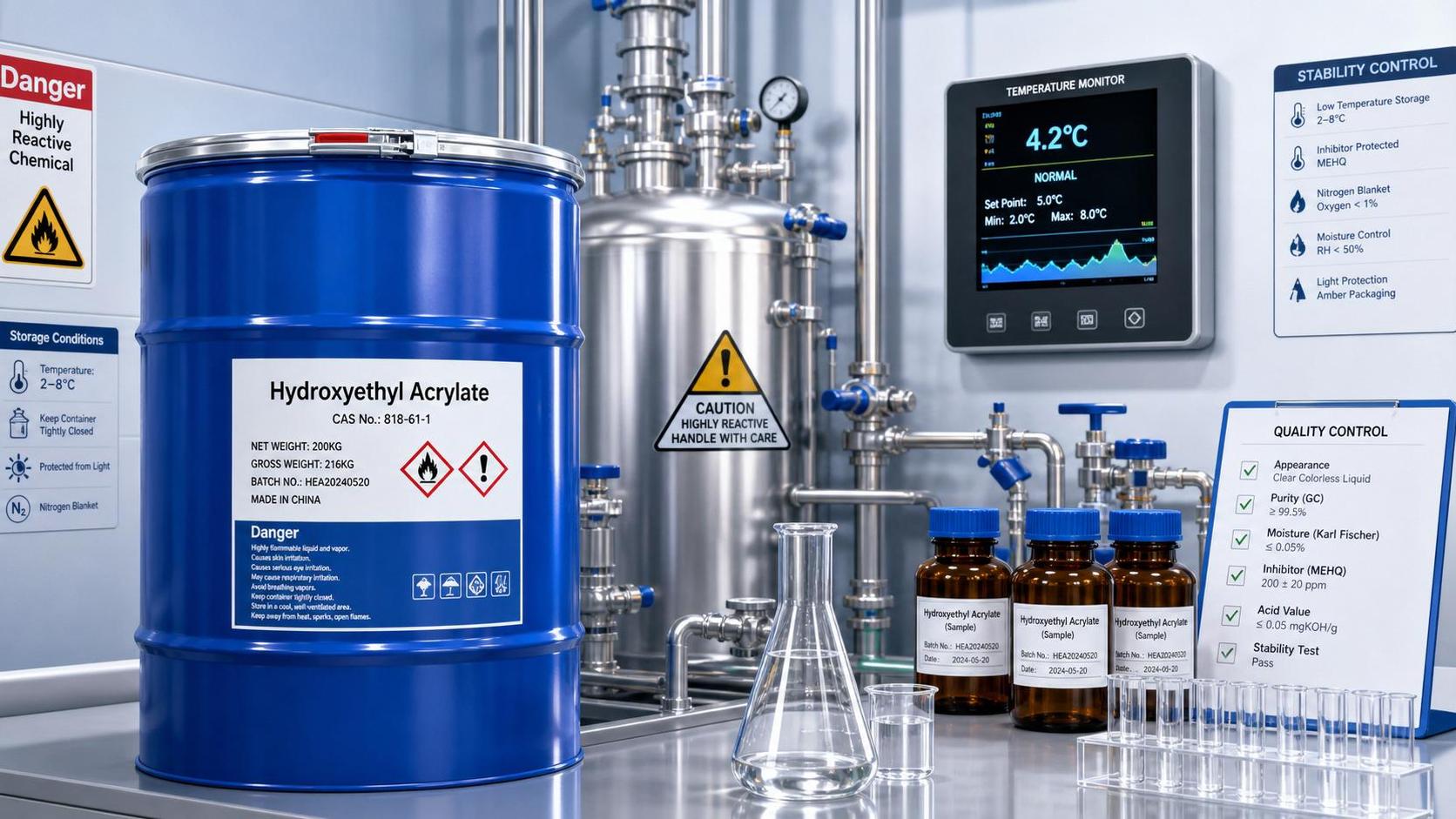
Hydroxyethyl Acrylate: Key Reactivity and Storage Concerns
Hydroxyethyl Acrylate is widely used in coatings, adhesives, and specialty formulations.
Its value comes from high reactivity, fast formulation response, and strong compatibility with many resin systems.
That same reactivity also creates storage and handling pressure.
If Hydroxyethyl Acrylate is exposed to heat, light, contamination, or poor inhibitor control, stability can drop quickly.
In practical operations, this affects product consistency, tank safety, transport reliability, and downstream process control.
A clear understanding of Hydroxyethyl Acrylate behavior helps reduce polymerization risk and support compliant chemical management.
Why Hydroxyethyl Acrylate Is So Reactive
Hydroxyethyl Acrylate contains both an acrylic double bond and a hydroxyl group.
This structure gives it two important characteristics.
- It polymerizes readily under unfavorable conditions.
- It also reacts well in copolymer systems and functional coatings.
This is why Hydroxyethyl Acrylate is attractive in UV coatings, pressure-sensitive adhesives, and reactive diluent systems.
However, reactivity is never only a production benefit.
It also means trace impurities, metal ions, oxygen imbalance, and elevated temperature can change the storage profile significantly.
Main Stability Risks During Storage
The biggest concern with Hydroxyethyl Acrylate is unwanted polymerization.
Once polymerization begins, heat generation can accelerate the reaction.
That can lead to pressure rise, viscosity increase, off-spec material, and serious safety events.
Common triggers include:
- Storage temperatures above the recommended range
- Direct sunlight or local heat sources
- Contact with peroxides, rust, or reactive residues
- Loss or depletion of inhibitor content
- Poor tank turnover and extended holding time
Moisture is another factor that should not be ignored.
Hydroxyethyl Acrylate can absorb water, which may affect purity, color, and reaction performance in sensitive formulations.
From a quality perspective, even small deviations can alter final coating hardness, adhesion, or cure behavior.
Critical Storage Conditions for Hydroxyethyl Acrylate
Hydroxyethyl Acrylate should be stored in cool, dry, and well-ventilated conditions.
Temperature control is the first priority.
The exact storage range should follow the supplier technical data sheet and transport classification requirements.
Containers should remain tightly closed and protected from contamination.
Routine control points usually include:
- Check inhibitor status on receipt and before long storage.
- Use clean, compatible tanks and transfer lines.
- Avoid contact with oxidizers, strong initiators, and metal contamination.
- Track batch age and apply strict FIFO management.
- Monitor color, viscosity, and unusual odor trends.
Ventilation also matters because acrylic monomers can create operator exposure concerns during transfer and sampling.
In real warehouse practice, good housekeeping often prevents more incidents than complex emergency controls.
Quality Control Checks That Matter Most
For Hydroxyethyl Acrylate, quality control should focus on both specification compliance and early instability signals.
Useful checks often include:
- Appearance and color
- Purity and moisture level
- Acid value or related chemical indicators
- Inhibitor concentration
- Viscosity drift during storage
Trend review is often more valuable than a single test result.
A slight but repeated viscosity increase may signal early polymer formation.
A color shift may point to contamination, oxidation, or excessive storage time.
More importantly, incoming inspection should align with supplier documentation, lot traceability, and intended end use.
Supply Reliability and Chemical Management
Stable Hydroxyethyl Acrylate performance depends on more than warehouse control.
It also depends on sourcing discipline, packaging integrity, transport timing, and supplier consistency.
Shandong JunTeng Chemical Co., Ltd. brings ten years of experience in chemical trading and supply chain coordination.
Its supplier network includes major domestic and international enterprises, supporting stable quality and timely delivery.
That matters when reactive materials require dependable source control and efficient logistics.
In broader procurement planning, some facilities also source supporting treatment chemicals through the same channel.
For example, water treatment and process support applications may involve Sodium Hexametaphosphate(SHMP), known for dispersion and scale inhibition.
This kind of integrated sourcing can simplify coordination across coatings, water treatment, and plant utility systems.
Practical Actions to Reduce Risk
A practical Hydroxyethyl Acrylate control program should be simple and repeatable.
Hydroxyethyl Acrylate can be managed safely when its reactivity is treated as a core operating condition, not a secondary detail.
Better storage discipline, tighter inspection, and reliable sourcing usually deliver the biggest gains first.
When procedures stay close to actual plant conditions, Hydroxyethyl Acrylate remains easier to control, safer to store, and more consistent in production use.
Leave A Message
If you are interested in our products and want to know more details, please leave a message here, we will reply you as soon as we can.