





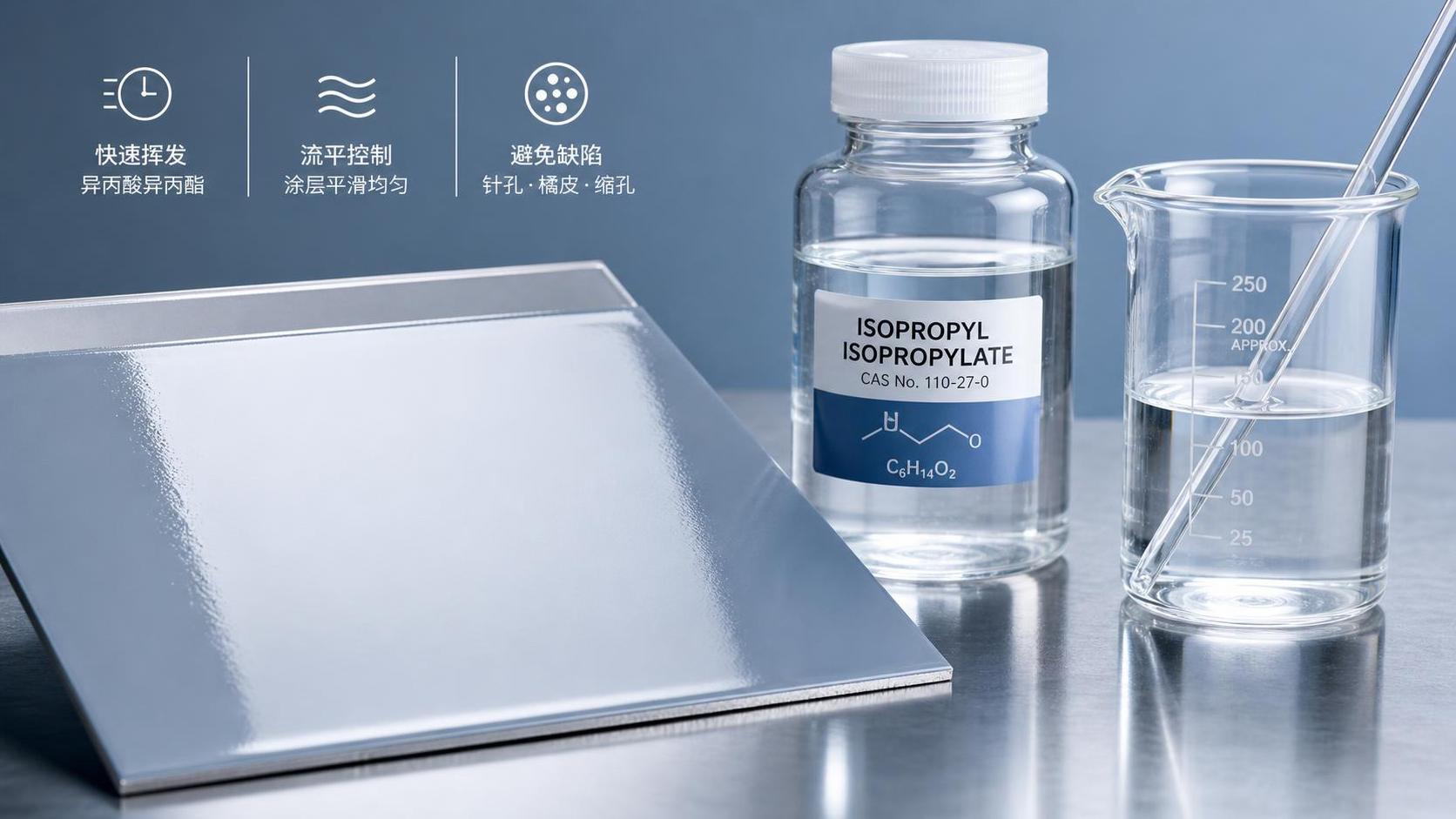
Start with the defect you are actually trying to prevent
When a team asks for a faster solvent, the real issue is usually not evaporation by itself. It is a production problem: dust pickup before cure, slow line speed, edge flow, print blocking, or visible defects such as pinholes, craters, blush, orange peel, and solvent popping. That is where Isopropyl Acetate earns attention. It evaporates quickly enough to help shorten open time, but the decision only makes sense when the coating or adhesive can still level before the film closes.
For technical evaluators, the practical question is simple: will Isopropyl Acetate move the process toward a smoother surface, or will it flash too fast and create a new defect? The checklist below is the one worth using before approving it in a formulation or on a production line.
Check the drying window, not just the evaporation label
Fast evaporation sounds attractive until the wet film skins over before trapped solvent can escape. In practice, that is one of the main reasons a “fast” package starts throwing surface defects. With Isopropyl Acetate, review the full drying profile of the system:
- Initial flash-off at the application temperature
- Time available for leveling
- Film thickness at the heaviest applied area
- Oven entry conditions, if the line is baked
- Air movement across the coated surface
If the coating already sits close to the edge of solvent pop or pinholing, adding a faster component can make the problem worse. If the current package is too slow and leaves the surface vulnerable to sagging or contamination, Isopropyl Acetate may improve the window. The judgment depends on the whole solvent blend, not a single component viewed in isolation.
Look at resin solvency before you look at line speed
A fast solvent that does not hold the resin properly is expensive trouble. Surface roughness, seed formation, gloss loss, and unstable viscosity often show up before anyone formally labels it a solvency issue. During evaluation, confirm whether Isopropyl Acetate keeps the target resin system fully workable across the expected temperature range and solids content.
This matters even more in mixed packages. Many formulators use a fast solvent to open the process, then balance it with slower components to preserve flow and film formation. In systems that need a slower tail solvent, a material such as Ethylene Glycol Butyl Ether Acetate can be relevant because its higher boiling point and moderate volatility make it suitable for coatings, inks, adhesives, latex paints, and related process blends where a longer wet edge is needed. It should be treated as a balancing tool, not as a substitute for the role Isopropyl Acetate plays.
Match solvent choice to the defect pattern on the panel
Different defects point to different mistakes. That sounds obvious, but teams still waste time changing solvent packages before identifying what they are seeing.
Do not ask one solvent to solve unrelated defects. If contamination, substrate cleanliness, or additive imbalance is the root cause, solvent changes will only blur the diagnosis.
Run the trial at production film build
Lab panels often flatter a fast solvent because they are applied thinner and under calmer conditions than the real line. Approval should come from the heaviest realistic wet film, with actual spray settings, substrate temperature, and flash-off timing. If the process includes corners, overlaps, or recessed sections, those areas deserve extra attention because they are usually where defects appear first.
A useful rule during trial work: watch the worst section of the panel, not the best-looking center. That is where Isopropyl Acetate either proves itself or gets ruled out.
Check application method and airflow together
The same solvent behaves differently in gravure, spray, dip, or roller application. Fine atomization and strong booth airflow can make a fast solvent act even faster, especially at the surface. If your line already runs with high air velocity, short gun distance, or warm substrates, Isopropyl Acetate may tighten the process window more than expected.
This is one of the most common evaluation mistakes: the solvent is blamed when the real change came from airflow or application energy.
Review water sensitivity and incoming solvent quality
For appearance-sensitive systems, water content and general consistency of incoming solvent matter more than many buyers expect. If the finish is prone to haze, poor gloss, or instability, the purchase review should include the supplier’s certificate fields, lot consistency, and storage handling. This is not paperwork for its own sake. A fast-evaporating solvent package tends to expose quality variation quickly because there is less process slack.
That is also why technical teams usually prefer suppliers with stable sourcing and dependable logistics rather than spot-market uncertainty. In chemical trading, consistency between lots often matters as much as nominal specification.
Use a blended approach when the target is smoothness plus speed
Very few good-looking industrial finishes rely on one solvent to do everything. If the target is faster drying without surface defects, the practical path is often a blend: a quicker component like Isopropyl Acetate to improve flash-off, paired with a slower solvent to preserve flow, coalescence, or resin holdout where needed. In that context, Ethylene Glycol Butyl Ether Acetate may fit formulations that need a high-boiling, good-solvency component with low water content and moderate volatility.
The key is not whether a slower solvent exists. The key is whether the blend still solves the original production problem without trading it for another one.
Make the approval decision in this order
- Define the defect you are trying to eliminate.
- Confirm resin compatibility and viscosity behavior.
- Trial Isopropyl Acetate at real film build and line conditions.
- Inspect heavy sections for pop, blush, and leveling loss.
- Adjust the solvent blend if flow or wet edge becomes too short.
- Approve only after lot quality and supply consistency are acceptable for repeat production.
That order saves time. Isopropyl Acetate is a strong candidate when you need quicker evaporation and cleaner surface formation, but it performs best when it is evaluated as part of the full application window: resin, film thickness, airflow, temperature, and blend balance. If those checks line up, it can help deliver the faster drying profile technical teams want without pushing the surface into avoidable defects.
Leave A Message
If you are interested in our products and want to know more details, please leave a message here, we will reply you as soon as we can.