





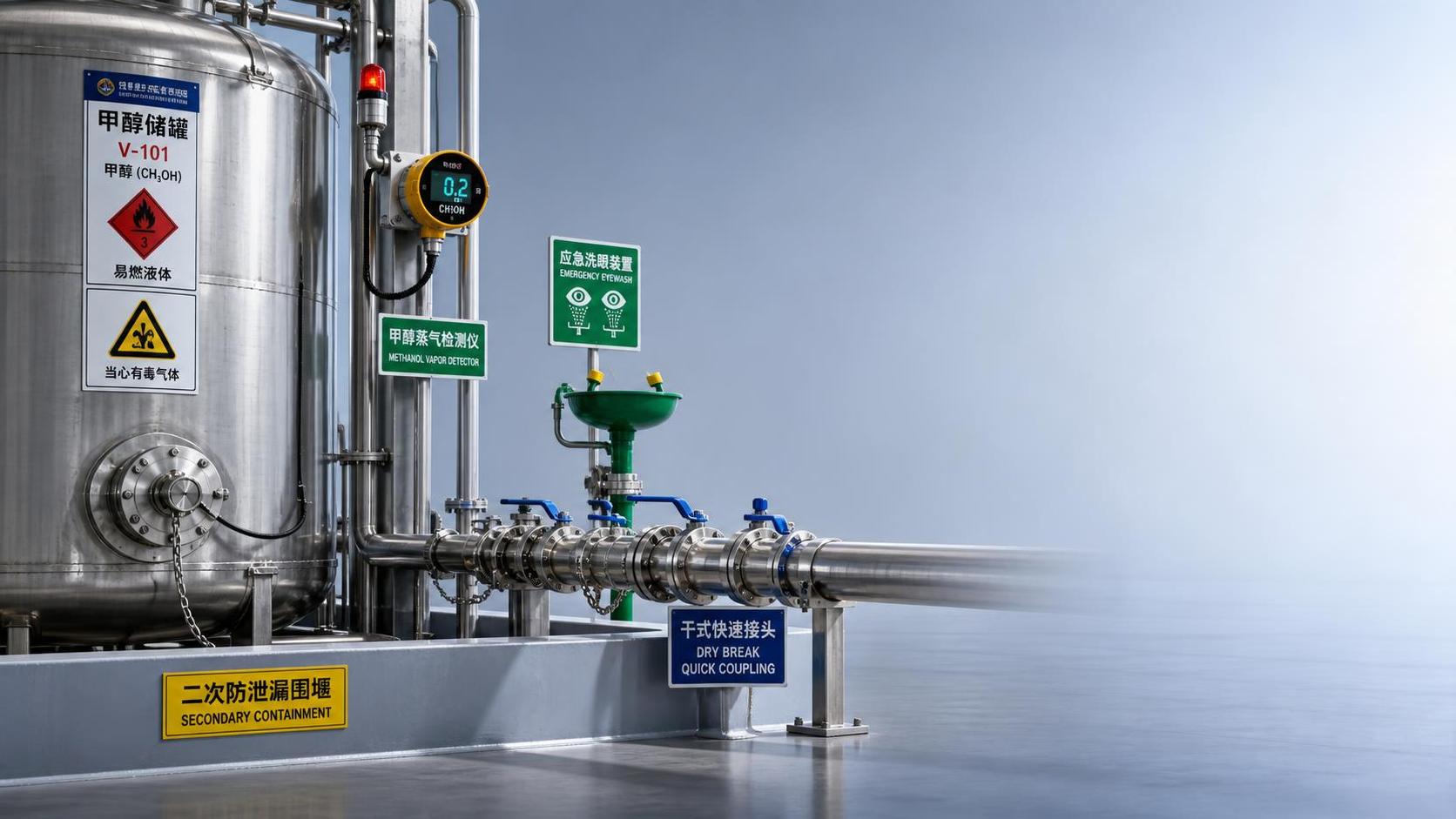
Methanol Toxicity in Industrial Operations: Exposure Limits and Response Planning
Methanol toxicity is a serious operational risk because vapors, skin contact, and accidental ingestion can cause delayed but severe health effects, including permanent visual injury and death.
For quality control and safety managers, the priority is not merely knowing that methanol is hazardous. It is ensuring exposure controls, monitoring, and emergency decisions work under real conditions.
A strong program connects purchasing specifications, storage design, work practices, medical response, and incident investigation. Gaps between these functions can turn a manageable release into a life-threatening event.
This guide focuses on practical judgments: where exposure occurs, how limits should be applied, which warning signs require escalation, and how response plans should be tested.
Why Methanol Toxicity Requires a Different Level of Attention
Methanol is widely used as a solvent, feedstock, fuel component, and processing aid. Its familiarity can create false confidence during routine transfer, sampling, blending, and cleaning activities.
The liquid is colorless, and its odor may resemble ethanol. Workers cannot reliably use smell as a safe exposure indicator, particularly in poorly ventilated or high-noise production areas.
Unlike simple irritation hazards, methanol toxicity may worsen after an initial symptom-free period. The body metabolizes methanol into formaldehyde and formic acid, which can damage the optic nerve.
Headache, dizziness, nausea, fatigue, and blurred vision should therefore be treated as potential exposure signals. Delayed symptoms do not prove that a worker has recovered safely.
Safety managers should identify every task involving open containers, hose connections, maintenance breaks, laboratory testing, tank entry, unloading, and spill cleanup. These are usually higher-risk points than sealed storage.
Apply Exposure Limits as Operational Control Targets
Exposure limits are important benchmarks, but they are not substitutes for engineering control. Managers should confirm the applicable legal limits for their jurisdiction and customer requirements before setting internal standards.
In many programs, occupational limits are expressed as time-weighted averages and short-term exposure limits. Both matter because brief vapor peaks can occur during manual handling or equipment opening.
A time-weighted average helps evaluate exposure across a full shift. A short-term limit helps control concentrated releases that may occur within minutes during sampling, transfer, or emergency intervention.
Where national requirements differ, use the stricter applicable value as an internal planning basis unless a qualified industrial hygienist determines another approach is justified and documented.
Personal air sampling should represent actual worker behavior, including normal production, line breaks, cleaning, and foreseeable upset conditions. Sampling only during quiet periods produces misleadingly favorable results.
Direct-reading vapor instruments can support leak checks and task monitoring, but they should be calibrated, maintained, and used within their specified detection range and environmental limitations.
Quality teams can contribute by reviewing methanol purity, packaging integrity, labeling accuracy, and certificates of analysis. Product quality deviations can create unexpected process emissions or handling changes.
Control Exposure Before Relying on Personal Protective Equipment
The most reliable controls remove or contain the hazard. Closed transfer systems, fixed piping, dry-break couplings, local exhaust ventilation, and sealed sampling devices should be evaluated before administrative measures.
Storage tanks and drums require compatible seals, controlled venting, secondary containment, clear labeling, and separation from ignition sources. Methanol is both toxic and highly flammable.
Ventilation performance should be verified through commissioning tests and periodic inspection. A hood that appears operational may not capture vapors at the worker’s breathing zone.
Administrative controls remain valuable when engineering improvements are incomplete. Examples include limiting time at open vessels, scheduling high-exposure tasks, restricting access, and requiring written transfer checklists.
Glove selection must be based on chemical compatibility and breakthrough data, not generic assumptions. Contaminated gloves, sleeves, and clothing can extend skin exposure after the original task ends.
Respiratory protection should be used only within a formal program covering hazard assessment, cartridge selection, fit testing, medical evaluation, training, maintenance, and replacement schedules.
For unknown concentrations, oxygen-deficient spaces, confined-space releases, or emergency rescue, air-purifying respirators may be inadequate. Response teams need equipment selected for those conditions.
Build Monitoring Around Real Exposure Scenarios
A useful exposure assessment begins with a task inventory rather than a single facility-wide measurement. Different job roles can face very different methanol concentrations within the same operation.
Prioritize receiving operators, warehouse staff, production technicians, laboratory analysts, maintenance crews, waste handlers, and contractors. Contractors may be unfamiliar with site-specific labeling and response arrangements.
Document the chemical concentration, temperature, quantity handled, duration, ventilation status, transfer method, and worker position. These details make monitoring results actionable instead of merely archival.
Repeated measurements are especially important after equipment modification, production expansion, supplier changes, ventilation repairs, or incident reports. Exposure profiles can shift even when procedures remain unchanged.
Alarm thresholds on fixed detectors should support early intervention, not encourage personnel to remain until a legal limit is reached. Escalation instructions must be visible and unambiguous.
Review trends in near misses, odor complaints, eye irritation, ventilation failures, and small leaks. These records often reveal deteriorating controls before personal sampling identifies an exceedance.
Recognize Symptoms and Escalate Without Delay
Employees should understand that symptoms may be nonspecific at first. Headache, dizziness, nausea, confusion, unusual fatigue, abdominal discomfort, or visual changes require prompt evaluation after possible exposure.
Visual symptoms are particularly urgent. Blurred vision, reduced visual clarity, altered color perception, or a sensation of looking through fog may indicate significant methanol toxicity.
Do not allow affected personnel to drive, operate machinery, or return to exposure while waiting for symptoms to pass. Supervisors need authority to stop work immediately.
Medical providers should be told explicitly that methanol exposure is suspected. This information supports appropriate laboratory assessment, antidotal treatment decisions, and consultation with toxicology specialists.
Safety plans should include local emergency numbers, poison-center contacts, transport arrangements, and the location of current safety data sheets. Response information must remain accessible during power or network failures.
Incident reports should capture the suspected route of exposure, duration, material identity, concentration, controls in use, symptoms, and timeline. Accurate chronology is valuable for clinical and corrective-action decisions.
Plan Spill and Release Response Around Toxicity and Fire Risk
Methanol release plans must address two simultaneous hazards: toxic vapor exposure and flammable vapor ignition. Isolating the area without controlling ignition sources is not sufficient.
Initial responders should approach from upwind when possible, prevent unnecessary entry, eliminate ignition sources, and notify trained personnel. Unprotected workers should never conduct improvised cleanup.
Small spills can still create hazardous vapor concentrations in enclosed rooms, pits, loading bays, and drains. Ventilation and atmospheric monitoring should guide re-entry decisions.
Use compatible absorbents and waste containers according to the site procedure and local regulations. Do not allow contaminated materials to enter drains, waterways, or uncontrolled waste streams.
Emergency showers and eyewash stations should be accessible along likely handling routes. Their function, water flow, and access clearance should be checked during routine safety inspections.
Drills should include a worker reporting delayed symptoms after a minor splash or vapor event. This tests whether supervisors recognize the medical urgency beyond visible spill control.
Integrate Chemical Procurement With Safe Handling Requirements
Procurement decisions affect safety performance long before a container reaches the site. Suppliers should provide consistent specifications, transport documentation, packaging information, and current safety data for each shipment.
Incoming inspection should verify labels, seals, container condition, batch documentation, and compatibility with storage systems. Damaged packaging should trigger a controlled receiving and quarantine process.
For operations that combine methanol with moisture-sensitive reagents, process planning becomes more important. Unexpected residual solvents, water, or incompatible materials can increase both reaction and exposure risks.
For example, Sodium T-Amylate(STA) is moisture-sensitive and reacts vigorously with protic materials, so controlled segregation and documented transfer procedures are essential.
Safety and quality managers should review supplier changes through management-of-change procedures. A change in concentration, packaging, impurity profile, or delivery method can alter workplace exposure assumptions.
Reliable supply-chain coordination also reduces rushed unloading and emergency substitutions. Stable scheduling gives teams time to inspect deliveries, confirm storage capacity, and prepare appropriate handling controls.
Turn the Response Plan Into a Verifiable System
A written response plan is effective only when employees can apply it quickly. Define who stops work, who isolates equipment, who contacts medical support, and who communicates with management.
Assign specific responsibilities for incident command, first aid, spill control, air monitoring, access control, documentation, and external communication. Role ambiguity is a common source of delayed response.
Training should use realistic task examples rather than generic hazard statements. Workers should practice recognizing a leaking coupling, contaminated clothing, vapor alarm, and delayed symptom report.
Conduct tabletop exercises for major releases and field drills for credible small incidents. After each exercise, record timing, communication failures, equipment gaps, and corrective actions with owners and deadlines.
Review the plan at least annually and after any incident, process change, regulatory update, or significant staffing change. Emergency readiness declines when documents remain static while operations evolve.
Management should track leading indicators such as completed inspections, ventilation maintenance, training participation, drill outcomes, and corrective-action closure. These measures support prevention before injury occurs.
Conclusion
Methanol toxicity should be managed as a predictable operational risk, not an unusual emergency. Exposure limits, monitoring, containment, trained supervision, and rapid medical escalation must function together.
For quality control and safety managers, the clearest standard is practical: workers should be protected during normal work, abnormal conditions, and delayed symptom scenarios without relying on guesswork.
Organizations that connect procurement controls, exposure assessment, emergency drills, and continuous review are better positioned to prevent serious harm while maintaining reliable chemical operations.
Leave A Message
If you are interested in our products and want to know more details, please leave a message here, we will reply you as soon as we can.