





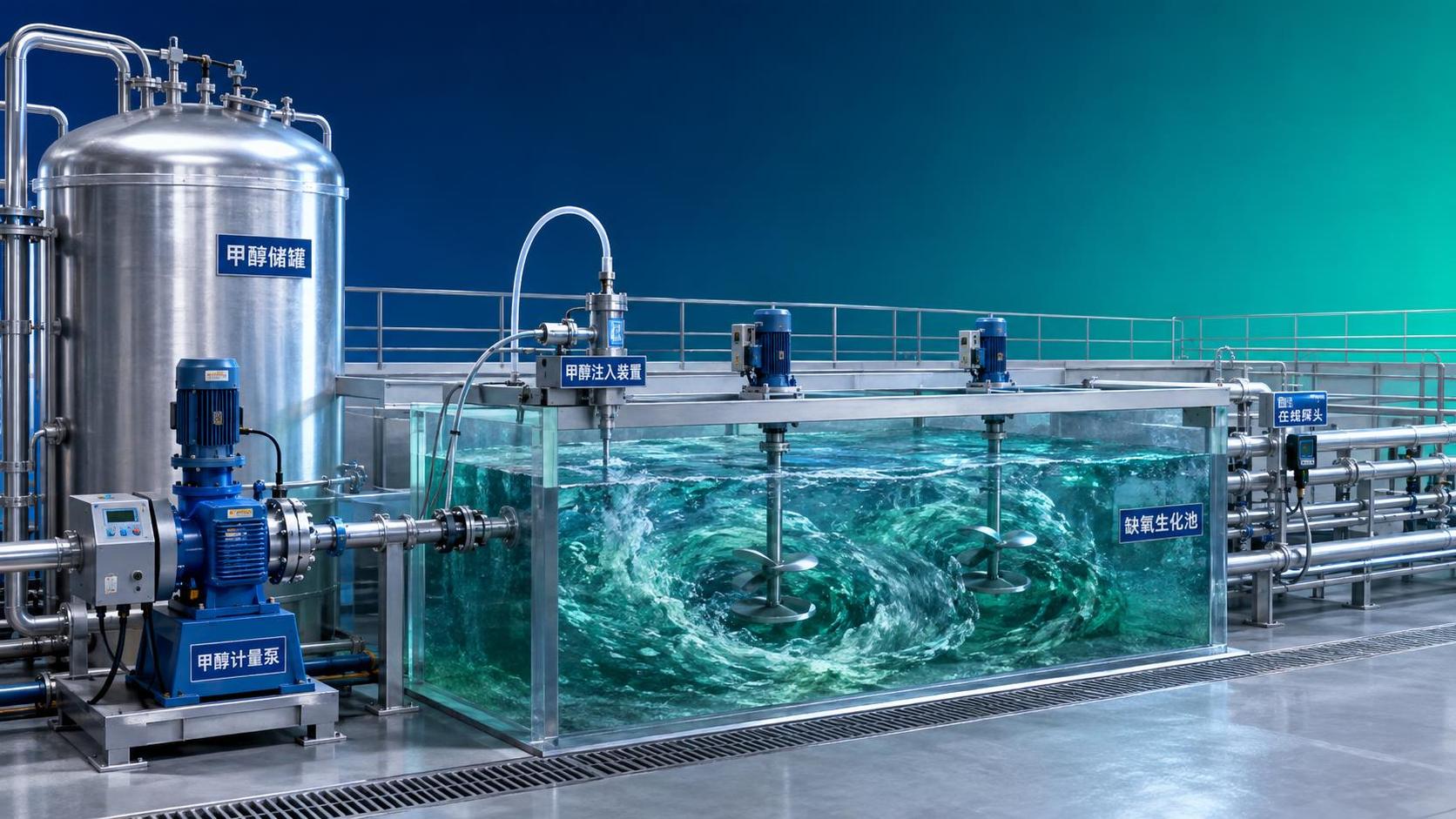
When a biological wastewater system has insufficient readily biodegradable carbon in its denitrification zone, nitrate removal can become unstable even when aeration, sludge age, and hydraulic retention time appear acceptable. Methanol is widely used as an external carbon source because denitrifying biomass can metabolize it efficiently under anoxic conditions, using nitrate or nitrite as the electron acceptor. The result is conversion of oxidized nitrogen to nitrogen gas, provided that methanol delivery, mixing, biomass condition, and process control are aligned.
Methanol for wastewater treatment is most effective when it is treated as a controlled process input rather than a simple chemical addition. A dose that is too low leaves residual nitrate in the final effluent. A dose that is too high can increase residual organic matter, promote unwanted biomass growth downstream, consume dissolved oxygen after the anoxic zone, and obscure the actual cause of poor nitrogen removal.
Match Carbon Addition to the Actual Nitrogen Load
The starting point is not a fixed methanol feed rate. Carbon demand changes with influent flow, nitrate concentration entering the anoxic stage, recycle flow, temperature, biomass activity, and the amount of biodegradable carbon already present in the wastewater. Systems receiving variable industrial streams often experience rapid shifts in this balance. A feed setting that performs well during steady loading may produce nitrate breakthrough after a production change or excessive residual carbon during a low-load period.
Stoichiometric calculations establish an initial dose, but field control must account for biological efficiency and site-specific losses. Methanol is consumed not only by denitrification; a portion may support cell synthesis or be oxidized where oxygen enters the intended anoxic zone. Therefore, dose adjustment should be guided by measured nitrate or nitrite at the relevant process boundary, together with effluent organic indicators and dissolved oxygen readings. Using only the final total nitrogen result delays correction because it does not show where the process lost control.
Locate the Real Carbon Limitation
Residual nitrate does not automatically prove that methanol demand is high. The same result can arise from several different conditions: insufficient anoxic volume, excessive dissolved oxygen carried by internal recycle, poor mixing near the injection point, inadequate active biomass, or an unexpectedly high nitrification load. Adding more methanol to an oxygen-contaminated zone may raise organic residuals without improving denitrification.
A useful diagnostic sequence follows the nitrogen through the process. Confirm the nitrate concentration entering the anoxic zone, examine dissolved oxygen in the mixed liquor and recycle stream, verify that the carbon feed reaches a well-mixed location, and compare nitrate reduction across the anoxic volume. A steep reduction near injection followed by a plateau can point to uneven distribution or insufficient downstream contact time. Little reduction throughout the zone suggests that oxygen intrusion, biomass condition, or available volume deserves attention before the carbon dose is increased.
Injection Location Shapes the Response
Methanol should enter a zone where it can disperse quickly into an anoxic mixed liquor volume. Point injection into a poorly mixed area creates a concentrated local substrate plume. This can encourage uneven biological activity and makes grab samples difficult to interpret. An injection quill, eductor arrangement, or feed point located near established mixing energy is commonly considered, but the selected hardware must suit the basin geometry and recirculation pattern.
Feeding upstream of an aerobic zone is also a frequent source of wasted chemical. Where dissolved oxygen is present, heterotrophic organisms can consume methanol before nitrate reduction occurs. Conversely, feeding too late in the treatment train may leave too little residence time for complete denitrification. The appropriate location depends on whether the process is pre-denitrification, post-denitrification, a polishing filter, or a hybrid configuration with internal nitrate recycle.
Control Strategy Must Follow Process Dynamics
A flow-paced methanol feed is a useful baseline where wastewater flow is the dominant variable, yet flow alone rarely captures the full nitrogen demand. Nitrate-paced trim control can improve response when an online analyzer is reliable and representative of the process stream. The analyzer location, sample conditioning, response delay, and maintenance discipline matter as much as the control algorithm. A delayed nitrate signal coupled with an aggressive dosing response can create repeated overcorrection.
For installations without dependable online nitrate measurement, routine composite sampling and controlled step changes can establish a workable dose curve. Changes should be deliberate and held long enough for the relevant hydraulic and biological response to appear. Several feed changes in a short period make it difficult to separate the effect of methanol from normal influent variability. Trending internal nitrate, effluent nitrate, dissolved oxygen, pH, oxidation-reduction potential where applicable, and residual organic indicators gives a clearer operating record than relying on a single end-of-pipe value.
Temperature shifts deserve separate attention. Denitrification activity declines as wastewater cools, so the same methanol feed may no longer achieve the previous nitrate reduction within the available contact time. Increasing dose may be justified only after confirming that mixing, biomass inventory, and anoxic residence time can support the additional substrate demand. Where biological capacity is the limitation, a chemical-only response has limited value.
Storage and Feed Reliability Are Part of Treatment Performance
Methanol is flammable and requires a storage and transfer arrangement designed for its hazard characteristics. The feed system should include compatible tank, pipe, valve, pump, venting, containment, bonding, grounding, leak detection where appropriate, and clearly isolated maintenance points. Metering pumps need stable suction conditions and calibration against actual delivered volume; a nominal pump stroke setting is not a verified chemical dose.
Interruptions in external carbon feed can rapidly affect denitrification performance, especially where influent wastewater contains little readily available carbon. Practical design and operating provisions include duty-and-standby pumping where continuity is necessary, low-level alarms that allow replenishment before the tank reaches a critical level, protected dosing lines, and a defined response for analyzer or pump failure. Delivery scheduling should consider usable tank volume rather than nameplate capacity, because safety inventory and receiving constraints reduce the quantity available for normal operation.
Segregation during receiving and storage is essential. Organic liquids used elsewhere at a facility are not interchangeable with methanol, even when they are clear solvents. For example, Cyclchexane(cyclohexane) is water-insoluble and intended for solvent, extraction, and chemical-processing applications; it is not a substitute external carbon source for an aqueous denitrification system. Dedicated connections, unambiguous labeling, and controlled unloading procedures reduce the chance that a transfer error becomes a biological treatment upset.
Product Quality Should Be Considered in Context
For biological treatment, a consistent methanol composition supports predictable feed calculations and reduces the chance of introducing contaminants that affect biomass, analytical results, or downstream treatment. The required specification should be defined around the treatment process and storage system, including water content and any impurities relevant to the site. A specification that is technically acceptable on paper can still create operational difficulty if delivery documentation, receiving verification, or batch traceability are inconsistent.
Before commissioning a new or modified system, the operating sequence should connect chemical delivery with process evidence: confirm the actual concentration and feed calibration, establish a conservative initial dose, verify dispersion in the anoxic zone, then adjust against internal nitrate and effluent response. This approach keeps the biological process observable while avoiding the common cycle of increasing methanol whenever nitrogen removal weakens.
Leave A Message
If you are interested in our products and want to know more details, please leave a message here, we will reply you as soon as we can.