





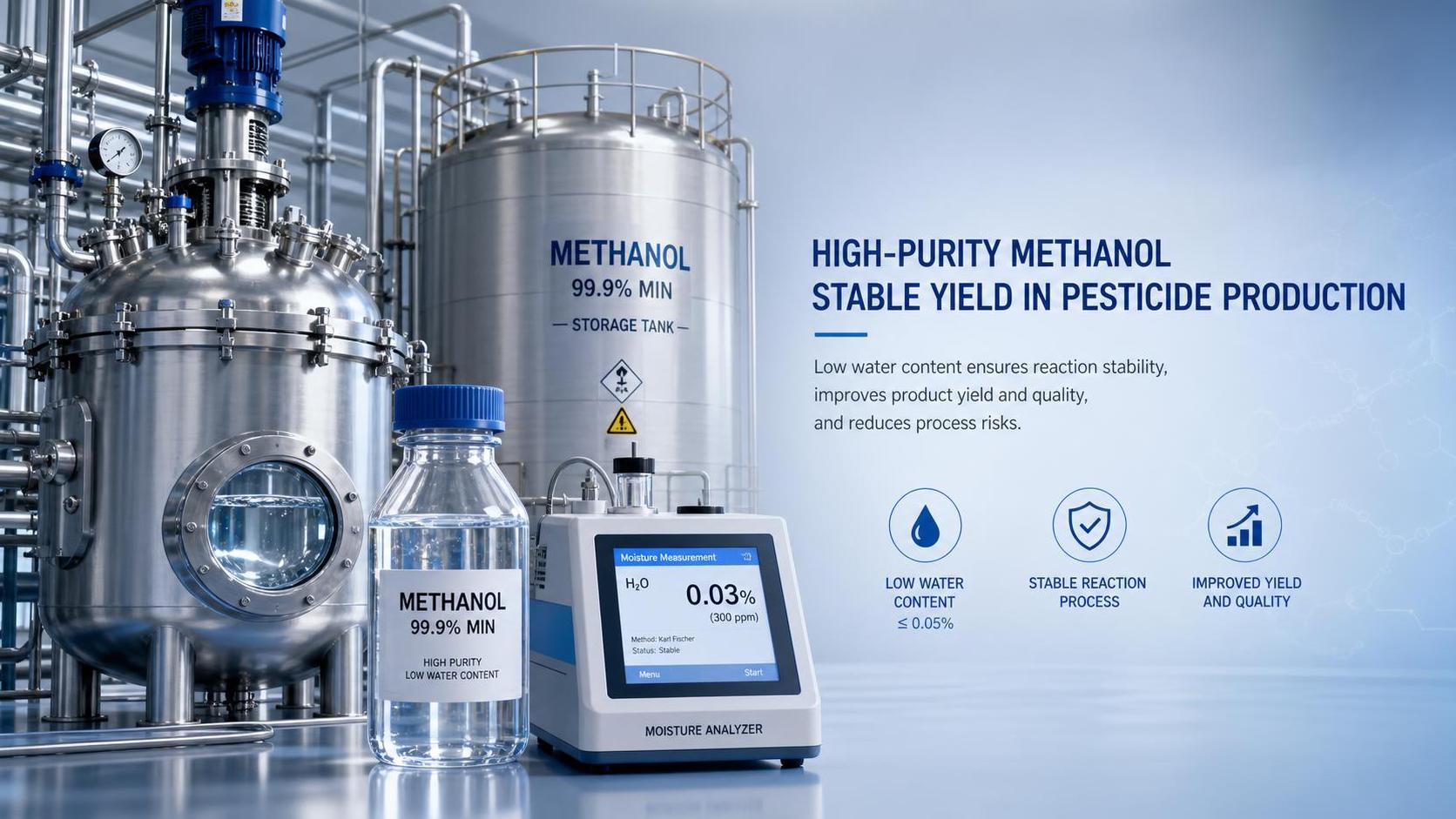
Methanol for Pesticide Production: Purity, Moisture, and Yield Impact
In pesticide plants, methanol quality usually becomes a serious topic only after a batch starts drifting. A formulation turns hazy after storage, a synthesis step slows down without an obvious equipment fault, or solvent recovery performance changes from one delivery to the next. On paper, methanol can look like a straightforward commodity. On the production floor, methanol for pesticide production is judged less by its label and more by how consistently it behaves in reactors, blending tanks, and storage systems.
The first thing technical teams tend to watch is not price per ton, but whether the material matches the process window. In some pesticide manufacturing routes, methanol is a reaction medium; in others, it is used in extraction, dilution, cleaning, or formulation adjustment. Those are not equivalent duties. A grade that is acceptable for line flushing may create avoidable trouble in a formulation where clarity, low water content, and repeatable evaporation behavior matter. That is why purity and moisture are discussed together. Purity alone does not tell the full story if the water level is unstable from lot to lot.
Where Purity Actually Shows Up
In technical evaluation, “high purity” is only useful if someone ties it back to a production effect. For pesticide intermediates and finished formulations, impurity control matters in three practical ways. One is reaction selectivity. Trace contaminants can alter side-reaction tendencies, especially in systems that are already sensitive to catalyst condition, temperature control, or feed sequence. Another is appearance stability. Even when the active ingredient is on spec, low-level contamination in methanol can contribute to color drift, haze, or sediment risk during storage. The third is downstream handling: distillation, recovery, and residue management become more predictable when the incoming solvent profile is stable.
This is one reason buyers in chemical trading increasingly ask not only for a certificate, but also for source stability. Shandong JunTeng Chemical Co., Ltd., based in Jinan, has spent years serving customers across pesticides, pharmaceuticals, petrochemicals, and industrial processing, where repeatability matters more than a one-time attractive quotation. With long-term cooperation covering established upstream producers and an organized supply chain, the practical value is straightforward: the customer is less exposed to abrupt shifts in raw material origin, transport timing, and batch-to-batch handling conditions. In solvent-dependent production, that kind of consistency is often underestimated until the plant has to explain a sudden yield loss.
Moisture Is a Small Number with Large Consequences
Moisture tends to be the more disruptive variable, particularly when the process includes water-sensitive intermediates, controlled crystallization, or concentration targets that leave little room for deviation. A small increase in water content may not look dramatic in a specification sheet, but inside a pesticide plant it can show up in several places at once: slower reaction rate, lower conversion, longer solvent removal time, and changed viscosity or solubility behavior in the final blend.
This is also where site conditions matter. A plant in a humid season, with frequent drum opening or less controlled storage, may not only receive methanol with a certain moisture level, but also add more moisture during handling. The issue is not always the supplier alone. Bulk tank breathing, transfer line exposure, and partial-use container management can all move the real water content away from the original shipment condition. When teams say “the same solvent performed differently this month,” the answer is sometimes in storage discipline rather than in the invoice description.
For that reason, experienced purchasers usually separate two questions: what was shipped, and what entered the reactor? If the process is moisture-sensitive, incoming inspection, sealed storage, and transfer management deserve as much attention as the purchase specification itself.
Yield Loss Is Often Indirect
Yield impact from methanol is rarely dramatic in a way that points to a single cause. More often it appears as accumulated inefficiency. A slightly wetter solvent can reduce effective concentration, extend cycle time, and change phase behavior. A less stable impurity profile can make operators compensate with tighter temperature watching or extra hold time. None of these issues always triggers an immediate off-spec batch, but over weeks they affect throughput, energy consumption, and rework frequency.
That is why technical teams should avoid judging methanol only by a pass/fail commodity mindset. In pesticide production, the better question is whether the solvent supports a stable manufacturing rhythm. If one source forces operators to keep adjusting drying time, distillation cutoff, or blending order, the nominal purchase savings may disappear quickly.
Questions Worth Asking Before Approval
When customers compare solvent options, they often focus on assay and overlook the logistical side. Yet for continuous or campaign-based pesticide production, supply consistency is part of technical suitability. Late delivery can interrupt a production sequence; mixed source history can complicate troubleshooting. A trading partner with reliable upstream coordination and efficient logistics is useful not because it sounds reassuring, but because it helps keep the process conditions comparable from one production window to the next.
It is also reasonable to look beyond the solvent itself and consider adjacent plant chemicals. For example, maintenance shutdowns, scale removal, and utility system cleaning can influence line condition before sensitive solvent service resumes. In those support tasks, some plants also use materials such as Sulfamic Acid, particularly where a stable, non-volatile acid is preferred for descaling and industrial cleaning. That is not part of methanol substitution, but it reflects a broader purchasing reality in chemical operations: process reliability often depends on how well the plant manages the entire chemical support package, not only the headline raw material.
For buyers and production engineers evaluating methanol for pesticide production, a few checks usually provide more value than lengthy generic discussions:
- Whether the moisture level is suitable for the most water-sensitive step, not just the average process.
- Whether the source and batch consistency are documented well enough to support troubleshooting.
- Whether storage, transfer, and container-opening practices at the site can preserve the delivered quality.
- Whether any observed yield or clarity issue is truly solvent-related, or partly created by plant-side handling.
A good solvent decision in pesticide manufacturing is rarely about choosing the highest number on a specification sheet. It is about matching purity, moisture control, and supply reliability to the actual process behavior of the plant. When those three line up, operators usually notice it in a practical way: fewer adjustments, steadier batches, and less time spent explaining why the same recipe no longer behaves the same.
Leave A Message
If you are interested in our products and want to know more details, please leave a message here, we will reply you as soon as we can.