





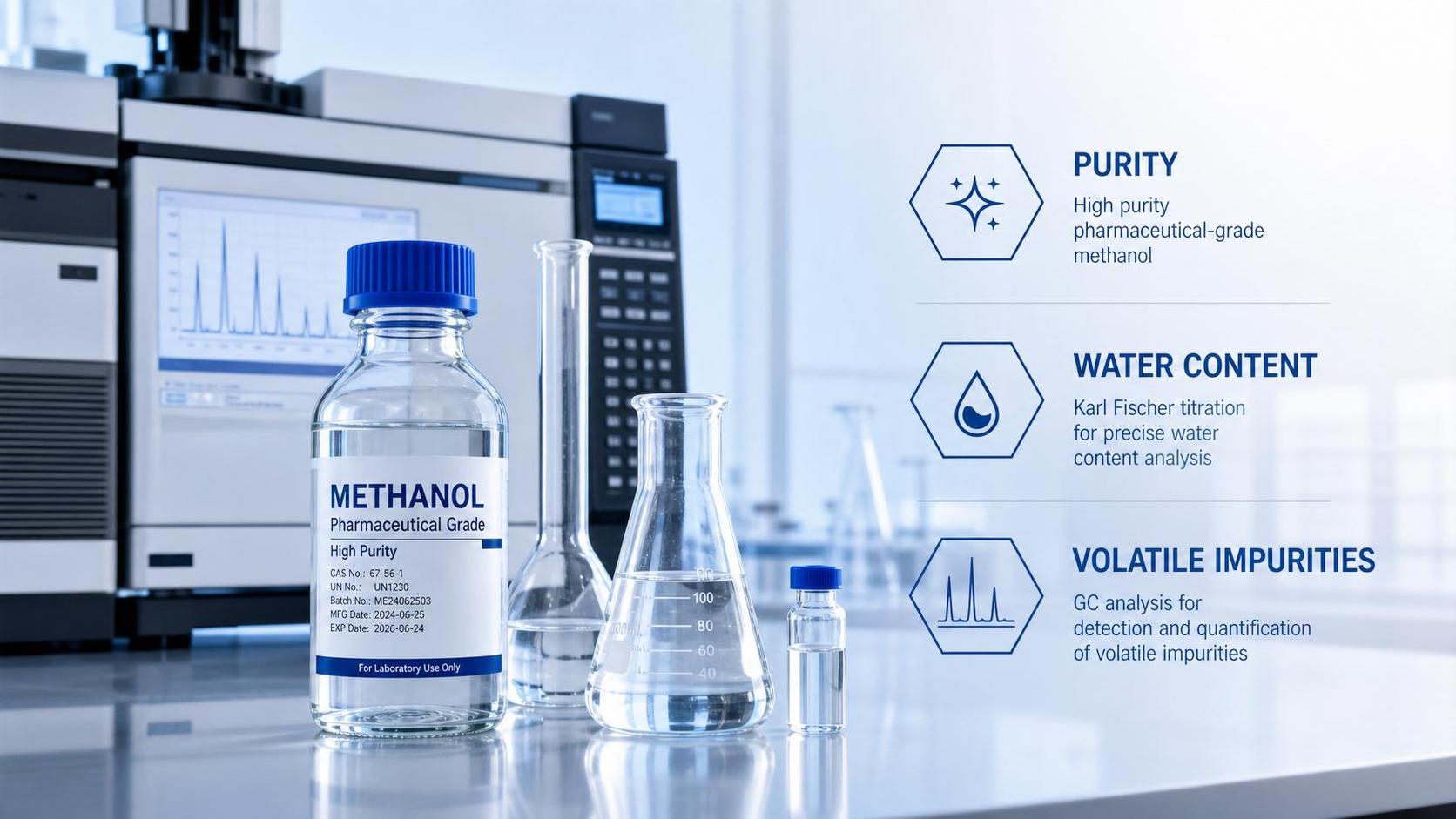
Methanol for Pharmaceuticals: Key Purity Specs That Affect Formulation
When evaluating methanol for pharmaceuticals, purity is more than a specification sheet item. It directly affects formulation stability, process repeatability, and regulatory confidence.
In practice, methanol for pharmaceuticals is rarely judged by assay alone. The more decisive question is which impurities can disrupt the product, process, or filing.
That is why technical evaluation usually goes deeper. Teams look at water, non-volatile residue, related alcohols, carbonyl compounds, and trace metals together.
A high assay number may still hide formulation risk. Small impurity shifts can change solvent behavior, reaction selectivity, drying time, or analytical background.
Why Methanol Purity Matters Beyond Assay
Methanol for pharmaceuticals is often used as a reaction solvent, extraction medium, cleaning solvent, or analytical reagent. Each use places pressure on different purity attributes.
For formulation work, consistency matters as much as absolute purity. A batch that technically passes may still behave differently from a previously qualified source.
This becomes more visible in moisture-sensitive APIs, impurity-controlled synthesis routes, and residue-limited final dosage forms. Solvent variation then moves from procurement detail to process variable.
From a compliance angle, the solvent must also align with pharmacopeial expectations, internal quality agreements, and change-control procedures across sites.
The Key Purity Specs to Review First
1. Assay by GC or Equivalent Method
Assay is still the first screen. For methanol for pharmaceuticals, high purity confirms the solvent base is suitable for controlled manufacturing use.
However, assay alone is not enough. Two lots with similar assay can perform differently if the impurity pattern is not the same.
2. Water Content
Water is one of the most influential specifications. It can affect solubility, reaction equilibrium, hydrolysis risk, crystallization behavior, and drying efficiency.
Karl Fischer results are especially important when the methanol contacts hygroscopic intermediates or water-sensitive catalysts. Even a small increase may alter yield or impurity formation.
3. Non-Volatile Residue
Non-volatile residue shows whether trace heavy ends remain after evaporation. This matters in final cleaning, residue studies, and analytical sample preparation.
If residue is too high, background interference may rise. In some workflows, it can also complicate filterability or generate unexpected visible residues.
4. Related Volatile Impurities
Typical volatile impurities include ethanol, acetone, and other low-boiling organics. These can influence extraction selectivity, evaporation profile, and chromatographic baseline behavior.
In route development, trace co-solvents may seem minor. Later, they can complicate validation because process reproducibility becomes harder to defend.
5. Acidity or Alkalinity
Acidic or alkaline carryover can catalyze degradation or shift reaction outcomes. This is particularly relevant in esterification, salt formation, and pH-sensitive formulations.
A neutral-looking solvent is not always chemically neutral enough for sensitive systems. That is why this specification deserves closer review during qualification.
6. Trace Metals and Elemental Contaminants
For many applications, metals are a secondary concern. But in catalytic chemistry or tightly controlled impurity profiles, they can become a real risk factor.
Where necessary, methanol for pharmaceuticals should be assessed against the site’s elemental impurity strategy, not only against a generic supplier certificate.
How These Specs Affect Real Formulation Outcomes
The practical impact usually appears in three areas: stability, process consistency, and analytical clarity. Each one can be affected by a different impurity group.
- Higher water may reduce drying efficiency and increase hydrolysis risk.
- Volatile by-products may shift solvent strength during extraction or crystallization.
- Non-volatile residue may leave background signals in analytical work.
- Acid-base deviation may accelerate degradation in sensitive formulations.
This also affects sourcing decisions. The best methanol for pharmaceuticals is not simply the cheapest compliant grade, but the grade that stays predictable in your process window.
What to Check During Supplier Qualification
A technical review should connect the certificate of analysis to actual manufacturing use. That step is where many purchasing risks become visible.
- Confirm the test methods behind assay, water, and volatile impurity results.
- Review batch-to-batch trend data, not only one passing certificate.
- Check packaging suitability for moisture and contamination control.
- Assess logistics stability, storage conditions, and delivery lead times.
- Clarify change-notification rules for source, process, or specification updates.
In broader solvent procurement, some manufacturers also align related raw materials under one sourcing framework. For example, Acetic acid solution 45%/55%/65%/75%/80%/90% is commonly used in pharmaceuticals, organic synthesis, and analytical applications, making coordinated supply review more practical.
Why Supply Reliability Matters with Methanol for Pharmaceuticals
Even a strong specification loses value if supply is unstable. Delays, inconsistent lots, or unclear traceability create operational pressure very quickly.
Shandong JunTeng Chemical Co., Ltd. brings ten years of chemical trading experience, supported by supply chain management, qualified supplier resources, and efficient logistics coordination.
Its long-term cooperation with major producers and industrial customers helps strengthen source control, product authenticity, supply continuity, and timely delivery planning.
For teams reviewing methanol for pharmaceuticals, that supply structure can reduce qualification uncertainty and support more stable procurement execution.
A Practical Review Framework
Conclusion
The most useful way to assess methanol for pharmaceuticals is to link purity data with formulation risk. That means looking beyond assay and focusing on functional impurities.
When water, residue, volatile impurities, and acidity are reviewed together, sourcing decisions become more defensible. Process performance also becomes easier to predict.
For procurement and qualification work, a practical next step is simple: compare supplier specifications against your most impurity-sensitive process, then validate supply consistency before scale-up.
Leave A Message
If you are interested in our products and want to know more details, please leave a message here, we will reply you as soon as we can.