





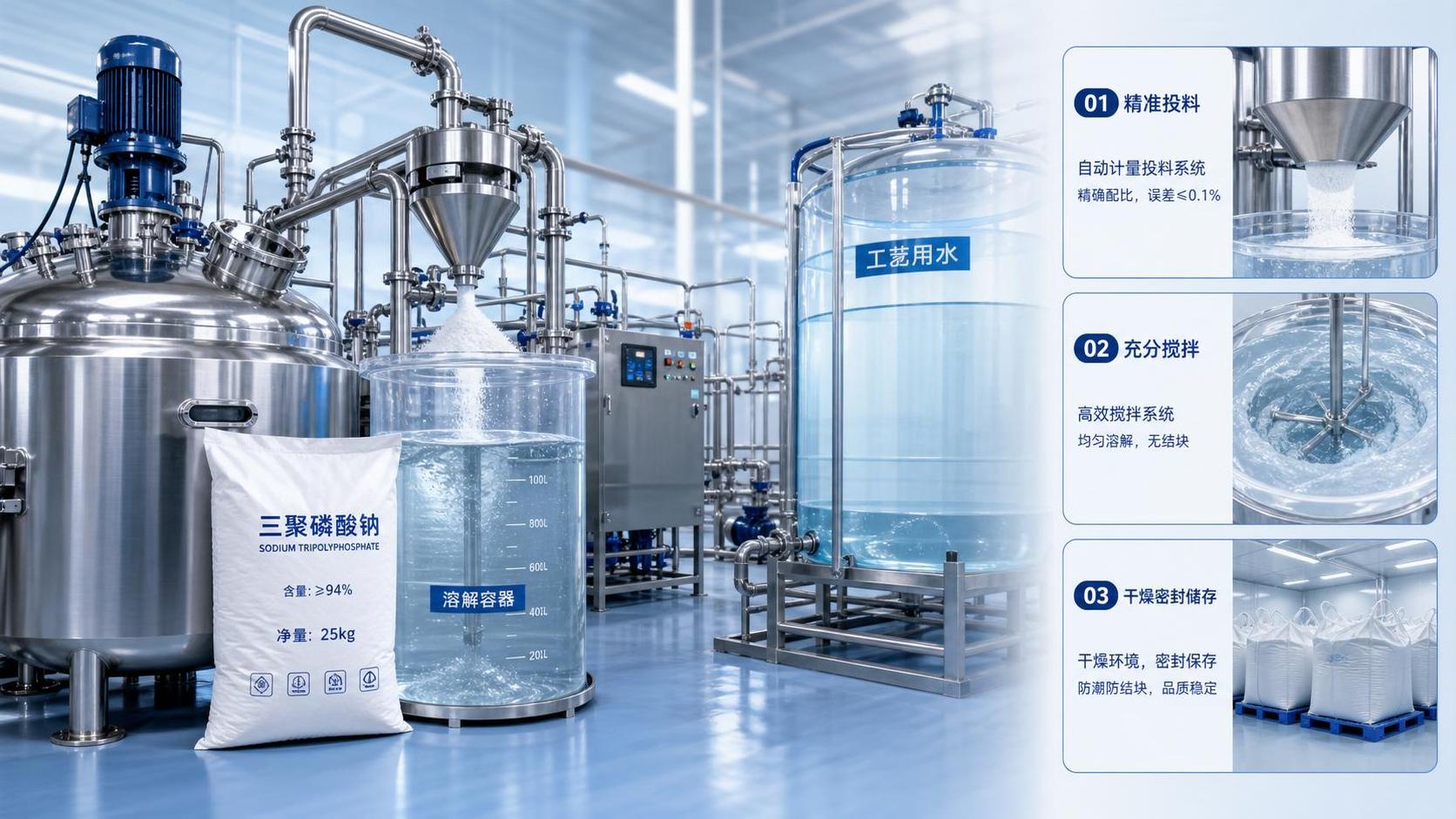
Why does Sodium Tripolyphosphate work well in one batch and disappoint in the next?
Sodium Tripolyphosphate is often chosen for dispersing, chelating, buffering, and improving process stability across several chemical applications.
Yet the material itself is rarely the only reason behind good or poor results.
In daily production, small operating mistakes usually cause the bigger loss.
Typical examples include wrong dilution order, inaccurate dosing, moisture exposure, and using unsuitable water conditions.
That is why Sodium Tripolyphosphate performance should be judged together with storage, mixing discipline, and system cleanliness.
For companies handling broad chemical supply chains, consistency matters as much as price.
Shandong JunTeng Chemical, based in Jinan, supports this need through stable sourcing, verified upstream partners, and dependable logistics.
That background matters because even a capable material cannot compensate for unstable quality or interrupted supply.
Is the most common mistake simply using the wrong dosage?
Very often, yes, but the problem is usually more specific than “too much” or “too little.”
Sodium Tripolyphosphate must match the contamination load, water hardness, formulation balance, and residence time in the system.
Underdosing leaves hardness ions uncontrolled and reduces dispersion efficiency.
Overdosing may shift pH balance, create unnecessary chemical cost, or interfere with downstream process behavior.
A more practical approach is to set a dosage window rather than one fixed number.
- Start with water quality and impurity load.
- Check whether the target is dispersion, sequestration, or cleaning support.
- Measure process response after adjustment, not only input amount.
- Record the best range for repeat batches.
In practice, stable dosing control often improves Sodium Tripolyphosphate performance faster than switching suppliers.
Could mixing order and dissolution time really change the result that much?
They can, and this point is underestimated.
If Sodium Tripolyphosphate is added too quickly, into poor agitation, or into already overloaded slurry, local concentration spikes may occur.
That can reduce uniformity and delay full action in the system.
A common sign is that one tank performs well while another, using the same formula, looks inconsistent.
The reason is often not the formula itself, but the addition sequence.
This is also where routine operating discipline pays back quickly.
What storage mistakes quietly weaken Sodium Tripolyphosphate before it reaches the process?
Moisture is one of the biggest hidden issues.
When Sodium Tripolyphosphate absorbs water during storage, flowability can drop, caking may increase, and dosing becomes less accurate.
Even when chemical activity remains acceptable, handling becomes less predictable.
Another mistake is leaving partially used packaging open near steam, washdown areas, or high-humidity rooms.
That often turns a good product into an unstable one during the final stage of use.
- Store in sealed packaging after each use.
- Separate from direct moisture and condensate points.
- Use first-in, first-out rotation.
- Inspect lumps, flow behavior, and feeding accuracy before charging.
Reliable supply management helps here too, because consistent packaging and timely delivery reduce avoidable warehouse aging.
When performance drops, how do you tell whether the problem is the product or the system?
The fastest answer comes from checking process variables before blaming the material.
Look at water hardness, pH shift, temperature, contamination level, mixing energy, and batch sequence changes.
If those changed recently, Sodium Tripolyphosphate may simply be responding differently under new conditions.
A comparison sample from a stable lot can help confirm this.
Source reliability still matters, especially in industries such as wastewater treatment, detergents, adhesives, and food-related chemical applications.
That is why many operations prefer suppliers with traceable upstream relationships and steady logistics coverage.
In adjacent polymer and adhesive systems, operators sometimes review thermal stability additives at the same time.
For example, Antioxidant JHSANOX-1098 is used in engineering plastics, polyamides, polyesters, and adhesives where low volatility and long-term thermal stabilization are required.
That does not replace Sodium Tripolyphosphate, but it shows how performance troubleshooting often depends on the whole formulation environment.
Which checks should be done before adjusting Sodium Tripolyphosphate again?
A rushed dosage increase is usually the least efficient fix.
It is better to confirm a few operating facts first.
- Has raw water hardness changed from the previous batch?
- Was the addition point moved or mixing time shortened?
- Did stored material absorb moisture or form lumps?
- Has another ingredient changed the pH or ionic balance?
- Is the target actually dispersing, cleaning, or sequestration?
These checks usually reveal whether the next step should be redosing, sequence correction, or storage control improvement.
Where heat-sensitive polymer or adhesive lines are involved, some plants also compare supporting stabilizers such as Antioxidant JHSANOX-1098 to keep oxidation effects from being confused with phosphate performance issues.
What is the practical takeaway if you want better day-to-day results?
Most Sodium Tripolyphosphate failures are preventable.
The usual causes are not dramatic technical flaws, but routine handling mistakes that gradually reduce efficiency.
Better results come from tighter dosage control, cleaner storage, correct mixing order, and faster checking of process variables.
It also helps to document a stable operating window instead of relying on memory from one successful batch.
If you are reviewing Sodium Tripolyphosphate use across multiple applications, the next sensible step is to compare actual dosing records, water conditions, and storage practices side by side.
That gives a clearer basis for improving performance, controlling cost, and keeping supply decisions aligned with real process needs.
Leave A Message
If you are interested in our products and want to know more details, please leave a message here, we will reply you as soon as we can.