





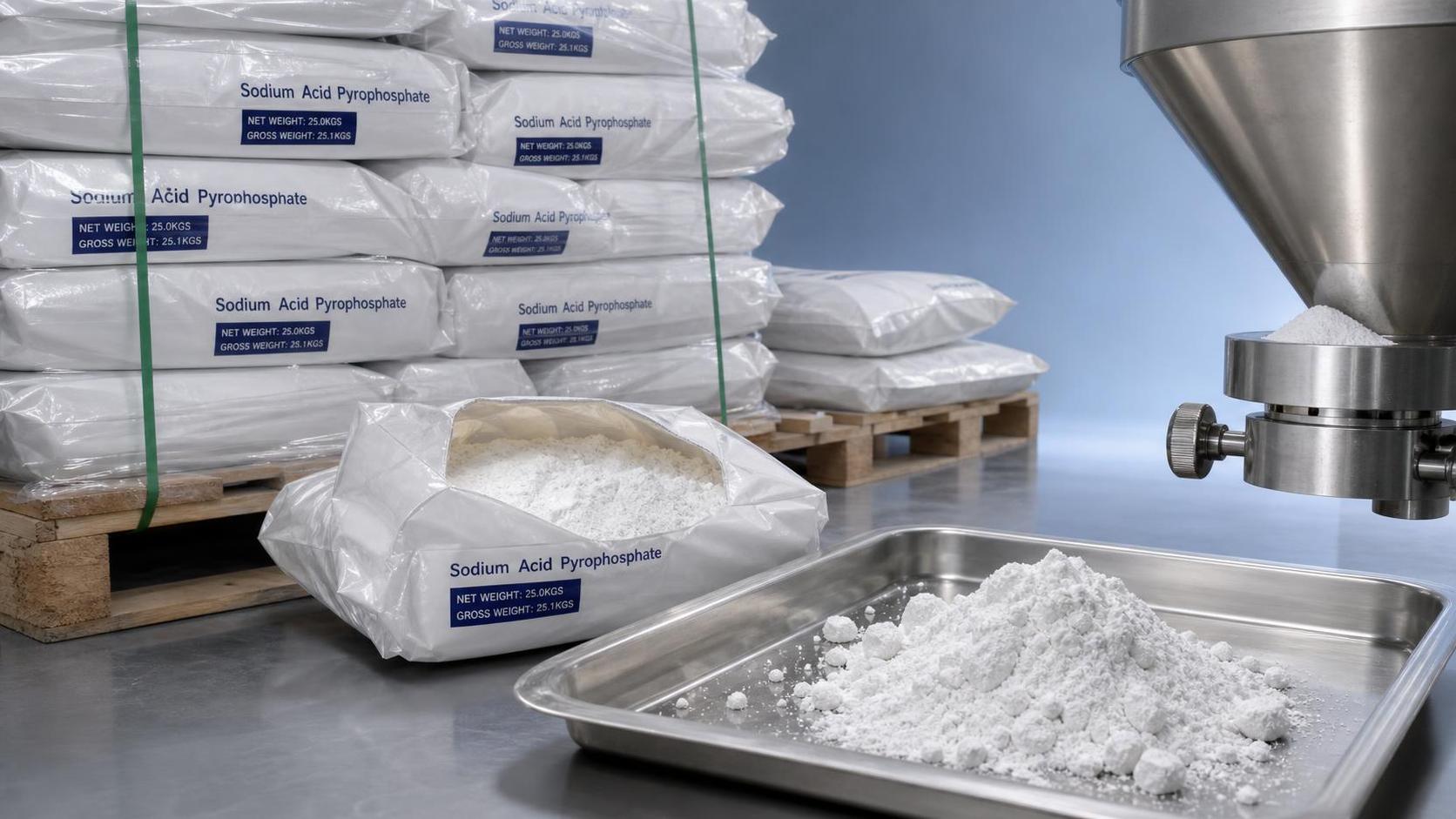
Why does Sodium Acid Pyrophosphate cake in storage at all?
In most plants, caking starts for one simple reason: the powder picks up moisture, then the particles begin to stick together. Sodium Acid Pyrophosphate is not the only powdered chemical that behaves this way, but it can become especially troublesome when bags are opened and closed repeatedly or stored in a humid warehouse. What starts as a free-flowing material can turn into lumps that slow down feeding, make weighing less accurate, and create inconsistency in batching.
Humidity is the main trigger, but it is rarely the only one. Temperature swings, pressure from stacking, damaged packaging, and long storage time often work together. Operators usually notice the problem first at the hopper, screw feeder, or manual dosing station, not when the product is received.
Is moisture always the main cause?
In practice, yes, moisture is usually the starting point. Even when the warehouse does not look damp, air exposure during unloading, sampling, or partial use can be enough. Fine powders have a large surface area, so they absorb moisture from the surrounding air faster than many operators expect.
A common mistake is focusing only on water leaks or wet floors. That misses the real issue. Many caking problems come from ambient humidity, especially in coastal areas, rainy seasons, or storage spaces without steady climate control. Once a small amount of moisture sits on particle surfaces, bridges form between particles and hard lumps follow.
Can temperature changes make caking worse even if the bags stay sealed?
They can. A sealed bag is not perfect protection if it moves between cool and warm environments. Temperature fluctuations can create condensation inside the package or on the inner surface of the liner. Once that happens, the product near the contact area starts compacting first, and the rest may still look normal until the bag is emptied.
This is why product stored near loading doors, exterior walls, or uninsulated roofs often cakes faster than the same material kept in a stable room. The bag may appear intact, but the storage conditions are doing the damage.
Does particle size affect how badly Sodium Acid Pyrophosphate cakes?
Very much. Finer grades generally cake more easily because they expose more surface area to air and moisture. They also pack more tightly under their own weight. If your process uses a fine powder for fast dissolution or better dispersion, that benefit can come with a storage penalty.
Operators sometimes assume all lumps mean poor product quality from the supplier. That is not always correct. Two lots with acceptable quality can behave differently if one has a finer particle distribution and the storage environment is less controlled.
How much does stacking pressure matter?
More than people think. If bags or drums are stacked too high, the material at the bottom carries continuous pressure. Over time, that pressure compresses the powder bed and helps weak particle bridges become hard masses. If moisture is already present, compaction becomes much worse.
This is often why the first few bags taken from the top seem acceptable while the bottom layer feels brick-hard. The storage period may have been the same, but the load was not.
What should operators check first when caking shows up?
Start with the basics before blaming the formulation:
- Look at the package condition: torn liners, poor resealing, punctures, or loose closures.
- Check where the lot was stored: near doors, windows, walls, or hot equipment.
- Review how long the material sat after opening.
- Compare top and bottom bags on the same pallet.
- Notice whether lumps break apart easily or stay hard after moderate force.
Soft, breakable lumps often point to early moisture pickup or mild compaction. Hard, dense blocks usually suggest longer exposure, repeated humidity cycles, or excessive stacking pressure.
When is caked material still usable, and when is it risky?
That depends on what the lumps are like and how the product is used. If the material breaks down cleanly and returns to a consistent powder without visible contamination, some operations can still use it after screening or controlled deagglomeration. But if the lumps are hard, uneven, or contain obvious wet zones, use becomes risky because dosing uniformity is no longer reliable.
This matters most in processes where Sodium Acid Pyrophosphate is metered precisely. Lumps do not flow like the original powder, so feeders may pulse, underfeed, or suddenly dump material. That affects process stability even when the chemistry itself has not changed dramatically.
What storage practices reduce caking in day-to-day operations?
The most effective controls are operational, not complicated:
- Keep unopened material in a dry, temperature-stable area.
- After opening, reseal the inner liner immediately and limit repeated exposure.
- Use partial bags quickly instead of leaving them in routine warehouse circulation.
- Follow a first-in, first-out approach so older stock does not sit under load too long.
- Avoid storing pallets directly against exterior walls or near frequent door openings.
- Do not overstack beyond what the packaging can handle during long storage.
If your site handles both powders and solvents, segregated storage discipline also helps. For example, liquid materials such as Diethylene Glycol Butyl Ether Acetate are typically managed with close attention to sealed containers, water content, and stable warehouse conditions. That same mindset improves results with moisture-sensitive powders.
Are packaging and logistics part of the problem?
Absolutely. A good product can arrive in poor handling condition if the packaging has been stressed during transport, cross-docking, or storage transfer. Torn liners, weak sealing, and long transit in changing weather all raise the chance of caking before the material even reaches the production floor.
This is where a stable supply chain matters. Consistent sourcing, proper packaging control, and timely delivery reduce the amount of time material spends exposed to warehouse turnover and transport variation. For operators, that means fewer surprises at the point of use.
What is the most common operator mistake?
Leaving a partly used bag open longer than necessary is near the top of the list. The second is assuming that if lumps can be broken manually, they will feed normally in equipment. In reality, manual breakup does not restore the original flow behavior. Material that seems acceptable on a bench can still bridge in a hopper or feed unevenly through an auger.
A better approach is to treat caking as an early storage control signal. Check the package, review the location, isolate badly affected material, and correct the handling routine before the next lot is opened.
A practical rule for deciding what to do next
If Sodium Acid Pyrophosphate shows light, friable caking, review storage exposure and correct the handling path immediately. If it shows hard lumps, wet spots, or unstable feeding behavior, stop treating it as a simple housekeeping issue. At that point, the right move is to inspect the packaging, separate the affected stock, and evaluate suitability based on flow and dosing performance, not appearance alone.
Leave A Message
If you are interested in our products and want to know more details, please leave a message here, we will reply you as soon as we can.