





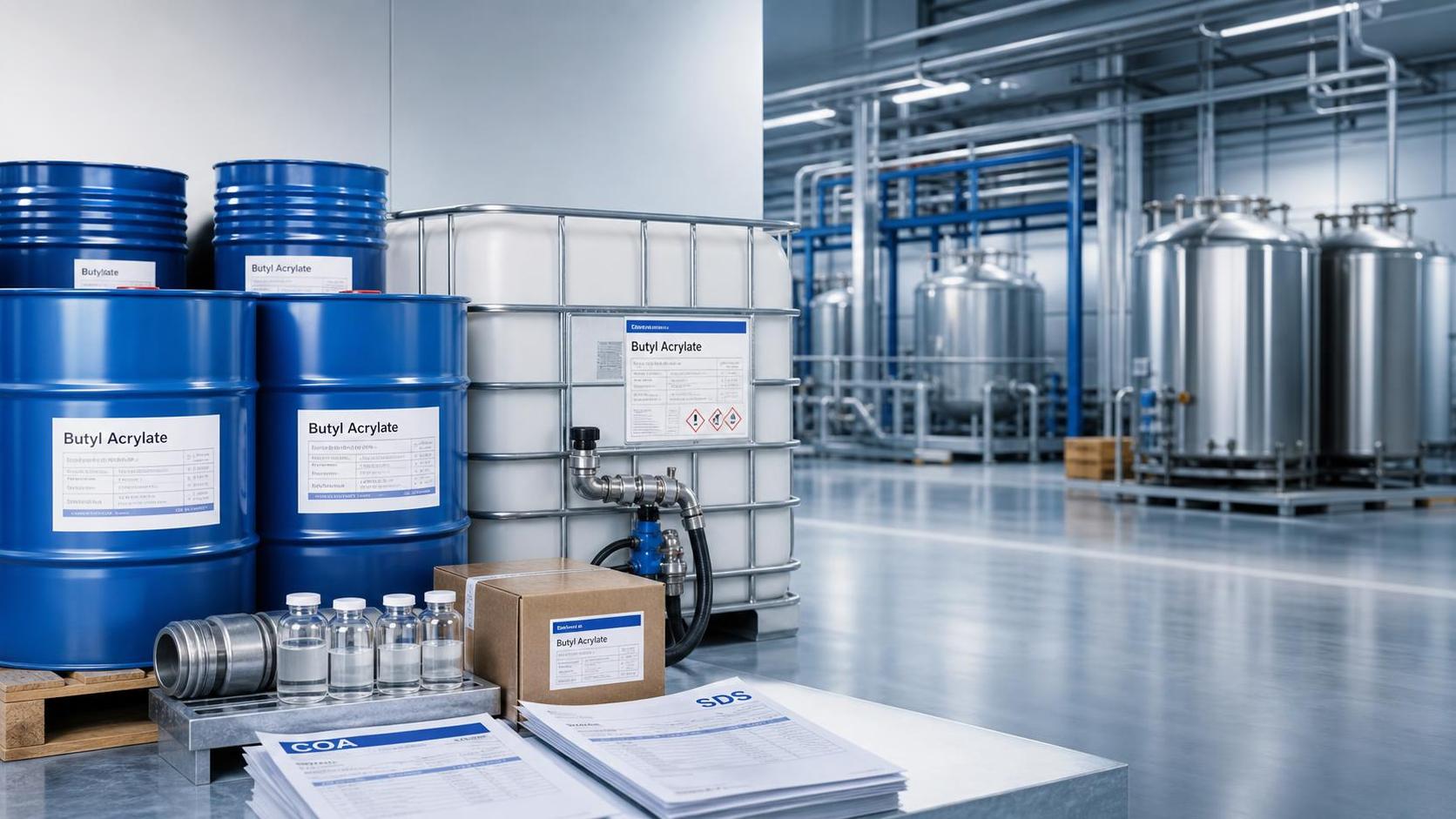
Start with batch consistency, not the offer sheet
Price still matters, but for a business evaluator comparing a Butyl Acrylate manufacturer, it should not be the first screen. The real question is whether the supplier can deliver the same material profile, on the same schedule, under the same documentation standard, every time your plant needs it. A cheap batch that forces reformulation, delays unloading, or triggers a quality complaint is not cheap anymore.
A reliable source usually shows its strength in ordinary transactions, not in sales language. You can tell a lot by how they handle specifications, shipment planning, source transparency, and problem response before the first contract is signed.
What to check before shortlisting a supplier
- Ask for the current product specification and recent COA format. Do not stop at a generic datasheet. You want to see how the manufacturer reports actual batch values, not just standard limits. If the documentation is vague or overly simplified, it becomes harder to control incoming quality and easier for disputes to drag on.
- Check whether the source is direct or layered through multiple traders. A supplier with stable upstream relationships can usually explain where the material comes from, how supply is allocated, and what happens when one source tightens output. That matters more than many buyers admit, especially when feedstock pressure or logistics disruption hits the market.
- Look at delivery reliability as a system, not a promise. A dependable Butyl Acrylate manufacturer or supply partner should be able to discuss lead time, packaging options, loading arrangements, and how they manage urgent replenishment. If the answer is just “we can deliver fast,” keep asking.
- See how they respond to technical questions. When your team asks about storage, transport conditions, documentation, or application sensitivity, the reply should be specific and usable. Slow or evasive answers usually show up again later in claims handling.
A practical evaluation sequence
In real procurement work, the safest path is to narrow the list by operational risk. This is the order many buyers use because it exposes weak suppliers quickly.
- Confirm whether the supplier can support your required volume and shipment rhythm.
- Review specification control and batch documentation.
- Verify source stability and upstream cooperation depth.
- Check logistics readiness, including packaging and delivery windows.
- Discuss issue handling: off-spec material, delayed cargo, document mismatch, or replacement timing.
- Only after that, compare commercial terms.
This order prevents a common mistake: choosing the lowest quote first, then discovering the supplier cannot support stable replenishment or consistent paperwork.
Source control is often the real differentiator
For many chemical buyers, the strongest signal is not marketing scale but supply chain control. Companies that work through a complete supply management system, maintain long-term relationships with recognized upstream enterprises, and coordinate logistics closely tend to be more predictable under pressure. That predictability matters when your own production schedule leaves little room for inventory risk.
In practice, this means asking where the material sits in the chain and who is accountable when something goes wrong. A supplier with established relationships across major domestic and international chemical producers is usually in a better position to secure genuine product, maintain steady availability, and respond faster when market conditions tighten.
Do not ignore documentation discipline
Reliable manufacturers and supply partners are usually disciplined on documents because they know procurement does not end at the truck gate. The review should cover:
A surprising number of supply problems begin as paperwork problems. Once lot numbers, packaging counts, or technical descriptions stop matching, operational friction follows.
Use adjacent product handling as a signal
Sometimes the best way to judge a supplier is to see how they manage other industrial chemicals with stricter application demands. If a company can clearly present materials with defined technical parameters, packaging formats, and end-use logic, that usually says something useful about internal product control.
For example, a supplier offering Tris(1,3-Dichloropropyl)Phosphate (TDCP) and presenting it with concrete details such as appearance, viscosity at 25°C, water content, packaging in 300KG drums or 1500KG IBCs, and application relevance in building materials or electronic encapsulation, is showing the kind of documentation discipline buyers usually want to see across the portfolio. It does not prove Butyl Acrylate performance by itself, but it is a useful signal when comparing supply partners.
Common mistakes during supplier evaluation
One is treating all Butyl Acrylate suppliers as interchangeable once the headline specification looks acceptable. They are not. Some are strong on price but weak on replenishment stability. Others can deliver, but only with inconsistent document support. Another frequent mistake is skipping the discussion around problem handling. Ask what happens if the delivered batch is questioned, who reviews the issue, and how quickly replacement or clarification is arranged. You are not being difficult; you are testing whether the supplier has a workable process.
It is also worth checking whether the supplier serves multiple downstream sectors such as adhesives, petrochemicals, pharmaceuticals, plastics, rubber, or construction-related chemical applications. Broad industry coverage does not automatically make a company better, but it often indicates more mature coordination across product sourcing, logistics, and customer requirements.
What a strong final candidate usually looks like
By the time you finish evaluation, the most credible option is usually the supplier that can do four things without hesitation: provide stable quality from the source, explain supply continuity under changing conditions, support timely delivery through an organized logistics network, and handle documents and communication cleanly. That is what separates a usable long-term partner from a name on a quotation list.
If you are building a shortlist, start with source control and batch documentation, then test delivery execution, then compare terms. That sequence gives you a procurement decision you can defend internally, not just a price you can approve quickly.
Leave A Message
If you are interested in our products and want to know more details, please leave a message here, we will reply you as soon as we can.