





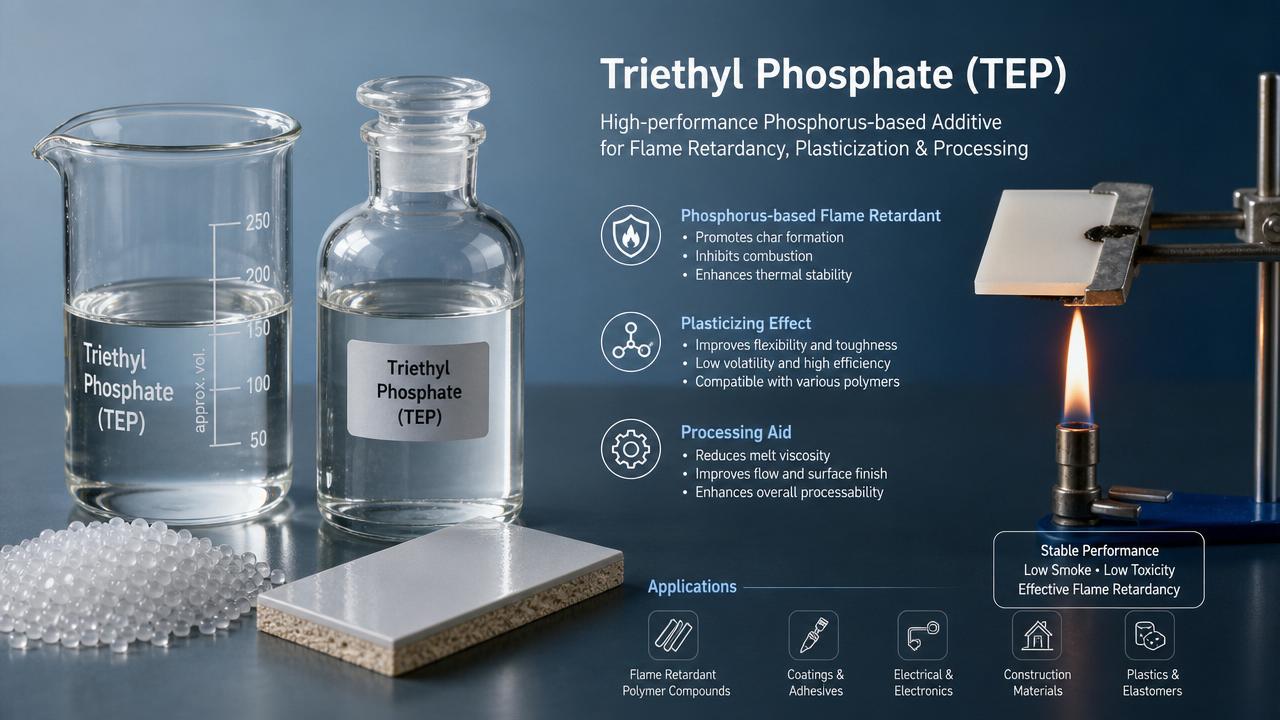
Triethyl Phosphate is widely chosen in flame-retardant formulations because it does more than add phosphorus to a system. It can help improve flame resistance, support processing, reduce brittleness, and work as a plasticizing component in selected materials.
For researchers, sourcing teams, and technical buyers, the real question is not only what Triethyl Phosphate is, but why formulators prefer it in certain plastics, coatings, and industrial blends. The answer depends on performance targets, compatibility, regulatory needs, and supply consistency.
What Is Triethyl Phosphate?
Triethyl Phosphate, often abbreviated as TEP, is an organophosphorus compound with the molecular formula C6H15O4P. It is typically a colorless liquid and is used in several industrial applications where solvency, plasticization, or flame-retardant contribution is needed.
In commercial practice, Triethyl Phosphate is valued less as a simple laboratory chemical and more as a functional additive. It appears in flame-retardant systems, resin processing, coatings, and specialty formulations that need a balance between performance and manufacturability.
Why Is Triethyl Phosphate Used in Flame-Retardant Formulations?
The main reason Triethyl Phosphate is used in flame-retardant formulations is that phosphorus-containing compounds can help reduce flammability. In many systems, phosphorus contributes to char formation or interferes with combustion processes, which helps slow flame spread.
However, its value is not limited to fire performance alone. Triethyl Phosphate can also act as a plasticizer or processing aid in some formulations. That means it may improve flexibility, reduce viscosity, or make it easier to handle and incorporate into production systems.
This dual function matters to formulators. Instead of selecting one additive for flame retardancy and another for processing, they may use Triethyl Phosphate where both effects are desirable. That can simplify formulation design and improve cost-performance balance in some applications.
How Does It Improve Fire Performance?
Triethyl Phosphate is commonly selected because phosphorus chemistry can support flame inhibition in condensed or gas-phase mechanisms, depending on the formulation. In practical terms, it helps materials resist ignition more effectively or burn less aggressively once exposed to heat.
Its exact contribution depends on the polymer matrix, loading level, and the presence of synergists such as halogen-free additives, metal hydroxides, or nitrogen-based flame-retardant components. For this reason, formulators usually evaluate TEP as part of a complete system rather than as a stand-alone answer.
Buyers should note that no flame-retardant additive performs identically across all materials. A formulation used in plastics may behave differently in coatings, adhesives, or textile treatments. The suitability of Triethyl Phosphate must therefore be judged through compatibility and performance testing.
What Practical Advantages Do Formulators Look For?
From an application standpoint, Triethyl Phosphate is often chosen for its practical formulation benefits. It can support easier blending, help maintain workable viscosity, and contribute to improved flow during manufacturing, especially where liquid additives are preferred.
Another advantage is that liquid phosphorus-based additives can sometimes be easier to meter and distribute uniformly than some solid flame-retardant materials. Better dispersion may improve consistency in finished products and reduce processing variation between batches.
In some formulations, Triethyl Phosphate can also help reduce brittleness compared with more heavily filled flame-retardant systems. This is especially relevant where the final product must maintain mechanical performance alongside fire safety targets.
Which Industries Commonly Use Triethyl Phosphate?
Triethyl Phosphate is relevant in plastics and rubber processing, coatings, resins, adhesives, and some specialty chemical systems. It is particularly useful where manufacturers need a combination of fire performance and process efficiency rather than only one isolated property.
In plastics, it may be used in systems where flexibility and flame retardancy must be balanced. In coatings, it may contribute to functional performance while fitting into a liquid formulation process. In specialty chemicals, it can serve as a useful intermediate or auxiliary component.
For companies operating across chemical supply chains, it is common to evaluate Triethyl Phosphate alongside other industrial additives. For example, buyers in broader formulation sectors may also source products such as Sodium Hexametaphosphate(SHMP) for water treatment, detergents, coatings, or process support applications.
What Do Buyers and Researchers Need to Evaluate Before Choosing It?
The first issue is compatibility. Triethyl Phosphate must work with the target resin, solvent system, additive package, and end-use requirements. Poor compatibility can lead to migration, instability, reduced effectiveness, or unacceptable physical properties in the finished material.
The second issue is performance under real conditions. Lab screening should verify flame-retardant effect, processing behavior, volatility profile, and influence on mechanical properties. A product that looks promising on paper may not meet practical manufacturing or compliance requirements.
Third, researchers should review environmental, health, and regulatory considerations in the destination market. Depending on the application, this may include transportation, storage, worker handling, and customer-specific standards for industrial chemicals used in production.
Finally, stable supply matters. For industrial users, additive performance is only valuable when quality is consistent and delivery is reliable. Variations in purity, moisture, or source quality can affect formulation reproducibility and downstream production efficiency.
How Does Triethyl Phosphate Compare with Other Flame-Retardant Options?
Triethyl Phosphate is not always the strongest flame retardant by itself, and that is an important point for decision-makers. In many cases, it is selected because it offers a useful balance of flame-retardant contribution, liquid handling convenience, and formulation flexibility.
Compared with heavily loaded mineral flame retardants, it may offer easier processing and lower impact on density or viscosity. Compared with some specialty phosphorus additives, it may be attractive where moderate performance and practical processing are the priority.
The right comparison is therefore application-specific. Buyers should ask whether they need maximum flame-retardant efficiency, easier processing, halogen-free positioning, cost control, or a combination of these goals. Triethyl Phosphate is often chosen when balanced performance is more important than extreme performance in one area.
What Supply Factors Matter in Commercial Procurement?
For sourcing teams, procurement decisions go beyond chemical identity. They typically include supplier credibility, upstream resource stability, logistics responsiveness, documentation support, and the ability to maintain consistent product quality over long purchasing cycles.
Shandong JunTeng Chemical Co., Ltd., based in Jinan, Shandong Province, operates with extensive experience in chemical trading and one-stop procurement support. With established cooperation across well-known domestic and international enterprises, the company emphasizes stable quality, sufficient supply, and timely delivery.
This matters when buyers are comparing industrial additives such as Triethyl Phosphate across multiple vendors. Reliable sourcing reduces risks related to production interruption, inconsistent batches, and delayed shipments, all of which can affect formulation approval and customer fulfillment.
When Is Triethyl Phosphate a Good Fit?
Triethyl Phosphate is a good fit when a formulator needs a phosphorus-containing additive that can support flame-retardant performance while also helping with plasticization or processing. It is especially relevant in systems where liquid handling and balanced formulation behavior are important.
It may be less suitable when a product requires very high flame-retardant efficiency from a single additive, very low volatility for a specific end use, or a different regulatory profile. In those cases, alternative phosphorus compounds or synergistic packages may be preferable.
That is why buyers should treat Triethyl Phosphate as a formulation tool rather than a universal solution. Its value becomes clear when assessed against the exact resin, process, fire standard, and cost target involved.
Conclusion
Triethyl Phosphate is used in flame-retardant formulations because it helps improve fire resistance while also offering practical benefits such as plasticization, easier processing, and good formulation flexibility. These combined advantages explain why it remains relevant across several industrial applications.
For information researchers and technical buyers, the key takeaway is simple: Triethyl Phosphate is often selected not just for what it is, but for the balance it offers between safety performance, processability, and commercial practicality. The best choice still depends on application testing, regulatory review, and dependable supply.
Leave A Message
If you are interested in our products and want to know more details, please leave a message here, we will reply you as soon as we can.