





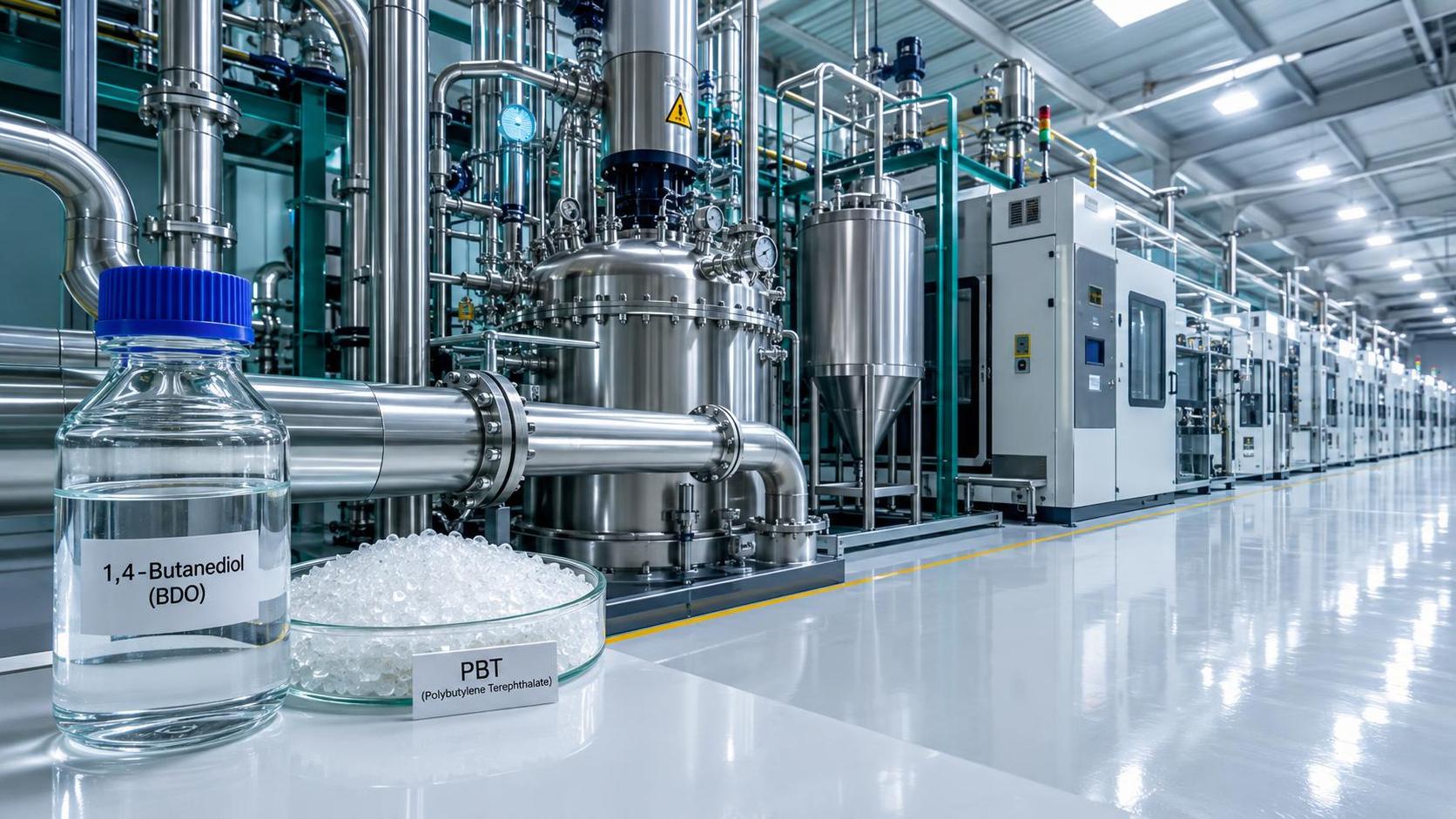
Where BDO Sits in the Polymer Value Chain
For an engineering plastics project, 1,4-Butanediol (BDO) matters most when the selected material family depends on it as a structural building block rather than as a minor formulation additive. Its importance is especially clear in polybutylene terephthalate (PBT), tetrahydrofuran (THF) production, and several polyurethane systems. In each route, the quality, consistency, and availability of BDO can influence polymer properties well beyond the purchase price of the intermediate itself.
A project team does not need to treat BDO as a generic commodity simply because it is bought in bulk. The relevant question is whether variations in feedstock quality, water content, trace impurities, delivery continuity, or handling conditions can affect the polymerization process and the final material specification. Where the answer is yes, BDO should be included in early material qualification and supply planning rather than being addressed only by procurement after process design is complete.
PBT: the most direct engineering-plastics connection
PBT is one of the clearest examples of where BDO fits in engineering plastics. It is produced through polycondensation involving terephthalic acid or related ester feedstocks and 1,4-Butanediol. The resulting polyester is widely selected where designers need a balance of mechanical strength, dimensional stability, electrical performance, chemical resistance, and practical molding behavior.
For project managers, the relevance is not limited to the PBT resin price. BDO participates directly in determining whether polymer production can run consistently toward the intended molecular-weight range and downstream processing window. Variations in raw-material quality can complicate reaction control, contribute to off-specification batches, or require adjustment of operating conditions. Those adjustments may later show up as changes in viscosity, molding performance, surface finish, or part consistency.
This is particularly important when PBT will be used in applications with narrow functional tolerances, such as electrical connectors, automotive components, housings, precision molded parts, or assemblies exposed to heat and moisture. The polymer producer is responsible for the final resin specification, but the project owner should understand that the reliability of upstream diol supply is part of the material-risk picture.
When reviewing a PBT supply route, teams should ask practical questions:
- Is the BDO source qualified for the polymer grade and process conditions being used?
- Are incoming quality controls designed around the impurities that matter to the reaction, rather than only basic identity testing?
- Can the supplier maintain the same grade and source over the project life, or may supply be switched without a formal requalification process?
- What happens to production scheduling if a shipment is delayed, rejected, or replaced with material from another origin?
These questions are often more useful than trying to predict short-term feedstock price movements. A low-cost BDO shipment that introduces process instability can carry a much higher total cost than a stable source with clear batch documentation and predictable logistics.
THF and PTMEG: BDO's route into flexible polymer systems
BDO also has an important role through its conversion to tetrahydrofuran. THF is an intermediate used to produce polytetramethylene ether glycol (PTMEG), a polyether polyol used in elastomeric materials. PTMEG is associated with polyurethane elastomers, thermoplastic polyurethane grades, and other systems where flexibility, abrasion resistance, resilience, or low-temperature performance are central to the application.
This route changes the project discussion. In PBT, BDO is associated with a rigid engineering thermoplastic. Through THF and PTMEG, it becomes part of a chain leading to more flexible, high-performance polymer systems. A team specifying cable components, industrial rollers, seals, footwear materials, flexible automotive parts, or abrasion-resistant elastomeric products may therefore encounter BDO indirectly even when it is not listed on the final bill of materials.
That indirect position can obscure supply exposure. A polyurethane processor may purchase PTMEG or a finished TPU compound and assume that upstream BDO availability has little relevance to the project. It becomes relevant when upstream constraints affect lead time, allocation, qualification choices, or the continuity of a material grade. For long-running programs, the procurement and technical teams should map the critical intermediates behind materials that are difficult to substitute.
Polyurethane uses require more than a simple “chain extender” decision
In polyurethane chemistry, BDO is commonly used as a chain extender. It reacts with isocyanate-functional prepolymers and helps build the hard-segment structure of the final polyurethane. Its selection can influence hardness, tensile behavior, heat resistance, phase separation, and processing characteristics, although the final result always depends on the full formulation: isocyanate type, polyol chemistry, catalyst package, ratio control, mixing conditions, and cure profile all matter.
It would be misleading to assume that BDO automatically improves every polyurethane formulation. Its suitability depends on the intended balance between rigidity and elasticity, the process equipment, the reaction rate that can be managed safely, and the finished-part requirements. A formulation designed for a high-performance elastomer may use BDO for a specific structural purpose; a foam, coating, adhesive, or lower-modulus system may call for a different approach.
For engineering leaders, this is a formulation-control issue as much as a sourcing issue. If BDO is changed because of supply pressure, a paper comparison of assay values alone may not be sufficient. The change-control review should consider water content, impurity profile, physical handling behavior, storage history, and whether the alternative material has been tested under the actual production cycle. In reactive systems, a modest upstream variation can affect pot life, viscosity rise, cure response, or final physical properties.
What to control before BDO reaches the reactor
BDO is a reactive diol, and its management should be aligned with the sensitivity of the downstream process. The most useful controls are usually straightforward, but they need to be defined before plant start-up or supplier qualification becomes urgent.
Water control deserves particular attention. In polyester and polyurethane production, moisture is not a cosmetic quality issue. It can affect reaction behavior, molecular-weight control, by-product formation, and the predictability of the manufacturing window. The acceptable limit should be defined by the process owner and final material requirements rather than copied from a general trading specification.
Packaging also needs to match consumption volume and site handling capability. Drum supply may suit pilot production, laboratory work, or lower-volume specialty formulations. IBC or bulk delivery can be more appropriate for repeat manufacturing, provided that unloading, storage, nitrogen protection where required, cleaning procedures, and inventory turnover are managed properly. The preferred format is operationally specific; larger packaging is not inherently safer or more economical if it raises contamination risk or leaves material in storage too long.
Separating a critical intermediate from adjacent chemical purchases
Projects in plastics and rubber often source several alcohol-based intermediates at the same time, but their roles should not be blurred. For example, Isooctyl alcohol is commonly associated with plasticizer, surfactant, coating, lubricant, and specialty-chemical applications. It may be relevant to the broader procurement portfolio of a plastics operation, yet it does not replace BDO in PBT production or in BDO-based polyurethane chain extension.
This distinction matters during cost-reduction programs. Chemicals can share a supplier category, packaging format, or broad description as alcohol intermediates while serving entirely different functions in a polymer system. Substitution decisions should therefore begin with reaction chemistry and material-performance requirements, then proceed to commercial comparison. Treating functionally different intermediates as interchangeable because they sit in the same purchasing category can create avoidable technical risk.
A practical decision framework for project teams
BDO deserves focused attention when the project depends on PBT, THF-derived PTMEG, or polyurethane structures where it is chemically active in the final material pathway. It deserves less attention when it is only a distant input to a broadly available, fully qualified resin with multiple approved sources. The level of management should reflect that difference.
Before finalizing a material route, project teams should identify whether BDO is a direct production input, an upstream dependency behind a selected resin, or merely an adjacent chemical in the same sourcing program. From there, the useful work is to define the required specification, establish source and batch controls, test any proposed change under production-relevant conditions, and align inventory planning with the consequences of interruption.
That approach keeps BDO in its proper place: not as an abstract chemical feedstock, but as a material-control point that can influence polymer performance, manufacturing stability, and the ability to deliver a qualified engineering product on schedule.
Leave A Message
If you are interested in our products and want to know more details, please leave a message here, we will reply you as soon as we can.