





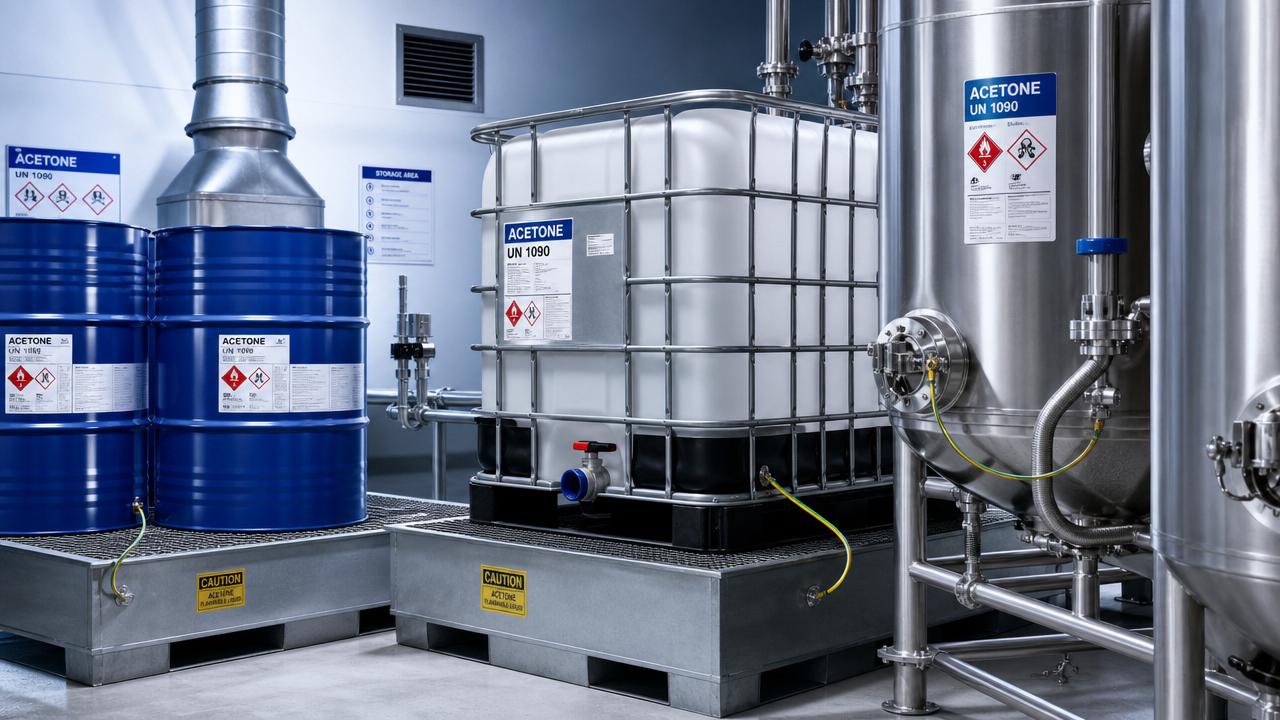
Acetone Packaging Choices Affect Loss and Compliance
In chemical procurement, Acetone packaging is more than a purchasing detail.
It directly affects evaporation loss, handling safety, regulatory compliance, and total project cost.
The wrong drum, IBC, or bulk delivery choice can create leakage risks, documentation gaps, delayed acceptance, and avoidable waste.
This article explains how Acetone packaging decisions influence storage, transport, and compliance performance.
Why does Acetone packaging affect actual product loss?
Acetone is a highly volatile solvent with a low boiling point and fast evaporation behavior.
Even small sealing defects can cause measurable loss during storage, transfer, or long-distance transport.
Packaging selection must consider vapor tightness, closure quality, gasket compatibility, and filling accuracy.
Steel drums are common for smaller Acetone orders and flexible site allocation.
However, repeated opening increases vapor release and contamination risk.
IBC packaging improves handling efficiency, but the valve and cap system require strict inspection.
Bulk Acetone delivery reduces unit packaging waste but needs qualified tanks and receiving systems.
- Check whether seals remain intact after loading and unloading.
- Confirm the container is suitable for flammable liquid transport.
- Avoid unnecessary repacking before production use.
- Control storage temperature and ventilation conditions.
Which Acetone packaging option fits different operating scenarios?
The best Acetone packaging choice depends on consumption rate, receiving equipment, storage layout, and compliance capability.
A low-volume laboratory may prefer drums because batch traceability is simple.
A continuous coating, adhesive, or pharmaceutical process may benefit from IBC or bulk supply.
Acetone drums provide flexibility when different production lines need separated inventory.
They also help isolate quality concerns to smaller batches.
IBCs reduce manual handling and support faster transfer into process tanks.
Bulk delivery is suitable when usage is predictable and unloading systems meet safety standards.
How does Acetone packaging influence compliance?
Acetone is classified as a flammable liquid, so packaging must support transport and site compliance.
A compliant container is only one part of the requirement.
Labels, safety data sheets, batch records, transport documents, and emergency information must align.
Incomplete documentation can delay warehouse acceptance, customs inspection, or internal safety review.
This risk becomes more serious when Acetone shipments cross regions with different dangerous goods rules.
Packaging markings should clearly match the order, product identity, net weight, and hazard classification.
Packaging decisions also affect fire control planning.
Large Acetone volumes may require explosion-proof ventilation, bonding, grounding, and dedicated containment.
Smaller drums reduce single-container volume but increase handling points and label management work.
What hidden costs appear when Acetone packaging is poorly matched?
The lowest packaging quote may not create the lowest total cost.
Acetone loss, rejected deliveries, damaged containers, and emergency repacking can quickly offset price savings.
Manual drum handling may require more labor, lifting equipment, and storage supervision.
IBCs may reduce labor but occupy more planned floor space.
Bulk Acetone supply can improve efficiency but needs investment in tanks, pumps, pipelines, and safety devices.
The practical choice balances product value, risk control, delivery frequency, and site readiness.
- Evaporation loss during waiting, unloading, or partial use.
- Extra inspection time caused by unclear markings.
- Waste disposal fees for contaminated or damaged packaging.
- Production delays from nonconforming delivery conditions.
How should suppliers support safer Acetone procurement?
Reliable Acetone supply depends on more than inventory availability.
Supplier capability should cover source control, packaging inspection, logistics coordination, and compliant paperwork.
Stable supplier relationships reduce quality fluctuation and improve shipment predictability.
Shandong JunTeng Chemical Co., Ltd. operates from Jinan, Shandong Province.
With ten years in chemical trading, the company provides one-stop chemical procurement solutions.
Its supply chain system supports stable quality, sufficient supply, and timely delivery.
JunTeng Chemical cooperates with well-known domestic and international enterprises.
These relationships help secure genuine products, source traceability, and dependable logistics performance.
The same packaging discipline applies across solvents, acids, additives, and specialty chemicals.
For example, Formic acid 85%/90%/94%/99% requires suitable PE drums, IBCs, or ISO tanks.
Its corrosive nature differs from Acetone, but packaging compatibility and documentation remain equally important.
What questions should be checked before confirming Acetone packaging?
A short packaging review can prevent many Acetone delivery problems.
The review should connect technical demand with transport, storage, and receiving conditions.
Is bulk Acetone always the best option?
No. Bulk Acetone works best when demand is stable and the site has qualified receiving infrastructure.
Without proper tanks and controls, bulk delivery may increase compliance and safety pressure.
Can packaging choice improve delivery reliability?
Yes. Standardized Acetone packaging simplifies loading, inspection, stock rotation, and emergency response.
It also helps logistics teams schedule vehicles and prepare compliant transport documents.
Conclusion: choose Acetone packaging as a risk-control decision
Acetone packaging affects loss control, operational safety, regulatory acceptance, and total procurement cost.
Drums, IBCs, and bulk tanks each have clear advantages and limitations.
The right decision starts with consumption rate, storage conditions, transport rules, and site readiness.
Before confirming an Acetone order, review packaging compatibility, documentation, unloading conditions, and emergency planning.
Working with an experienced chemical supplier can reduce avoidable loss and support safer, more predictable delivery.
Leave A Message
If you are interested in our products and want to know more details, please leave a message here, we will reply you as soon as we can.