





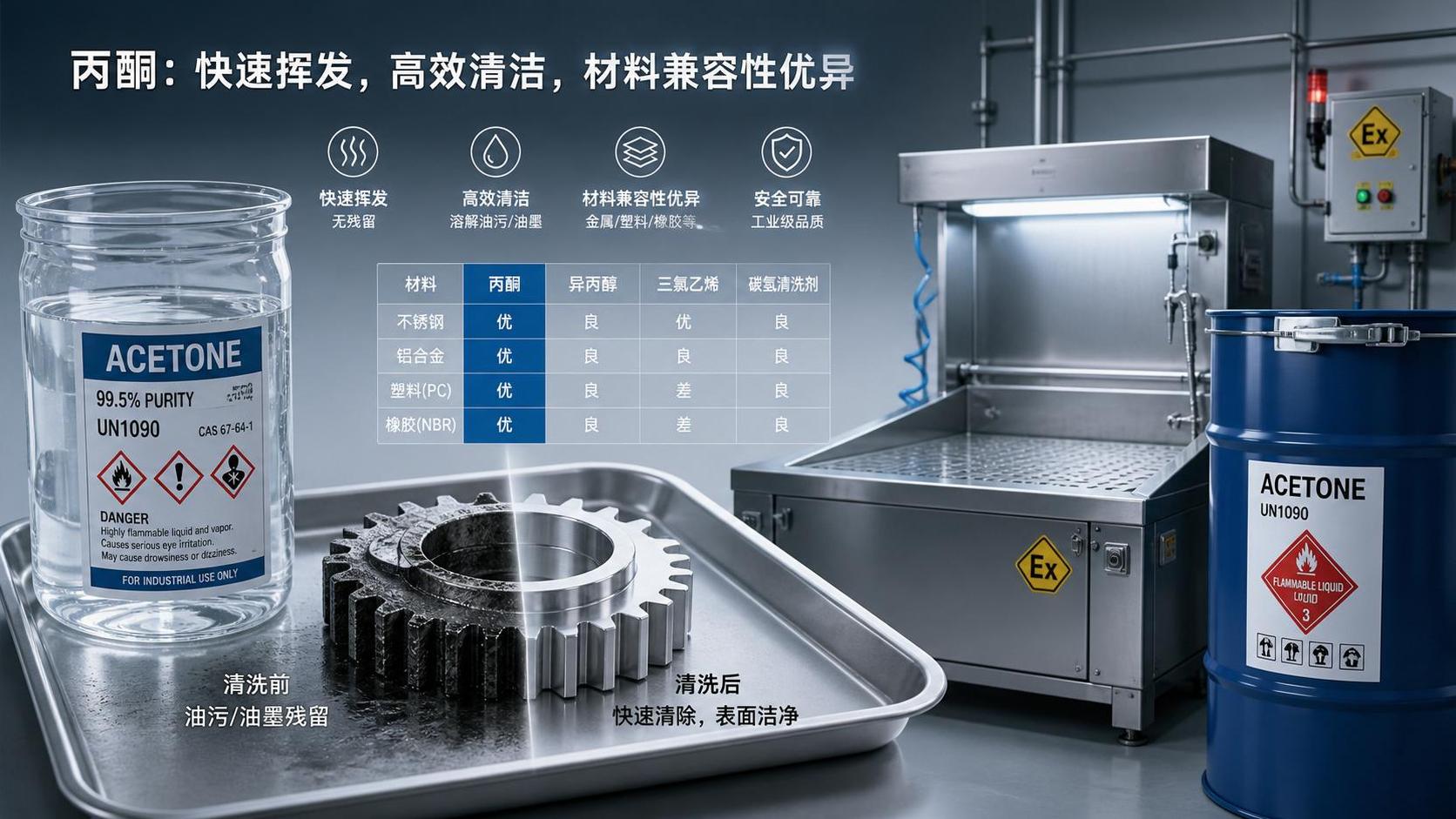
Why Acetone Stays Popular in Industrial Cleaning
Acetone remains one of the fastest solvents for industrial cleaning. It dissolves oils, light greases, inks, and many residues in very little time.
That speed matters when production downtime is expensive. In actual use, though, fast cleaning is only one part of the decision.
Acetone also brings volatility, flammability, and compatibility limits. A surface that cleans well in one workshop may be damaged or exposed to risk in another.
For companies handling chemicals across pharmaceuticals, petrochemicals, adhesives, plastics, and construction materials, the practical question is not whether acetone works. The real question is where it works best, and under what controls.
With stable upstream resources and coordinated logistics, Shandong JunTeng Chemical often supports supply decisions where cleaning performance, delivery reliability, and consistent product quality must be considered together rather than separately.
Different Cleaning Jobs Create Different Demands
Acetone is often discussed as a general-purpose solvent, but field conditions change the outcome. Residue type, drying speed, substrate sensitivity, and ventilation all shift the judgment.
A metal component before coating needs something different from a printing line roller. A tank exterior in maintenance work creates different priorities than a precision assembly area.
More often, the right evaluation starts with three questions: what must be removed, what must remain undamaged, and what operational risk can the site manage.
When rapid evaporation is an advantage
Acetone performs well where surfaces need to dry quickly before the next process step. This is common in metal preparation, tool cleaning, and adhesive line changeovers.
In these settings, quick flash-off can reduce waiting time. It can also lower the chance of residue remaining under a coating or bond line.
When that same speed becomes a limitation
On large surfaces or intricate parts, acetone may evaporate before contamination is fully lifted. The result is streaking, redeposition, or repeated wiping that increases solvent use.
This is why cleaning efficiency should be judged by total process stability, not by initial dissolution speed alone.
Where Acetone Fits Best in Daily Operations
In production environments, acetone usually earns its place in short-cycle cleaning tasks. It is especially useful when oily films, ink traces, or uncured adhesive residues must be removed fast.
Metal surfaces before coating or bonding
For steel fixtures, fabricated parts, and equipment housings, acetone can remove fingerprints, machining oils, and light organic residues effectively.
The key point is surface condition after cleaning. If the next step is anti-corrosion coating or adhesive bonding, even small leftover contaminants matter.
In coating systems used for aggressive environments, cleaning quality influences long-term durability. That is also why some formulations linked to marine coatings, chemical equipment protection, and concrete protection use materials such as CR-10, where substrate cleanliness supports coating adhesion and barrier performance.
Printing, ink, and adhesive process cleanup
Acetone is also common around inks and adhesive systems because it breaks down many fresh residues quickly. On short stoppages, that can keep equipment from hardening up between runs.
Still, timing matters. Once residues are partly cured, acetone may need mechanical assistance or repeated application, which changes both labor time and safety exposure.
The Same Solvent Is Not Equally Safe on Every Material
Material compatibility is where many acetone decisions go wrong. Metals often tolerate it well, but plastics, painted surfaces, seals, and composite parts may not.
This difference is especially important when one site handles metals, elastomers, packaging materials, and coated assemblies in the same process chain.
Common Misjudgments Before Acetone Is Put Into Routine Use
One frequent mistake is choosing acetone only because it cleans fast in a bench test. A small test rarely reflects continuous use, ventilation patterns, or operator handling speed.
Another is focusing on solvent price while ignoring total use rate. If evaporation is too fast for the task, real consumption can be higher than expected.
A third issue is treating similar residues as identical. Fresh adhesive, aged adhesive, and thermally exposed adhesive may respond very differently to acetone.
- Do not skip compatibility checks on seals, plastics, and coated parts.
- Do not assume quick drying always improves throughput.
- Do not separate cleaning performance from storage and transport reliability.
How to Judge Fit Before Expanding Use
A practical evaluation of acetone should stay close to the real application. Lab cleanliness, line cleanliness, and maintenance cleanliness are not the same thing.
Start by mapping residue type, substrate, contact time, and drying window. Then compare those conditions against safety controls, storage turnover, and delivery consistency.
For sites that also work with coating and protection systems, related material performance may shape solvent decisions indirectly. For example, chlorinated rubber materials such as CR-10 are selected in some anti-corrosion, fire-retardant, ink, and sealant applications because chemical resistance and water resistance matter over the full service cycle, not just during cleaning.
That broader view is often more useful than asking whether acetone is simply strong or weak. In chemical operations, the better question is whether it fits the whole process without creating new failure points.
A Better Next Step Than a Generic Solvent Choice
Acetone can deliver excellent industrial cleaning results when speed, residue type, and material tolerance align. It becomes a poor fit when evaporation, flammability, or substrate sensitivity are underestimated.
The most reliable next move is to sort cleaning needs by actual use condition, then confirm residue removal, surface response, handling limits, and replenishment stability together.
Where operations depend on consistent sourcing across solvents, coating inputs, adhesives, or specialty chemicals, a supply partner with traceable upstream channels and dependable delivery can make those comparisons more practical and more accurate.
Leave A Message
If you are interested in our products and want to know more details, please leave a message here, we will reply you as soon as we can.