





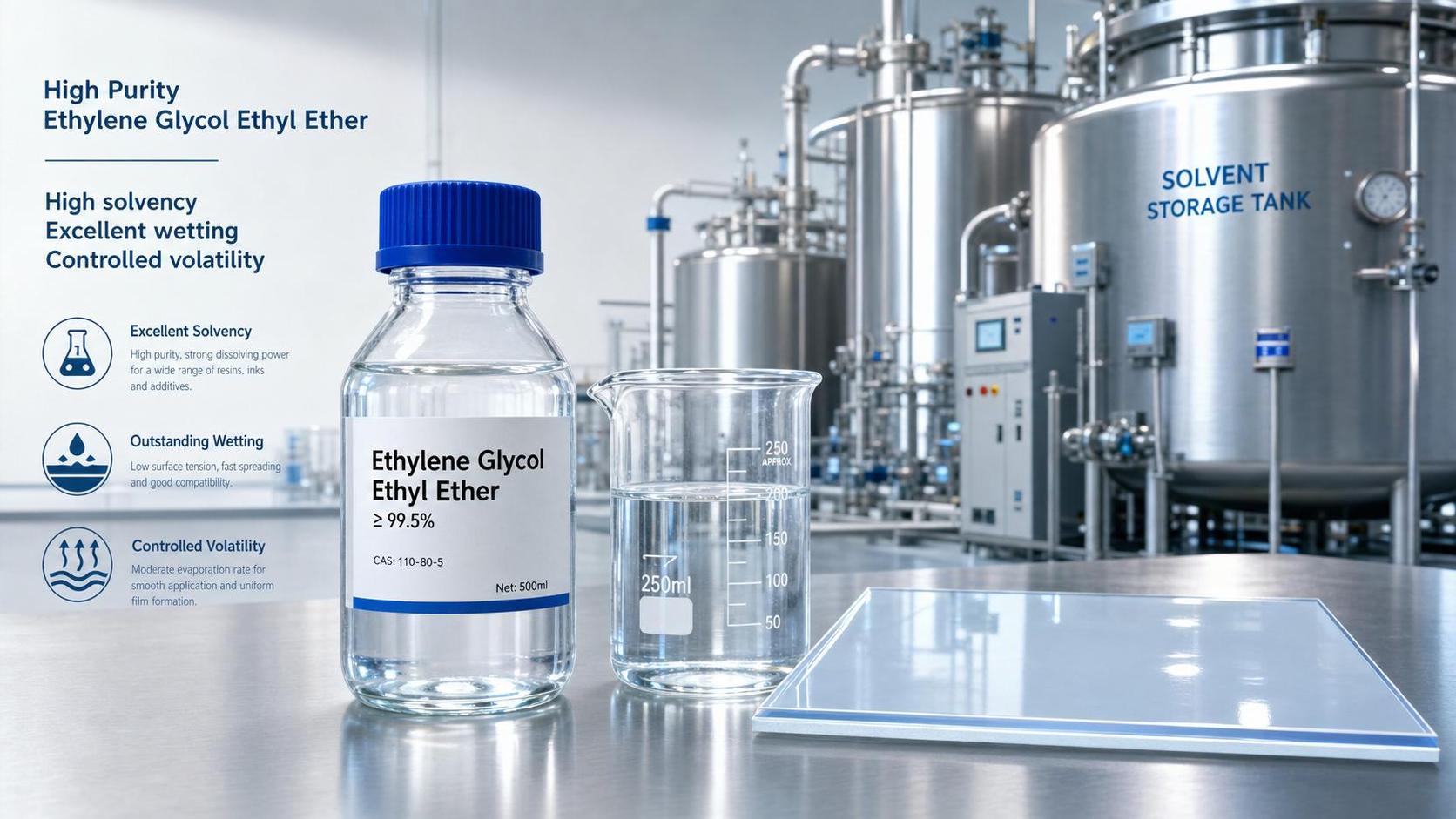
Why This Solvent Draws Attention
Ethylene Glycol Ethyl Ether sits in an important middle ground among industrial solvents. It is often considered when wetting power, resin compatibility, and process balance matter more than very fast evaporation.
That makes it relevant in chemical systems where surface behavior, dissolution strength, and controlled drying directly affect final performance. In practice, a slower profile can be an advantage rather than a limitation.
For companies handling complex chemical supply, this is not only a formulation question. It is also a sourcing question tied to consistency, logistics, and fit across different downstream industries.
Shandong JunTeng Chemical Co., Ltd., based in Jinan, has built its position around that kind of practical demand. With established supplier relationships and a stable logistics network, it supports one-stop procurement where product quality and delivery reliability matter as much as technical specifications.
A Practical View of Ethylene Glycol Ethyl Ether
At a working level, Ethylene Glycol Ethyl Ether is valued for solvency performance across systems that need controlled evaporation. It can help keep active components in solution longer during mixing, application, or film formation.
This changes how technical teams evaluate it. The key issue is rarely whether it flashes off quickly. The real issue is whether it improves application stability without creating downstream handling problems.
In coatings, intermediates, cleaning blends, and auxiliary process fluids, the material may contribute to smoother spreading, better penetration, and more predictable drying windows. Those points often determine whether a solvent system works consistently at production scale.
What assessors usually compare
- Solvency strength versus faster evaporating alternatives
- Compatibility with resins, additives, and active ingredients
- Effect on coating flow, open time, and leveling
- Process stability under variable plant conditions
- Storage, transportation, and supply continuity
Where Industry Interest Comes From
The current interest in Ethylene Glycol Ethyl Ether comes from tighter formulation targets. Many systems now need both strong solvency and controlled behavior during application or processing.
A solvent that evaporates too quickly can reduce working time, disturb film uniformity, or weaken compatibility in multi-component blends. That tradeoff becomes more visible in higher-value chemical applications.
JunTeng Chemical’s customer base spans pharmaceuticals, pesticide production, petrochemicals, adhesives, wastewater treatment, construction chemicals, detergents, fertilizers, plastics, and rubber. Across these sectors, material selection is usually driven by process fit, not by a single isolated property.
That is why source quality also matters. Partnerships with producers and major enterprises such as BASF Germany, Sinopec, Luxi Chemical, and Qilu Petrochemical strengthen confidence in traceability and stable supply from the origin.
Typical Use Contexts and Evaluation Logic
Ethylene Glycol Ethyl Ether should be assessed in relation to the system around it. Its value becomes clearer when the solvent must support both formulation compatibility and operational efficiency.
In polymer processing, solvent choice is often linked to additive performance. A formulation may rely on controlled solvency while also requiring thermal protection during high-temperature steps.
In that context, supporting materials such as Antioxidant JHANOX-626 can become relevant. Its hydrolysis stability, low volatility, and synergistic action with phenolic antioxidants suit polyolefins, engineering plastics, and synthetic rubber.
What Matters in Real Procurement Decisions
A technically suitable solvent still fails if supply is unstable or batch performance shifts too much. For Ethylene Glycol Ethyl Ether, commercial evaluation should stay close to real operating conditions.
Usually, the most useful review covers five points:
- Purity consistency across repeated orders
- Documentation and source traceability
- Packaging fit for storage and internal transfer
- Delivery responsiveness during demand changes
- Technical support for cross-industry applications
This is where supply chain depth becomes a technical asset. A distributor with stable upstream relationships can reduce the risk of specification drift and shorten the path from evaluation to regular use.
That is especially useful when Ethylene Glycol Ethyl Ether is one component inside a broader formulation package, alongside stabilizers, auxiliaries, or application-specific additives.
How to Judge the Next Step
The best way to assess Ethylene Glycol Ethyl Ether is to define the performance priority first. If solvency, compatibility, and processing window are more critical than rapid flash-off, the material deserves closer comparison.
Then narrow the review to application evidence. Check formulation stability, drying behavior, interaction with other ingredients, and supply reliability under normal purchasing conditions.
Where polymer or rubber systems are involved, it is also worth examining the fit between solvent behavior and thermal protection packages, including options like Antioxidant JHANOX-626.
A clear benchmark matrix, a small-scale formulation trial, and source verification from an experienced supplier will usually provide enough evidence for a sound decision.
Leave A Message
If you are interested in our products and want to know more details, please leave a message here, we will reply you as soon as we can.