





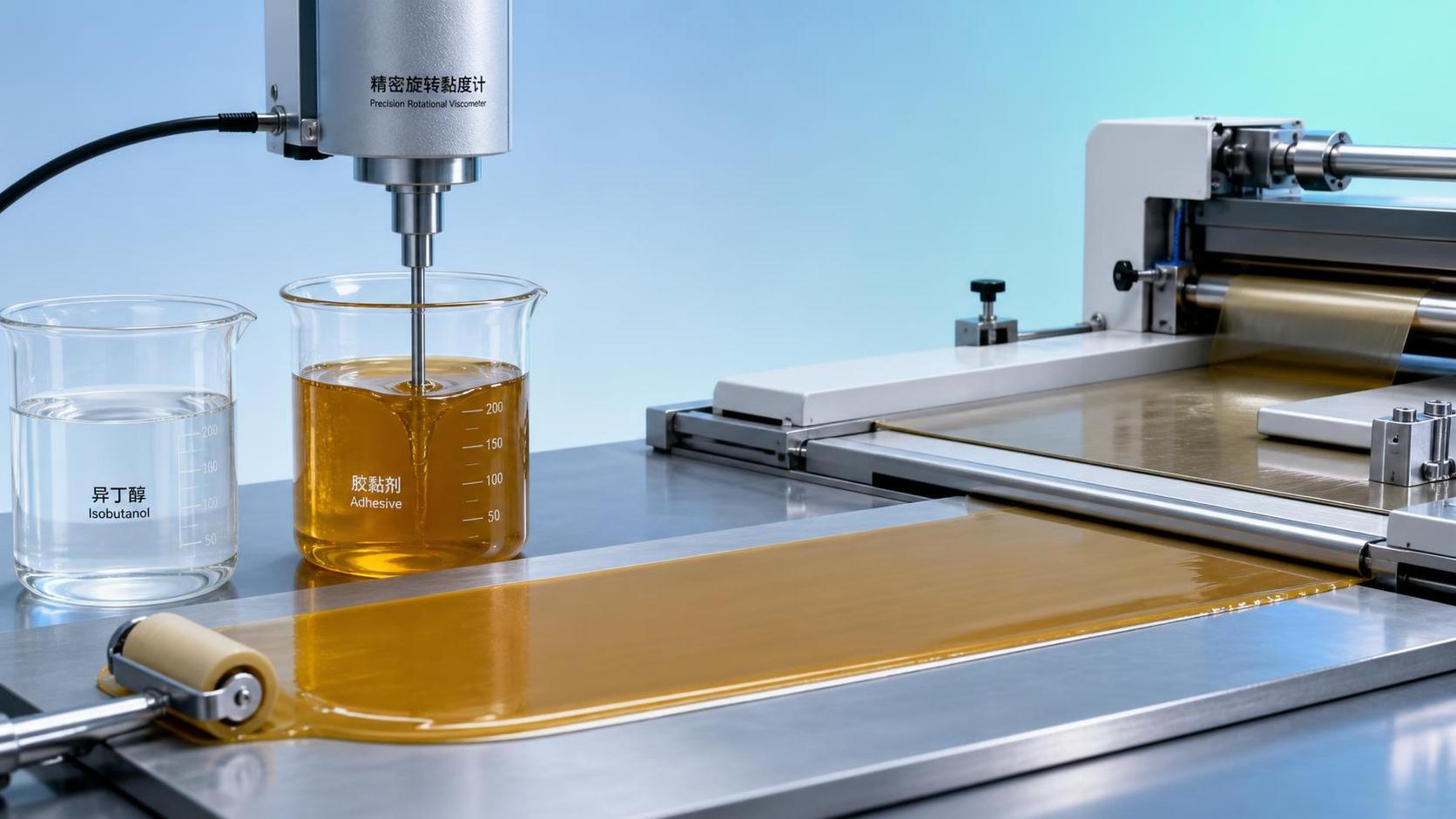
Open time and application viscosity are linked, but they are not the same property. In a solvent-borne adhesive, isobutanol can influence both by changing the liquid phase around the resin, tackifier, rubber, or reactive binder. The practical result is often a more workable adhesive film during spreading, rolling, spraying, or assembly, provided that the solvent package remains compatible with the full formulation and the substrate conditions.
Isobutanol has a moderate evaporation profile relative to lighter, faster solvents. When used as a solvent or co-solvent, it can slow the rate at which the wet adhesive film loses solvent. That slower loss can preserve surface tack long enough for parts to be aligned and joined. It can also reduce the tendency for the adhesive to become stringy or difficult to spread before the intended assembly step is complete.
Open Time Is Controlled by the Whole Solvent Package
Open time is the period after application during which an adhesive can still wet the opposing surface and form an effective bond. Adding isobutanol does not create a fixed increase in open time because the outcome is shaped by resin solubility, solids content, film thickness, air movement, substrate temperature, and the other solvents present.
Its contribution is most evident when it replaces part of a very fast-evaporating solvent fraction. The adhesive film remains liquid or tacky for longer, giving better latitude for positioning large sheets, laminates, insulation boards, trim pieces, or uneven components. This latitude is valuable only until the film becomes too wet for the bonding mechanism. Contact adhesives, for example, require sufficient solvent release before the surfaces are mated. Extending open time without confirming the correct dry-to-touch or dry-to-bond stage can lead to trapped solvent, reduced initial grab, blisters, or later bond movement.
A long open time and a long drying time should therefore be assessed separately. A film can remain receptive to bonding while still losing solvent at a useful rate. Conversely, a heavy coat may stay visibly wet but develop a surface condition that no longer transfers well to the second substrate. Film appearance alone is a weak indicator; tack transfer and bond development under the actual assembly pressure provide more useful information.
Why Viscosity Often Changes After Adding Isobutanol
Viscosity adjustment is not simply dilution. Isobutanol changes the balance between polymer chains, dissolved resins, fillers, and the surrounding solvent. If it is a good solvent for the binder system, it can improve resin solvation and produce a smoother, more uniform flow. In another system, especially one close to its solubility limit, the same addition can reduce viscosity less than expected, cause haze, or disturb the gel structure that gives the adhesive body.
For adhesives containing thickeners, elastomers, or high surface-area fillers, the measured viscosity can be misleading unless the test method is controlled. A batch may show the target value at low shear in a container yet behave poorly through a spray gun, slot die, roller coater, or narrow transfer line. Isobutanol can alter shear response as well as the single viscosity reading. The relevant question is whether the adhesive delivers a stable coat weight and a continuous film at the application shear rate.
Temperature adds another source of variation. A formulation adjusted in a warm mixing area may become appreciably thicker at the application point in a cooler workspace. Meanwhile, solvent loss from an open pail, recirculation tank, or poorly sealed hose can gradually move the viscosity upward. A formulation that relies on isobutanol for a controlled evaporation balance should be evaluated after realistic hold time, not only immediately after mixing.
Wet-Out, Flow, and Edge Behavior
Lower apparent viscosity can improve wetting, but excessive reduction may create a different set of defects. On porous wood, concrete, fabric, or paper, a low-viscosity adhesive can penetrate too deeply and leave insufficient material at the bond line. On nonporous metal, plastic, or coated surfaces, it can flow away from edges, form thin spots, or sag on vertical assemblies.
Isobutanol can be useful where a formulation needs improved leveling without moving entirely to a faster, more aggressive solvent blend. Its polar alcohol functionality may support compatibility in systems containing certain resins or polar additives, while its evaporation behavior can keep the film workable during application. Compatibility still has to be verified against every major ingredient. A clear mix at the beginning of production does not prove stability after storage, temperature cycling, or exposure to moisture.
- Stringing during roller or brush application: this may indicate insufficient flow, high solids, partial solvent loss, or inadequate polymer solvation. Adding solvent without identifying which condition is present can reduce bond-line thickness without resolving the stringing.
- Slow bond build: a longer open window may be mistaken for better workability when the real issue is delayed solvent release from an overly thick coating or an enclosed assembly with limited ventilation.
- Uneven coating: poor leveling can arise from viscosity, surface contamination, substrate energy, or application pressure. A solvent adjustment addresses only part of that chain.
Formulation Changes Need Process-Level Validation
When isobutanol is introduced or its proportion is changed, the first trial should hold the resin grade, tackifier level, curing agent, and solids target constant. Measure viscosity at a defined temperature and with the same instrument, spindle, speed, and sample conditioning period. Then apply the adhesive using the intended production method rather than relying only on a drawdown panel.
Application trials should compare coating appearance, wet film continuity, tack development, workable assembly window, and the response after pressing or curing. For two-sided contact bonding, evaluate both the time before joining and the period after the second coat reaches the intended dry state. For one-sided wet bonding, observe whether the slower solvent fraction affects clamp time, fixture movement, or the formation of voids in a closed joint.
Changes in substrate absorbency deserve particular attention. A solvent blend that produces a satisfactory open time on coated metal may lose solvent rapidly into unsealed wood or cementitious material. The opposite can occur on very smooth, low-porosity surfaces, where a film remains wet longer because little solvent is absorbed. Using a single open-time target across these surfaces can create avoidable variation in assembly timing.
Balancing Isobutanol With Other Solvents
Most adhesive systems use a solvent blend because no single solvent simultaneously gives the required resin solvency, application viscosity, flash profile, wetting, and drying behavior. Isobutanol is commonly treated as one component of that balance. Fast solvents can establish early flash; medium-rate components support flow and coating uniformity; slower components preserve a useful assembly window. The correct balance is specific to the polymer and process.
Highly volatile nonpolar materials serve a distinctly different function. For example, Cyclopentane has a low boiling point and very low viscosity, and it is used primarily in applications such as polyurethane foam blowing and nonpolar solvent processes. Its evaporation and solvency characteristics should not be assumed to substitute for an alcohol co-solvent in an adhesive formulation. A replacement decision must begin with binder compatibility, flash behavior, and the required bonding sequence.
Water sensitivity is another boundary condition. Alcohol-containing solvent systems can interact with moisture introduced through raw materials, humid air, containers, or substrates. For moisture-sensitive reactive adhesives, even a small uncontrolled change in water content may affect viscosity drift, pot life, foaming, or cure behavior. Storage and transfer practices should preserve the formulation assumptions used during development.
Reading Results Without Misdiagnosing the Cause
When a bond failure follows a viscosity or open-time adjustment, the failure mode matters. Adhesive remaining on both substrates suggests a cohesive limitation or incomplete cure; a clean interface can point toward insufficient wetting, contamination, incorrect flash time, or low application pressure. A bond line that looks starved may result from excessive penetration, excessive spreading, or solvent-driven flow after assembly. These outcomes require different corrections, even when all appear as low bond strength in a simple test.
Isobutanol is most useful when treated as a controlled lever within a defined solvent blend rather than as a universal thinner. Evaluating its effect through actual coating, assembly, and cure conditions keeps viscosity targets tied to usable processing behavior and keeps open time tied to the moment when the adhesive can still form the intended bond.
Leave A Message
If you are interested in our products and want to know more details, please leave a message here, we will reply you as soon as we can.