





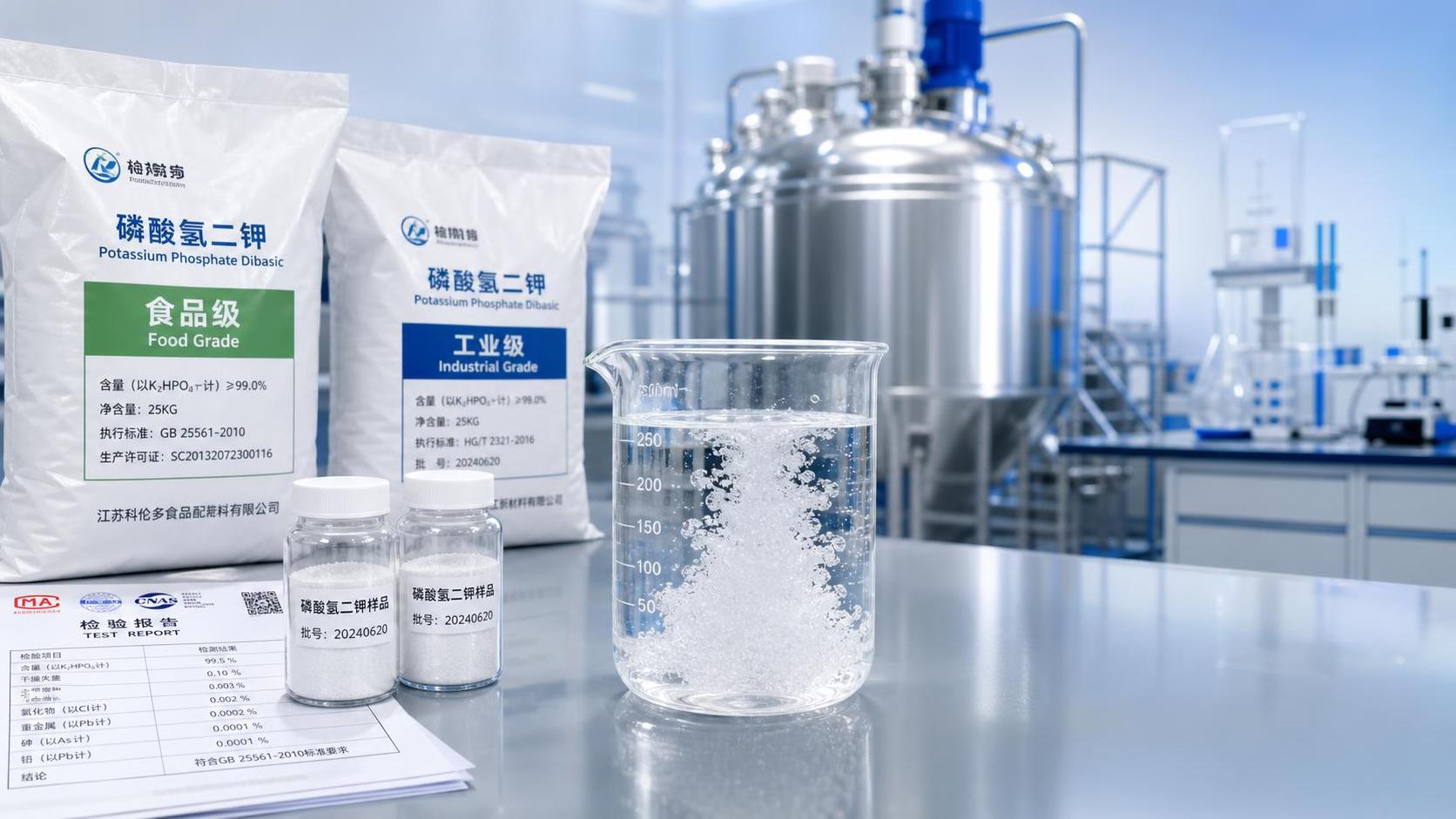
Start with the use case, not the grade sheet
When technical teams evaluate Dipotassium Phosphate, the mistake I see most often is treating it as a simple commodity. It is not. A material that works well in one process can create avoidable trouble in another, even when the basic assay looks acceptable. For food applications, the decision usually turns on purity profile, documentation, and consistency between lots. For industrial use, solubility behavior, interaction with the rest of the formulation, and supply stability often matter just as much as nominal content.
A practical review should answer a short list of questions: Is this grade suitable for the intended end use? Does it dissolve and behave the same way batch after batch? Are the impurity controls clear enough for your market and process? Can the supplier support repeat orders without shifting source or quality unnoticed? If those questions are not answered early, the rest of the evaluation tends to become expensive troubleshooting.
Check the application boundary first
Before comparing suppliers, define exactly where the material will be used. “Food use” is too broad by itself. A buffering agent in one formulation may face different acceptance criteria than a processing aid in another. The same applies on the industrial side: use in fermentation, wastewater treatment, detergents, or specialty chemical blending does not create the same technical risk profile.
- Identify the end product category and whether the Dipotassium Phosphate has direct contact with food or only indirect process contact.
- Map the dosage range. A trace addition and a high-loading use case do not tolerate impurities the same way.
- List the other formulation components that may react to pH shift, ionic strength, or insoluble residue.
- Define whether your process is batch, continuous, hot-fill, high-shear, or sensitive to undissolved particles.
That short front-end definition usually narrows the acceptable supplier pool faster than any price comparison.
Read the specification with a buyer's eye and a process engineer's eye
A specification sheet is only useful if it helps you predict plant performance. Assay matters, but not in isolation. Look for the fields that tell you whether the material will remain stable in handling, dissolve cleanly, and stay within your product limits.
For Dipotassium Phosphate, focus on purity, moisture-related handling behavior, pH in solution, water insoluble matter, and any impurity items that are relevant to the market you serve. In food-related assessments, the supporting quality documents matter almost as much as the numbers. In industrial use, teams sometimes underweight insolubles and particle behavior until filters start loading up or mixing time stretches out.
A useful review table
Do not skip the dissolution test
On paper, two offers can look equivalent. In the tank, they may not. A simple controlled dissolution check often reveals more than a stack of sales documents. Use the water quality, temperature range, mixing intensity, and concentration that your plant actually uses. Watch dissolution time, clarity, residue, and whether the material clumps when added too quickly.
This is where technical teams separate a workable grade from a merely acceptable one. If your line is sensitive to solids, a small amount of insoluble material can create downstream problems that have nothing to do with the nominal chemical content. Similar handling logic applies across many salts. For example, Calcium formate 98% is also selected with close attention to solubility, moisture response, and packaging format because plant behavior often decides the purchase more than a headline purity number.
Match documentation to the market you are supplying
For food-related use, the evaluation is not complete until the documentation package is reviewed against the destination market and the role of the material in the finished product. That means checking the product specification, certificate of analysis format, manufacturing source identity, batch traceability, and any declarations your internal quality or regulatory team requires for release.
The key point here is not to ask for “all documents.” Ask for the documents that decide release. Technical teams lose time when they collect broad paperwork but fail to compare the critical fields: product name consistency, grade description, batch number linkage, test items, and issuing entity. If those fields do not line up, even a technically suitable shipment can stall at incoming inspection.
Look for consistency, not just one clean sample
A supplier can usually prepare one good sample. What you need to know is whether the same quality holds across repeated shipments. Ask to review multiple recent certificates of analysis from different lots, then compare the spread on the items that affect your process most. A tight range is often more valuable than a single top-end result.
This is also where supply-chain structure matters. A trading company with stable source control, repeat supplier relationships, and dependable logistics can be easier to qualify than a low-price offer that changes origin frequently. For technical assessment staff, origin stability is not a commercial detail; it is part of quality control.
Review packaging as part of product performance
Packaging gets treated as a warehouse issue until the material arrives lumpy, damp, or partially compacted. Check bag type, net weight, sealing condition, palletization, and whether the pack size matches your actual consumption rate. A technically sound product can become troublesome if it sits open too long in a humid environment or if the bag design makes clean transfer difficult.
If your plant also handles products such as Calcium formate 98%, the same review habit carries over: white powder materials with strong water interaction need packaging that protects flow and reduces moisture pickup during storage and use.
Run a short approval sequence before full onboarding
The cleanest way to evaluate Dipotassium Phosphate is to keep the approval sequence disciplined:
- Define the exact application and release criteria.
- Screen the specification and documentation package.
- Run a plant-relevant dissolution and compatibility check.
- Compare several lots, not just one sample.
- Review packaging, lead time, and source stability before approval.
That sequence keeps the decision grounded in actual process risk. If a supplier clears those stages, you are no longer buying on assumption. You are buying on evidence that the material fits your formulation, your quality system, and your operating reality.
Leave A Message
If you are interested in our products and want to know more details, please leave a message here, we will reply you as soon as we can.