





How bulk export decisions change the way you evaluate a Glacial Acetic Acid supplier
Choosing a Glacial Acetic Acid supplier is rarely just about price or assay.
In export and bulk orders, small gaps in quality control, packaging, or shipping coordination quickly become costly.
That is why supplier evaluation should start from actual use conditions, not from a quotation sheet alone.
Some orders go into pharmaceuticals or food-related processing chains, where traceability and documentation matter most.
Others move into petrochemicals, adhesives, detergents, or wastewater treatment, where continuity of supply often decides production stability.
A reliable Glacial Acetic Acid supplier should therefore match the order context: purity target, delivery rhythm, export route, and compliance needs.
In actual trade, different application chains create different risk points
Glacial Acetic Acid is used across several chemical sectors, but procurement pressure is not the same in each one.
For continuous manufacturing lines, delayed arrival can be more damaging than a slight price increase.
For regulated downstream processing, the larger concern is whether the supplier can provide stable certificates, batch consistency, and inspection support.
This is where experience in chemical trading becomes practical rather than promotional.
A company with established upstream cooperation and export handling capability can reduce handoff errors between source factory, warehouse, and port.
Shandong JunTeng Chemical, based in Jinan, has built long-term cooperation with major domestic and international chemical enterprises.
That kind of network matters when orders require both source assurance and flexible shipment planning.
When stable output matters more than the lowest quote
In high-volume industrial use, the best Glacial Acetic Acid supplier is often the one that can keep the same quality over repeated shipments.
A low initial offer means little if later batches drift in color, purity, or moisture control.
More practical checks include batch records, loading photos, third-party inspection options, and response speed when specifications are questioned.
What to check first when comparing a Glacial Acetic Acid supplier
A useful comparison starts with a few points that directly affect order performance.
- Source factory partnerships and whether supply is direct or layered through traders.
- Purity consistency across batches, not just one sample report.
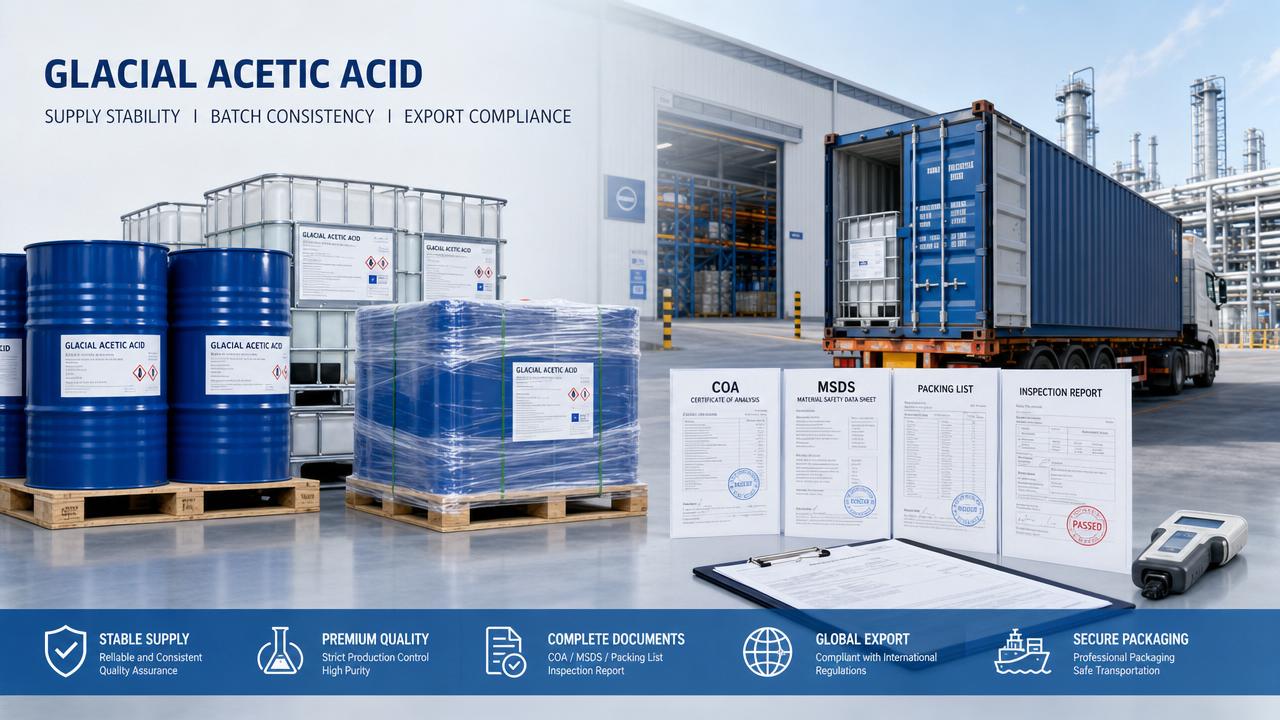
- Export document readiness, including COA, MSDS, packing list, and customs support.
- Packaging suitability for drums, IBCs, or tank shipments.
- Logistics responsiveness during peak season or port congestion.
- Claims handling process if leakage, delay, or spec deviation occurs.
If a supplier cannot answer these clearly, the export risk is usually higher than the quote suggests.
The judgment focus is not the same for every order type
Below is a practical comparison that helps separate common order situations.
This is why one Glacial Acetic Acid supplier may fit one route well, but not another.
Related chemical sourcing often reveals whether the supplier can really support complex orders
In practice, bulk buyers often source more than one chemical within the same project cycle.
A supplier handling acids, water treatment chemicals, detergents, or food-related additives usually understands cross-category logistics better.
For example, products such as Sodium Hexametaphosphate(SHMP)--Tech Grade &Food Grade are used in food, detergent, ceramic, paper, and water treatment applications.
Its functions as a sequestrant, scale inhibitor, and stabilizer show how different end uses demand different packaging, standards, and document control.
A trading partner familiar with such product variation is often better prepared for Glacial Acetic Acid orders with mixed compliance and delivery requirements.
Common mistakes that make Glacial Acetic Acid sourcing riskier
One common mistake is judging a Glacial Acetic Acid supplier only by assay and price.
That overlooks lead time, container suitability, and loading discipline, which often drive actual landed cost.
Another mistake is assuming all export experience is equal.
Some suppliers can issue documents, but struggle when schedules change or customs asks for extra clarification.
There is also the habit of testing one sample and treating it as proof of long-term consistency.
For bulk chemical orders, consistency over time matters more than one good batch.
A better way to reduce errors before confirming the order
- Request recent batch data, not only standard specification sheets.
- Confirm packaging details against route length and handling conditions.
- Ask how supply is maintained during market fluctuation or plant maintenance.
- Check whether the same contact team handles documentation and shipment follow-up.
- Review claim response timelines before problems happen.
What a dependable long-term partner should look like
A dependable Glacial Acetic Acid supplier should combine verified upstream resources with practical execution in transport and export documentation.
This is especially important when shipments support pharmaceuticals, pesticides, petrochemicals, adhesives, construction chemicals, or detergent raw materials.
Those sectors may all use chemicals at scale, yet their tolerance for delay, impurity, or paperwork gaps is very different.
Companies with mature supply chain management and established networks, such as JunTeng Chemical, are better positioned to coordinate source quality and timely delivery together.
When evaluating the next Glacial Acetic Acid supplier, map the decision to your real route, batch expectations, and downstream risk.
Then compare source reliability, export support, and repeat-order stability before moving forward.
Leave A Message
If you are interested in our products and want to know more details, please leave a message here, we will reply you as soon as we can.