





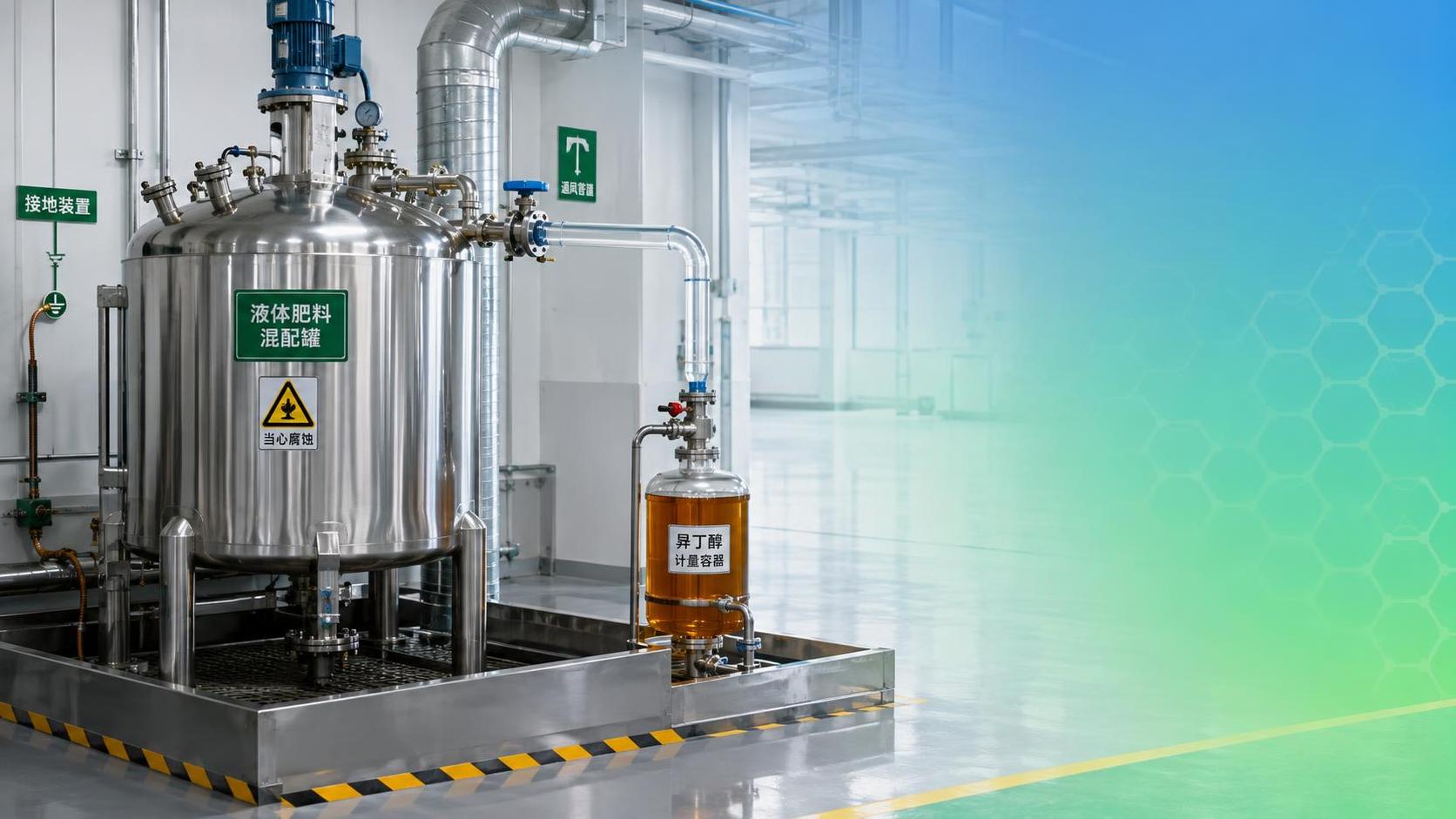
Isobutanol in Agricultural Fertilizers: Formulation Benefits and Safety Controls
In fertilizer manufacturing, a solvent decision is rarely just a purchasing decision. It affects how easily a formulation can be blended, whether additives remain uniform during storage, how reliably a batch runs through the plant, and what controls are needed on the shop floor. Isobutanol for agricultural fertilizers is most relevant where liquid fertilizer blends, micronutrient packages, crop-protection-compatible systems, or specialty nutrient products require an organic co-solvent rather than water alone.
For project managers, the practical question is not simply whether isobutanol can dissolve a component. The better question is whether it supports the full operating window: raw-material variability, mixing sequence, temperature changes, storage time, packaging compatibility, worker exposure controls, and delivery continuity. A formulation may look acceptable in a laboratory beaker yet become difficult to manage in a production tank or during winter transport.
Where isobutanol can help in fertilizer formulations
Isobutanol is an alcohol solvent with limited water solubility and useful compatibility with many organic materials. In agricultural fertilizer applications, it is generally considered when the formulation includes ingredients that do not disperse or dissolve consistently in a fully aqueous system. These may include certain organic additives, wetting aids, low-dose functional components, colorants, or nutrient-associated materials supplied in solvent-based concentrates.
Its value is often as a balancing solvent. A properly selected amount can improve the incorporation of an organic ingredient while avoiding the overly rapid evaporation or harsh solvency associated with some lighter solvents. This can be useful in concentrated liquid products where the plant needs predictable mixing behavior and the final product must remain visually consistent after filling.
That said, isobutanol is not a universal answer for nutrient solubility. It will not solve precipitation caused by incompatible salts, unsuitable pH, excessive loading of micronutrients, or poor water quality. When a zinc, iron, calcium, phosphate, or potassium system is unstable, the root cause may be inorganic chemistry rather than insufficient organic solvent. Adding more solvent to conceal that problem can create a more expensive and potentially less robust product.
Formulation work should begin with compatibility, not dosage
A common mistake in scale-up is deciding on solvent percentage before mapping the formulation’s compatibility limits. In practice, the mixing order matters just as much. Some organic components should first be pre-dissolved in isobutanol before entering the main tank; others may require dilution with water or another approved co-solvent to avoid localized separation. Introducing a concentrate too quickly into a high-salt fertilizer base can cause cloudiness, phase splitting, or a persistent surface layer.
A sensible pilot evaluation should examine more than immediate appearance. Teams should check clarity or dispersion after mixing, viscosity, sediment formation, odor acceptability, package interaction, and behavior after temperature cycling. If the fertilizer will be stored in drums, intermediate bulk containers, or tanks for extended periods, samples should also be reviewed after a realistic holding period. A formulation that stays stable for one shift is not necessarily suitable for commercial distribution.
For projects involving emulsifiable additives or mixed organic systems, it can also be useful to compare isobutanol against neighboring solvent options. The comparison should be based on actual formulation performance, flash point requirements, environmental and handling constraints, and local product-registration expectations—not solely on price per kilogram.
Safety controls need to be designed into the process
Isobutanol is a flammable liquid. That fact should shape the production arrangement from the beginning. Storage, transfer, and mixing areas need controls appropriate for flammable organic chemicals, including ventilation, ignition-source management, grounding and bonding during transfer, suitable electrical equipment where required, and clear procedures for spills and emergency response. The exact design requirements depend on local regulations, plant layout, container size, and the quantity handled.
Ventilation deserves particular attention in enclosed blending rooms. Even when the main concern is not acute toxicity, solvent vapor can create unpleasant working conditions and increase ignition risk if it accumulates. Operators need access to the current safety data sheet, task-specific training, appropriate personal protective equipment, and a defined response plan for leaks during unloading or drum handling.
It is also worth checking the entire formulation rather than assessing isobutanol in isolation. A fertilizer product containing flammable solvent may have different transport, labeling, storage, and customer-handling implications from a conventional water-based nutrient solution. Those implications should be reviewed early by engineering, EHS, quality, and commercial teams. Waiting until the product is ready for shipment can force a last-minute redesign of packaging or logistics.
Avoid confusing isobutanol with related solvent products
Chemical names in purchasing documents can look deceptively similar. Isobutanol and isobutyl acetate are different materials with different properties, handling profiles, and formulation roles. Isobutyl acetate, for example, is an ester commonly used in coatings, inks, adhesives, cleaning formulations, and resin systems. It is a colorless liquid with a fruity odor, slight water solubility, and a listed flash point of 18°C. Its medium-boiling, moderate-evaporation behavior may be relevant when evaluating organic solvent systems, but it should not be substituted for isobutanol without formulation testing and formal approval.
Where a project requires a solvent for resin-containing processing aids or a separate coating-related operation, product details for Isobutyl Acetate may be relevant to the procurement review. For fertilizer blending, however, the material identity on the purchase order, receiving label, certificate of analysis, and batch records must match the approved formula exactly. Similar names are not a sound basis for substitution.
Supply reliability is part of formulation reliability
A specialty fertilizer project can be disrupted by more than a failed batch. Changes in solvent quality, moisture content, packaging condition, or delivery timing can affect production planning as well. For this reason, engineering leaders should define procurement requirements before commercial scale-up: required grade, acceptable specification range, documentation, packaging format, lead time, inspection process, and contingency arrangements for supply interruptions.
Shandong JunTeng Chemical Co., Ltd., based in Jinan, Shandong Province, has worked in chemical trading for ten years and supports customers through supply-chain coordination, supplier resources, and logistics planning. For fertilizer producers, this type of sourcing support is useful when a project needs consistent material availability alongside routine documentation and delivery scheduling. Long-term cooperation with upstream chemical producers and established domestic and international enterprises can help improve source traceability, but incoming quality verification remains the responsibility of the manufacturing operation.
Before placing recurring orders, it is wise to confirm whether the supplier can provide consistent packaging, batch identification, current safety documentation, and timely communication if supply conditions change. A lower quoted price does not compensate for an unplanned line stoppage, a rejected shipment, or a mismatch between supplied material and the validated formulation.
A practical decision framework
Isobutanol for agricultural fertilizers is most defensible when it addresses a clearly identified formulation need: improving incorporation of a specific organic component, supporting blend uniformity, or providing a controlled co-solvent environment. The project should then validate the decision at pilot scale, confirm that flammability controls are proportionate to the operation, and establish raw-material specifications before routine manufacturing begins.
The best outcome is not the formulation with the most sophisticated solvent package. It is the one that remains stable through production, storage, transport, and customer use while being manageable for operators and dependable in the supply chain. That is where solvent selection becomes an engineering decision rather than a line item on a bill of materials.
Leave A Message
If you are interested in our products and want to know more details, please leave a message here, we will reply you as soon as we can.