





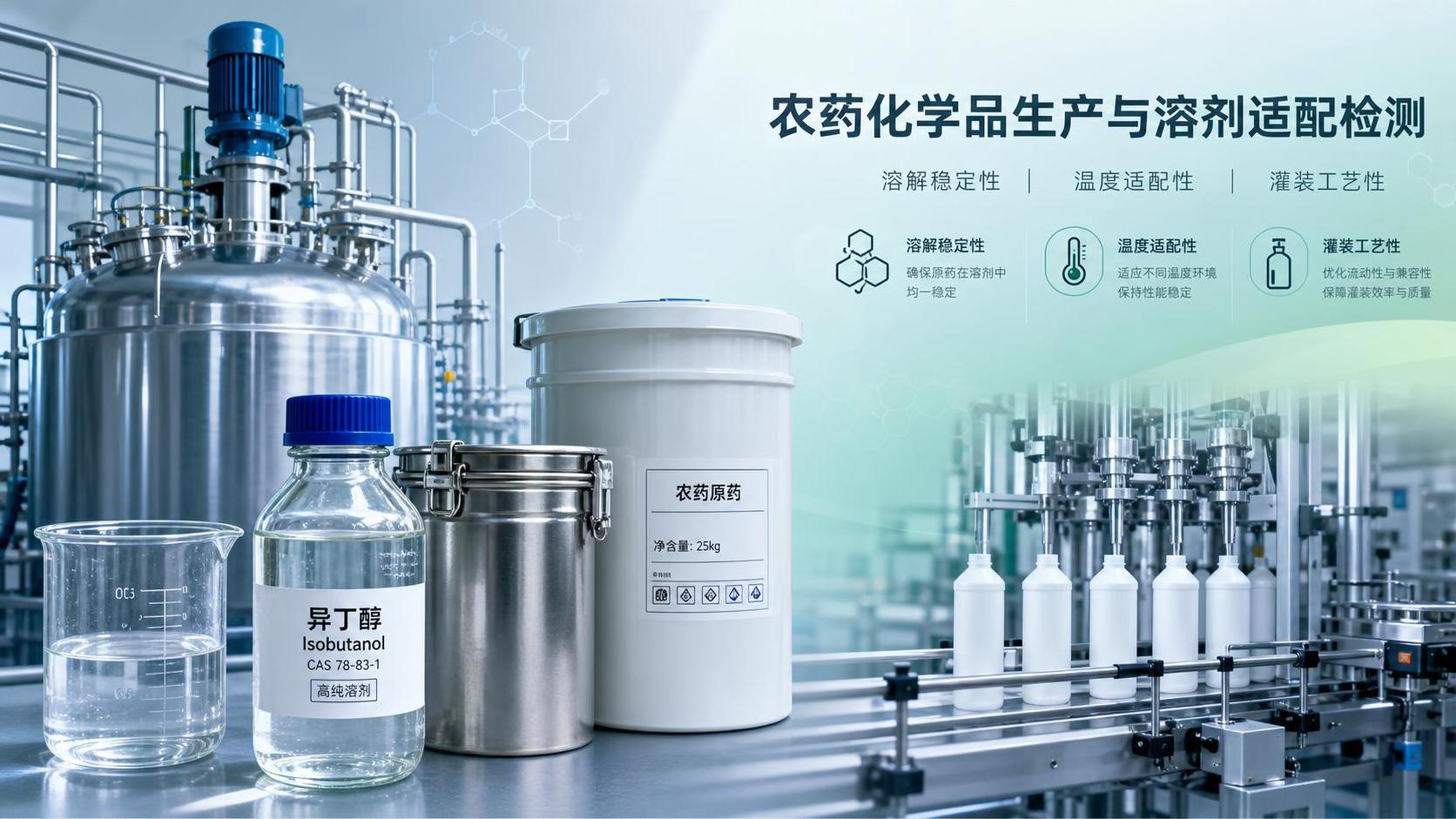
In pesticide manufacturing, the real question is not whether isobutanol can act as a solvent. It can. The harder question is whether it fits the specific formulation, process window, and plant controls you are working with. For technical assessors, that means checking solvency limits together with co-solvent behavior, active ingredient compatibility, evaporation profile, operator exposure, and supply consistency. A solvent that looks acceptable on a data sheet can still create filtration issues, haze, slow dissolution, or unstable filling performance once production starts.
Start with the formulation job, not the solvent name
When assessing isobutanol in pesticide production, begin by defining its exact role. Is it the primary solvent, a coupling solvent, a viscosity adjuster, or part of a mixed carrier system? That distinction matters because acceptable performance in one role does not guarantee fit in another.
- For emulsifiable concentrates, check whether it improves active ingredient loading without pushing the system toward phase separation.
- For intermediate processing, look at whether it actually helps dissolve the technical material at charging temperature, not just under lab stirring.
- If it is only there to tune drying or viscosity, test the minimum effective level. Overuse is a common and expensive mistake.
This sounds obvious, but many solvent screenings fail because the team evaluates chemical compatibility in isolation and skips the process purpose.
Check solvency at the temperatures your plant actually uses
Bench solubility at room temperature is only a starting point. In real plants, dissolution may happen after winter unloading, in heated blending tanks, or during long holding periods before packaging. Isobutanol may look workable at one temperature and fall short at another.
The practical checklist is straightforward:
- Test active ingredient loading at the lowest charging temperature expected on site.
- Hold the sample without agitation and watch for crystallization, haze, or viscosity drift.
- Retest after dilution with the full additive package, because surfactants and auxiliaries can change the solvent balance sharply.
If the system only stays clear under narrow temperature conditions, you do not have a robust solvent choice. You have a lab-only result.
Watch the water sensitivity and dilution behavior
This is where assessors often lose time. A formulation can appear stable in the drum and still fail when diluted or exposed to moisture during storage. Isobutanol has a useful place in many solvent blends, but its interaction with water and emulsifier packages needs attention, especially in pesticide systems that must remain workable across different field dilution conditions.
Check for:
- Milkiness that does not resolve after mild mixing
- Sediment after standing
- Excessive foam during dilution
- Changes in sprayability when water hardness varies
If the product will be used in agricultural systems that also involve fertilizer handling, keep neighboring raw material storage separated and documented. For example, Monoammonium Phosphate(MAP) is a water-soluble material used in agricultural and industrial settings, with specification references such as HG/T4133-2010. It is not a substitute for solvent evaluation, but mixed warehouse environments like this increase the need for clean segregation, moisture control, and accurate raw material identification.
Match evaporation profile to the process, not just the formula
A solvent can be chemically compatible and still be operationally awkward. Isobutanol’s volatility profile may be acceptable for one line and problematic for another. In open charging, poor local exhaust or long mixing cycles can make solvent loss and odor complaints show up before quality problems do.
Look at the process points where the solvent matters most: tank charging, heating, vacuum handling, transfer, and filling. Then ask three practical questions. Does the batch lose enough solvent during processing to change concentration? Does the drying or flash-off rate affect downstream coating or deposition behavior? And does the line have the ventilation and ignition control needed for the actual operating pattern, not the nominal one?
Do not separate compatibility from packaging and storage
Technical teams sometimes sign off on a solvent after a successful pilot batch, then run into trouble two months later in retained samples. That usually points to storage fit rather than immediate formulation failure.
Screen the impurity profile as part of process fit
For isobutanol in pesticide production, consistent quality matters more than hitting a broad product name. Minor composition shifts, residual water, or trace contaminants can change dissolution speed, color stability, and even reaction side behavior in upstream processing. If your line is sensitive, ask for a stable certificate package and compare lot-to-lot consistency instead of approving from a single reference sample.
This is where supply chain discipline becomes part of technical evaluation. A trading partner with established upstream relationships, controlled sourcing channels, and reliable logistics can reduce the operational noise that gets mistaken for formulation failure. In practice, stable supply and repeatable documentation are part of solvent fitness, not a purchasing afterthought.
Common assessment mistakes that waste pilot time
- Approving on clear appearance alone and skipping hold tests.
- Testing only with fresh lab water instead of the dilution water quality expected in use.
- Ignoring the effect of surfactant ratio changes after scale-up.
- Treating solvent replacement as a one-to-one swap without rechecking viscosity, flash behavior, and filling performance.
- Using commercial availability as a proxy for process suitability.
A workable decision sequence
If you need a fast screening path, use this order: define the solvent’s job, test active loading across the real temperature window, check dilution and moisture response, review evaporation impact at plant conditions, then confirm storage and packaging behavior. Only after that should you compare commercial supply options. That sequence filters out most false positives early.
A good assessment of isobutanol in pesticide production is rarely about a single pass or fail property. It is about whether the solvent stays inside your operating limits without creating hidden costs in rework, handling, or field performance. That is the standard worth using.
Leave A Message
If you are interested in our products and want to know more details, please leave a message here, we will reply you as soon as we can.