





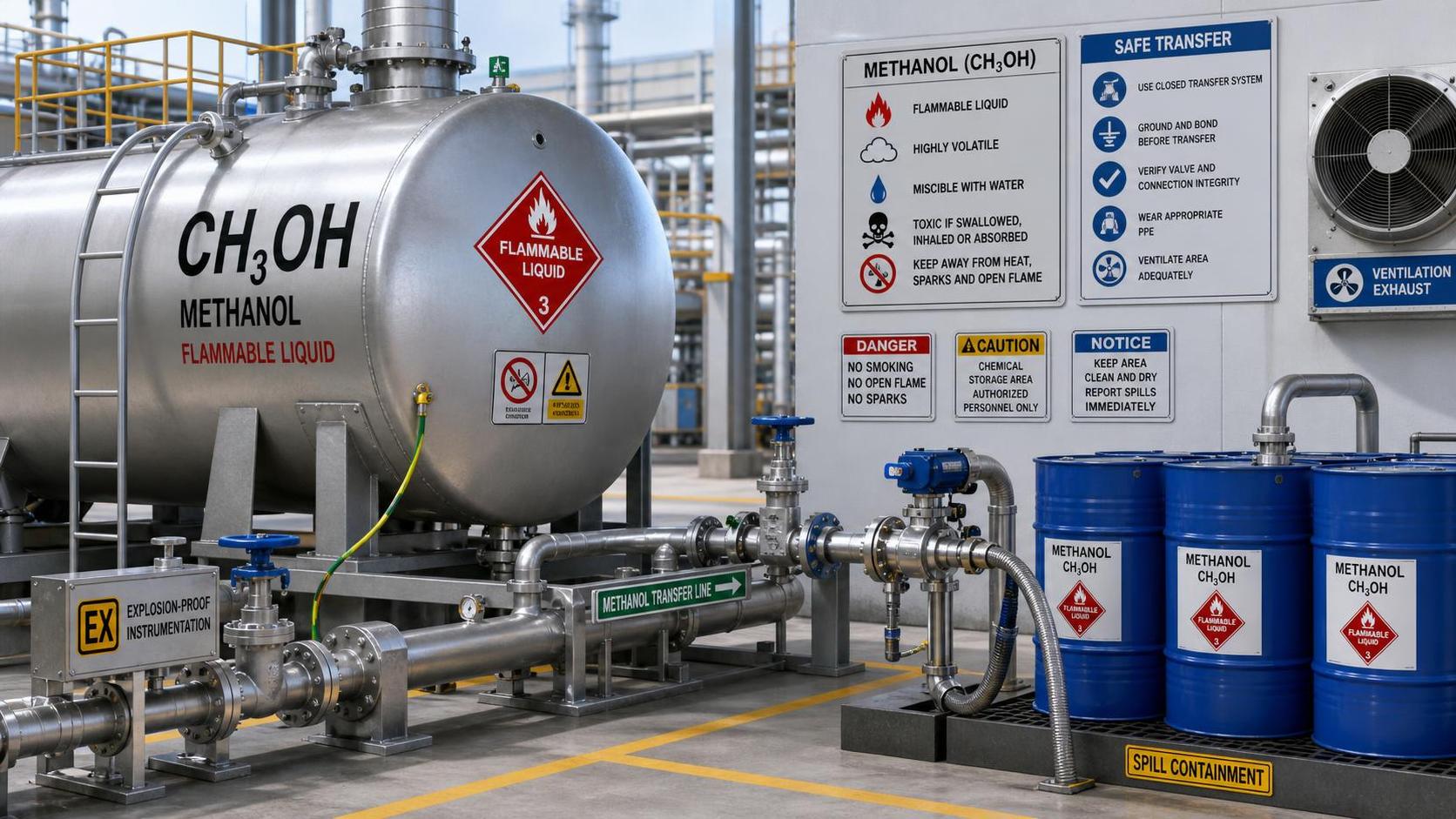
Methanol Chemical Formula and What It Means for Safe Handling
The Methanol chemical formula, CH₃OH, looks simple. In practice, it tells you almost everything that matters about day-to-day handling. One carbon, four hydrogens, and one oxygen place methanol in the alcohol family, but that does not make it comparable to beverage alcohol in any operational sense. It is a volatile, flammable, toxic industrial solvent and feedstock. For people working in storage, transfer, blending, drum unloading, or tank farm operations, the formula is not a classroom detail. It is the starting point for understanding vapor generation, ignition risk, water compatibility, and exposure control.
What often causes confusion is that CH₃OH seems close to ethanol in naming and structure. That similarity is exactly why mistakes happen. Methanol and ethanol are both alcohols, both are clear liquids, and both mix readily with water. But methanol has a very different toxicological profile. Even limited exposure by inhalation, skin contact, or accidental ingestion can become a serious health issue. In real operating environments, the hazard is not only the liquid in a container. It is also the vapor above the liquid, the residue left in transfer lines, and the false assumption that “clear and familiar” means low risk.
The formula also explains why methanol behaves the way it does in plant conditions. The hydroxyl group, the “OH” part, makes it polar and completely miscible with water. That matters during cleaning, spill response, and contamination control. Water can dilute methanol, but it does not remove the underlying flammability and toxicity concerns. A spill washed into a drain is still a methanol management problem. The small molecular structure also contributes to fast evaporation, which means enclosed spaces, loading bays, and poorly ventilated work areas can accumulate vapor more quickly than inexperienced operators expect.
Why the Formula Matters on the Shop Floor
When operators read CH₃OH as more than a label, several practical judgments become easier. First, methanol is an organic solvent with a low molecular weight, so breathing-zone exposure must be treated seriously during sampling, decanting, and tank opening. Second, because it is highly flammable, ignition source control is not optional. Static discharge, non-rated electrical equipment, hot work nearby, and even casual maintenance activity can turn a routine transfer into an incident. Third, because methanol mixes with water, cross-contamination in multiproduct systems can spread faster than people expect if valves, hoses, and intermediate containers are poorly managed.
This is where experienced chemical supply practice matters. Companies working with stable upstream sources and organized logistics tend to reduce handling errors long before the product reaches the user. Shandong JunTeng Chemical Co., Ltd., based in Jinan, has spent a decade in chemical trading with a supply chain model built around source quality, continuity of supply, and delivery coordination. In chemical operations, that kind of reliability is not just commercial convenience. It helps users maintain batch consistency, match storage planning to actual demand, and avoid improvised substitutions that often create safety gaps.
Long-term cooperation with established producers such as Luxi Chemical, Binzhou Petrochemical, Yanshan Petrochemical, Lihuayi Group, BASF Germany, Qilu Petrochemical, and Sinopec also points to another practical issue: operators should never treat the product name alone as sufficient information. Methanol may be a standard commodity, but safe handling still depends on the actual SDS, packaging form, concentration, transport condition, and storage setup on site. The formula identifies the substance. The operating controls come from the full product documentation and the work environment around it.
Common Misunderstandings That Lead to Poor Handling
One common misunderstanding is that methanol is mainly a fire hazard. Fire risk is obvious, so it gets attention. Toxic exposure is easier to underestimate because the liquid may look clean, the odor may not feel alarming, and short tasks may appear harmless. That is weak reasoning. In routine chemical operations, repeated low-level exposure opportunities matter: opening a manway, reconnecting a hose, wiping a spill, or standing downwind during unloading.
Another mistake is assuming that complete water miscibility makes a material easier to handle. In reality, it changes the control strategy. Water compatibility can help with some cleaning processes, but it also means leaks can spread into wash systems, wastewater streams, and porous materials more readily. In facilities that handle multiple solvents, this point becomes clearer when comparing methanol with other oxygenated solvents. For example, Ethylene glycol ethyl ether is also a colorless clear liquid used in coatings, cleaners, printing inks, textiles, and chemical synthesis, with complete miscibility in water and organic solvents. Yet its handling profile differs because its boiling point, flash point, and end use are different. Similar appearance does not mean interchangeable controls.
A third misunderstanding is operational rather than chemical: some sites believe standard PPE alone is enough. PPE is the last layer, not the first. If transfer points are poorly ventilated, labels are unclear, or temporary containers are used without proper identification, gloves and goggles only cover part of the problem. Good methanol handling starts earlier, with container integrity, segregation from ignition sources, grounding and bonding during transfer, clear line identification, and disciplined housekeeping.
How to Read “Safe Handling” in Practical Terms
Safe handling is not one instruction. It is a sequence of controls matched to how methanol moves through a site. In receiving and storage, the focus is package condition, correct labeling, ventilation, and flammable liquid segregation. In transfer operations, the emphasis shifts to closed handling where possible, vapor exposure reduction, and static control. During maintenance or cleaning, the main question becomes whether residual methanol remains in lines, pumps, or vessels that appear empty but still release vapor.
For most users, a workable judgment framework looks like this:
- If the task opens the system, assume vapor exposure is possible.
- If the liquid is being moved, assume ignition control is part of the task.
- If water is used for cleaning, think beyond dilution and consider where the methanol-containing liquid will go.
- If a substitute solvent is proposed, compare the actual physical and safety data instead of judging by appearance or product family.
That last point matters in procurement and production planning. A solvent such as Ethylene glycol ethyl ether may be chosen in some formulations because of its broad solvency, purity of ≥99.5%, and use in coating or ink systems, but those are formulation decisions, not reasons to relax controls around methanol. Each chemical has to be handled on its own parameters, transport condition, and exposure route.
If you remember only one thing about the Methanol chemical formula, it should be this: CH₃OH is a compact way of saying that methanol is small, mobile, water-miscible, flammable, and not forgiving when mishandled. Operators who understand that tend to ask better questions before a task starts. Is the area ventilated? Is the container clearly identified? Is the transfer equipment grounded? Where will wash water go? Has the SDS been reviewed for this exact product stream? Those are the questions that prevent ordinary work from becoming an avoidable incident.
Leave A Message
If you are interested in our products and want to know more details, please leave a message here, we will reply you as soon as we can.