





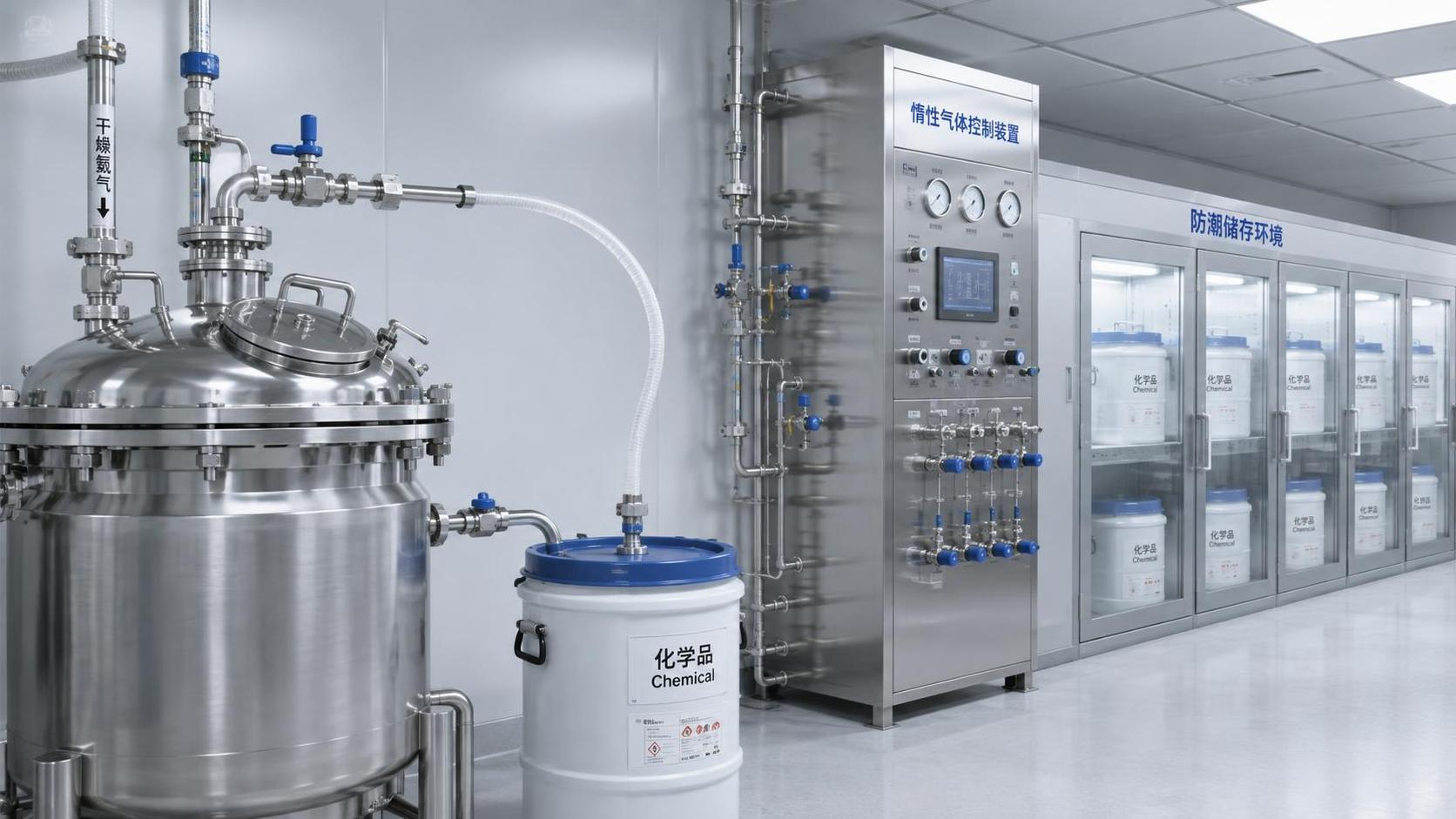
Moisture-sensitive reactions can fail before the reaction vessel is charged. A drum may have been opened too long, a transfer hose may retain humid air, or a nitrogen line may be connected but not adequately purged. With Sodium Tert-Butoxide, these seemingly small gaps can introduce water, reduce effective base strength, generate tert-butanol, and create inconsistent reaction behavior. For quality and safety teams, the control objective is clear: keep the material dry, limit exposure during handling, and verify that every part of the transfer path is suitable for a strong, reactive base.
The practical answer is not simply “use nitrogen.” Reliable handling requires a controlled system covering receipt inspection, sealed storage, dry transfer equipment, inerting discipline, compatible personal protective equipment, and response procedures for spills or loss of containment. The same controls protect batch consistency and reduce the chance of heat release when the material contacts moisture.
Why moisture exposure creates both quality and safety problems
Sodium Tert-Butoxide is a strong alkoxide base commonly used where water-sensitive reaction conditions are important. Contact with water consumes the active reagent and produces tert-butanol and sodium hydroxide-containing species. Even when no obvious incident occurs, partial hydrolysis can change stoichiometry, slow conversion, alter impurity profiles, or make one batch behave differently from another.
The safety concern is related but broader. Water contact may produce localized heat, particularly when contamination occurs in a concentrated area of solid material or within a closed transfer system. Dust, residues, or material trapped in valves can also react when exposed to humid air during maintenance. A reaction that appears manageable in a sealed vessel may become difficult to control if wet equipment, an unpurged line, or an inappropriate cleanup method introduces water unexpectedly.
Quality control should therefore treat moisture exclusion as a process condition rather than a laboratory preference. A dry product alone does not guarantee a dry process. The condition of containers, fittings, filters, sampling devices, receiving vessels, and inert gas supply must be considered together.
Start with receipt, packaging, and storage status
Before material enters the operating area, inspect the outer container for damaged seals, corrosion, punctures, distorted closures, or evidence of product leakage. Confirm that the packaging type matches the intended handling method and that the label, lot identification, and supporting documentation are available. A container that has been opened previously requires different scrutiny from an unopened original package because headspace humidity and closure integrity may already be uncertain.
Storage should remain cool, dry, and protected from atmospheric moisture. Keep containers tightly closed when not in active use. Storage areas should prevent rainwater entry, condensation, and contact with incompatible materials. Do not position moisture-sensitive alkoxides where sprinkler discharge, wash-down activity, or routine water-based cleaning could affect them.
For partial containers, establish a clear rule for resealing and recording the date opened. The record should identify whether the container was blanketed with dry inert gas, whether a desiccated connection was used, and whether the remaining material is still approved for the next intended reaction. Leaving this decision to informal visual judgment can lead to avoidable variation.
Control the entire transfer path, not just the source container
A common failure point is the assumption that a dry reactor compensates for a wet or poorly prepared transfer path. It does not. Hoses, dip tubes, pumps, couplings, filters, and charging ports can hold residual moisture after cleaning, maintenance, or storage. Before transfer, confirm that the equipment has been dried by an established site procedure and protected from recontamination.
Preparation before charging
- Verify that the receiving vessel is dry, closed, and suitable for inert operation.
- Confirm that all lines are correctly connected and that unused ports are capped or isolated.
- Purge the vessel and transfer path with dry inert gas according to the validated operating procedure.
- Check inert-gas quality. A nitrogen supply is not automatically dry enough for every moisture-sensitive operation.
- Ensure that pressure-relief arrangements remain functional during inerting and transfer.
- Review the planned addition rate, agitation status, temperature control, and available reactor capacity before opening the source container.
Where the product is supplied as a solution, verify solvent identity and concentration against the intended recipe. Where it is supplied as a solid, assess whether the charging method could create dust, bridging, or retained residues. Closed charging systems generally provide better control than open manual addition, but they still require appropriate drying, grounding where applicable, and operator training.
Do not use makeshift funnels, wet scoops, or containers that have been cleaned and air-dried without verification. A tool can look dry while retaining enough surface moisture to affect a small-scale addition or initiate caking at the point of contact.
Recognize early signs that the dry-control system is failing
Not every loss of material quality is visible. However, several observations should trigger investigation before a reaction proceeds: unexpected clumping or crusting in solid material, unusual difficulty during flow, pressure behavior that does not match the normal transfer profile, an unplanned temperature increase after charging, or a reaction requiring more reagent than expected to reach its usual endpoint.
Analytical checks should be based on the site’s approved specification and reaction requirements. Depending on the process, this may include assay verification, water determination, appearance review, or confirmation of solution concentration. The most useful testing point is often before charging, particularly after an opened container has been stored or when handling conditions were interrupted.
Separate dry-process controls from normal solvent handling
Facilities sometimes use hygroscopic liquids as drying aids or process solvents, but suitability depends on the chemistry and the validated process design. For example, Diethylene glycol is a hygroscopic industrial liquid used in applications such as natural-gas dehydration and as a chemical intermediate. Its ability to absorb water does not make it an automatic drying agent or compatible process medium for Sodium Tert-Butoxide reactions. Introducing any liquid into an alkoxide process must be justified by reaction compatibility, impurity limits, and the approved batch procedure.
This distinction matters during troubleshooting. A material may be useful for drying in one operation yet be unsuitable in a reaction system because of hydroxyl functionality, solvent effects, contamination risk, or downstream separation requirements. Process teams should not substitute materials simply because they are known to absorb water.
Protect operators during connection, sampling, and cleanup
Personnel protection should address splash, corrosive contact, and the possibility of reactive residues. The exact protective equipment must follow the current safety data sheet and site risk assessment, but work typically requires chemical-resistant gloves selected for the task, eye and face protection, protective clothing, and suitable controls for dust or vapors associated with the product form and transfer method.
Sampling deserves special attention because it often breaks the closed system. Use a dry, compatible sampling device and minimize the time that the container or vessel is open to the atmosphere. Return of sample residues to the original container should be avoided unless the approved procedure specifically permits it; this practice can introduce contamination that is not evident at the time of sampling.
For spills, do not apply water as a default cleanup method. Isolate the area, prevent material from reaching drains or wet surfaces, and follow the product-specific emergency procedure. Responders need to understand whether the release involves dry solid, solution, contaminated residue, or a material already reacting with moisture. The safest response method depends on that condition and on the quantity involved.
Build verification into routine operations
The strongest handling programs make dry control visible and repeatable. Operators should be able to confirm the status of the reactor, transfer line, inert-gas source, container closure, and charging sequence before the material is exposed. Quality personnel should have defined hold points for damaged packaging, suspected moisture exposure, out-of-trend analytical results, and deviations during transfer.
It is also useful to review deviations for patterns rather than treating each event as isolated. Repeated findings around one connection point, one shift handover, one storage location, or one cleaning practice may reveal a system weakness. Corrective action may involve equipment changes, clearer drying records, revised purge criteria, or better segregation of water-based maintenance activities from moisture-sensitive handling areas.
When the reaction has a narrow thermal or stoichiometric operating window, the final decision to use a questioned container should be based on documented quality evaluation, not on appearance alone. Maintaining that discipline helps prevent a minor storage or transfer lapse from becoming a batch-quality issue or a reactive handling event.
Leave A Message
If you are interested in our products and want to know more details, please leave a message here, we will reply you as soon as we can.