





Sodium Pyrophosphate works best when process stability is the real target
In chemical production, consistency rarely depends on one factor alone. Water quality, raw material fluctuation, mixing order, temperature, and storage behavior all affect the final result.
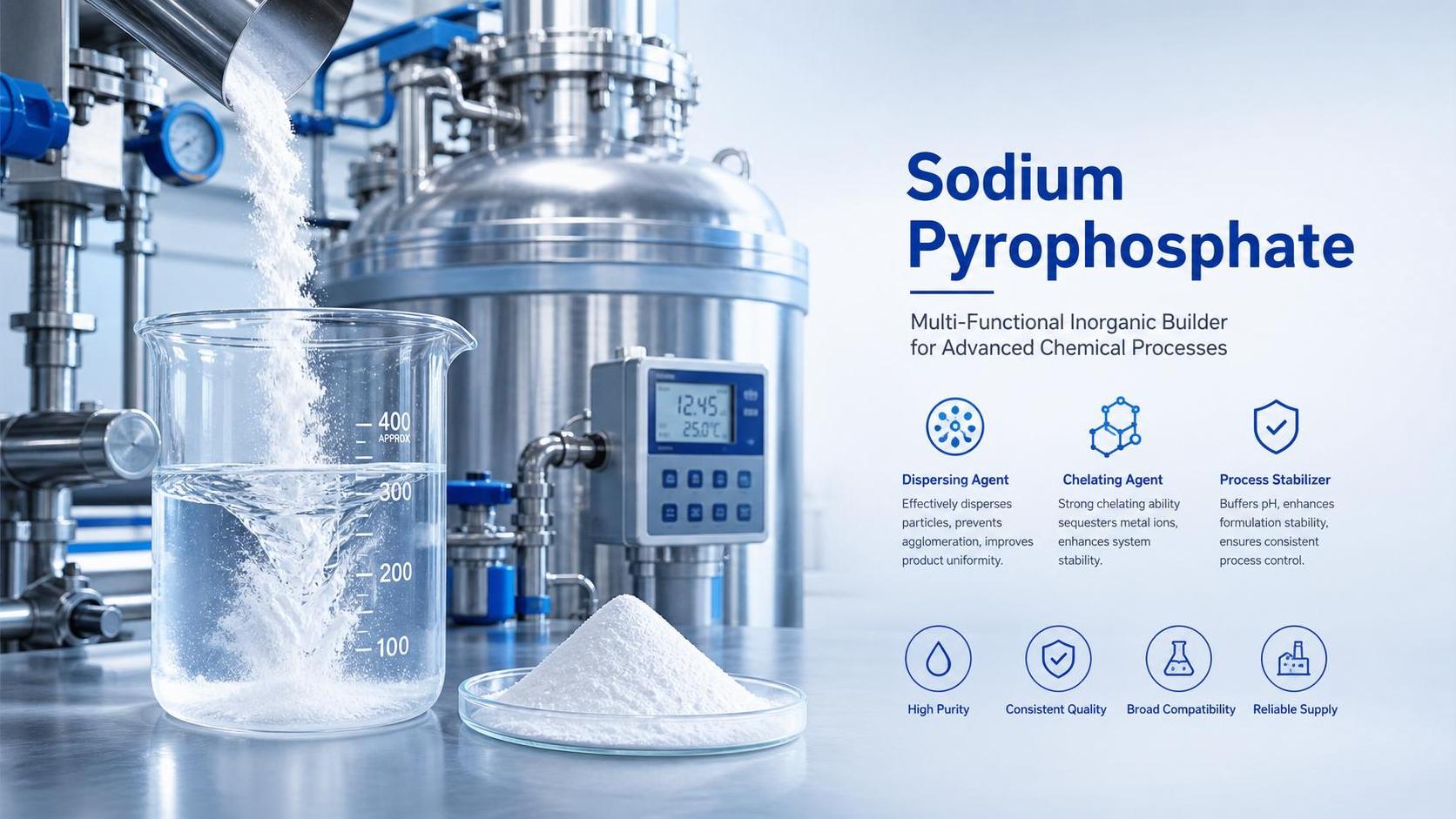
That is where Sodium Pyrophosphate becomes useful. It is often selected not simply as an additive, but as a control tool for dispersion, buffering, sequestration, and stability management.
In actual use, the value of Sodium Pyrophosphate is clearer in processes that suffer from batch variation, uneven solids distribution, mineral interference, or short processing windows.
A stable result also depends on supply reliability. Shandong JunTeng Chemical, based in Jinan, supports this need through established sourcing channels, supply chain coordination, and dependable delivery across multiple chemical sectors.
Why one application treats Sodium Pyrophosphate differently from another
The same material can behave differently across formulations because the process objective changes. In one system, the main problem is hard water. In another, it is solid settling or viscosity drift.
A detergent blend may need Sodium Pyrophosphate to improve cleaning consistency under variable water conditions. A ceramic or mineral slurry may rely on it for dispersion and smoother flow during handling.
Food-related and industrial systems also judge performance differently. Some focus on texture control and processing tolerance, while others care more about reaction stability, filtration behavior, or storage hold time.
So the practical question is not whether Sodium Pyrophosphate is effective. The better question is which instability it is expected to correct, and under what operating limits.
Where Sodium Pyrophosphate usually improves daily process control
Water-sensitive cleaning and detergent systems
This is one of the most common application settings. Hard water ions can weaken cleaning efficiency, disturb surfactant behavior, and create visible inconsistency between production lots.
In these cases, Sodium Pyrophosphate helps by binding interfering metal ions and supporting a more predictable formulation environment. That matters when products move across regions with different water profiles.
Some formulators compare this with surfactant-side stabilization. For example, Cocamidopropylamine Oxide CAO-30 is often considered where foam stability, thickening, and compatibility across acidic and alkaline systems are also important.
Dispersed solids, slurries, and suspension handling
A different pattern appears in mineral treatment, ceramic processing, pigments, and some construction chemical blends. Here, the issue is often particle behavior rather than simple water hardness.
Sodium Pyrophosphate can improve particle separation and reduce agglomeration. That may translate into easier pumping, more even coating, lower sedimentation risk, and cleaner downstream processing.
The useful judgment point is whether poor flow comes from particle interaction or from base liquid design. If the root cause is elsewhere, dosage changes alone will not solve the instability.
Food processing and texture-sensitive systems
In food-related applications, Sodium Pyrophosphate is usually judged more carefully because the performance target is narrower. Texture, moisture retention, and processing consistency tend to matter more than broad formulation flexibility.
The key is controlled use under the correct standard and specification. Small shifts in dosage or raw material interaction can change the functional outcome more than expected.
Different scenarios do not ask for the same performance window
A quick comparison helps clarify why Sodium Pyrophosphate should be selected by operating condition, not by name alone.
What is often misjudged before scale-up
A common mistake is to evaluate Sodium Pyrophosphate only by specification sheet values. That gives part of the picture, but not the operating reality.
- Treating similar formulations as identical, even when water source or solids profile has changed.
- Optimizing for raw material cost while ignoring cleaning loss, rework, or shortened storage stability.
- Adjusting dosage before confirming mixing order, pH range, or interaction with adjacent additives.
- Assuming short lab stability means the same result under transport, storage, and seasonal temperature shifts.
In practical terms, Sodium Pyrophosphate performs best when it is part of a process review, not a last-minute correction for a poorly defined system.
A more reliable way to match Sodium Pyrophosphate to the process
A useful approach is to define the instability first. Is the problem settling, chelation demand, inconsistent viscosity, poor rinse behavior, or variable reaction control?
Then confirm the process boundaries: raw material source, water condition, temperature cycle, hold time, and whether the system includes other functional additives.
In broader formulation work, it is sometimes necessary to pair sequestration or dispersion control with surfactant stabilization. That is why related materials with mild chemistry, hydrolysis resistance, and hard-water stability may also enter the discussion.
Reliable supply matters here because small quality variation can alter repeatability. JunTeng Chemical’s sourcing network and long-term cooperation with major upstream enterprises help reduce that uncertainty across repeated orders.
Before the next formulation decision
Sodium Pyrophosphate improves process stability when the application need is clearly defined and the operating context is understood. Its role is strongest where variation has a measurable source and a controllable response.
Before moving forward, it is worth mapping the real use scenario, comparing site conditions, and confirming the key limits around compatibility, dosage, and storage behavior.
That kind of review usually leads to better chemical selection, fewer trial errors, and more stable production performance over time.
Leave A Message
If you are interested in our products and want to know more details, please leave a message here, we will reply you as soon as we can.