





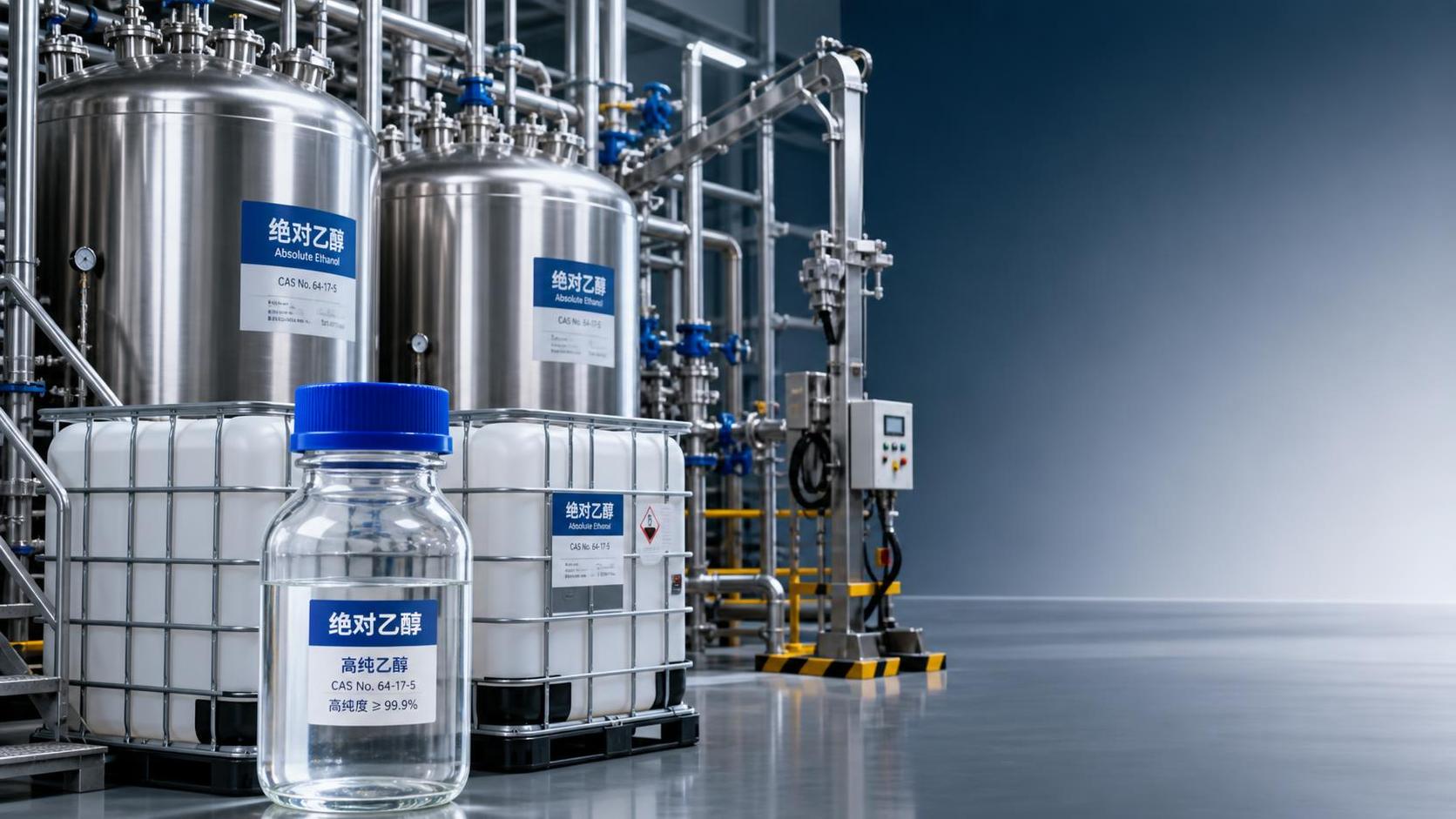
The quoted price of absolute ethanol is only one part of the cost decision. For industrial purchasing, the more important question is whether the quote reflects the required purity, denaturing status, delivery basis, packaging, lead time, and quality documentation. Two offers with a similar headline price can produce materially different landed costs and operational risks once these conditions are included.
Absolute ethanol generally refers to ethanol with very low water content, commonly used where moisture can interfere with formulation, reaction performance, cleaning validation, extraction, coating, electronics processing, laboratory work, or solvent recovery. Because the material is both a chemical feedstock and a regulated flammable liquid, its price is shaped by upstream economics as well as by handling and compliance costs. A budget based only on a monthly per-ton market reference is therefore vulnerable to variance.
Feedstock economics set the base cost, but not the final invoice
Ethanol can be produced from agricultural feedstocks, including corn, sugar crops, and other biomass sources, or through petrochemical routes in some markets. The production route affects exposure to different cost drivers. Bio-based ethanol is closely connected to feedstock availability, agricultural commodity pricing, energy consumption, fermentation efficiency, and co-product economics. Synthetic ethanol is more sensitive to petrochemical feedstock conditions and regional refinery or cracker economics.
This does not mean a buyer can calculate an exact ethanol price by following one commodity index. Producers operate under different feedstock contracts, energy costs, plant utilization rates, tax treatments, and logistics positions. Still, identifying the likely production route helps explain why one region’s quotation may move differently from another’s even when the product specification appears identical.
Energy is an important secondary driver. Distillation and dehydration require thermal energy, while electricity supports pumping, storage, vapor control, and loading operations. When energy costs rise, the effect may be less visible in spot quotations than in conversion charges, minimum order conditions, or suppliers’ willingness to hold fixed prices for extended periods.
Purity is a commercial specification, not a simple number
The difference between standard industrial ethanol and absolute ethanol is not merely a laboratory distinction. Removing water to reach a high-purity grade requires additional dehydration and quality-control steps. The premium attached to this process depends on the required water limit, the test method, and whether the specification includes limits for methanol, aldehydes, ketones, non-volatile residue, acidity, chlorides, or other impurities.
A request for “99.9% ethanol” can still be commercially incomplete. Volume percentage, weight percentage, and water determination methods are not interchangeable without context. If a production process is sensitive to water, the purchase specification should state the acceptable moisture limit and the analytical method used for release testing, such as Karl Fischer titration where appropriate. Otherwise, a low-priced material may be technically compliant under a broad description but unsuitable for the intended process.
Denatured and undenatured material must also be separated in budget planning. Denaturants can change tax treatment, transport classification details, documentation requirements, downstream compatibility, and resale restrictions. A denatured grade may reduce acquisition cost in some circumstances, but it can be unusable in pharmaceutical, food-contact, analytical, extraction, or high-purity manufacturing applications. The cost of rejecting an unsuitable grade is far greater than the apparent saving on the purchase order.
Supply availability affects both price and the cost of continuity
Absolute ethanol supply can tighten even when overall ethanol production appears adequate. A producer may have sufficient base ethanol but limited dehydration capacity, restricted access to suitable storage, or limited availability of packaging qualified for high-purity material. Scheduled plant maintenance, changes in export flows, and sudden demand from disinfectant, solvent, or specialty chemical users can further affect prompt availability.
For budget approval, the relevant exposure is not only the price of the next shipment. It is the financial consequence of supply interruption. If ethanol is a critical process solvent, an interruption may create production downtime, emergency freight, substitute-material trials, or off-spec output. These indirect costs justify evaluating a supplier’s confirmed allocation policy, lead time, stockholding arrangement, and alternative loading locations alongside its quotation.
Where annual usage is predictable, a contract can separate volume security from price certainty. A fixed-price agreement offers clarity but may embed a supplier risk premium. An indexed formula can reduce the risk of paying an outdated fixed rate, but it requires an agreed reference, pricing date, adjustment frequency, currency basis, and cap or collar mechanism if budget volatility must be constrained. A volume commitment without a clear allocation obligation may provide less protection than expected during a tight supply period.
Freight, packaging, and hazardous-goods handling can reverse the apparent price advantage
Ethanol is a Class 3 flammable liquid for transport purposes. This affects the cost and availability of approved packaging, tank containers, road tankers, bonded storage, insurance, loading procedures, and destination handling. Freight should not be treated as a flat add-on. It changes with lane distance, shipment size, container positioning, local restrictions, port congestion, return logistics, and whether the product moves in bulk or packed form.
Bulk deliveries usually reduce packaging cost per unit, but only if the receiving site has compatible tanks, suitable fire-safety controls, unloading equipment, and enough consumption to avoid excessive inventory. Drums, IBCs, and small packs improve flexibility but increase unit cost, waste handling, handling labor, and the likelihood of partial-load freight. The cheapest delivery mode is therefore determined by consumption pattern and site capability rather than volume alone.
Currency also deserves explicit treatment in cross-border purchases. A supplier may quote in USD while the operating budget is maintained in another currency; a favorable ethanol price can be offset by exchange-rate movement before payment. Incoterms must be read with the same care. A CFR, CIF, FOB, EXW, or DDP price shifts different responsibilities for freight, insurance, customs clearance, inland transport, and risk transfer. Comparing offers on different Incoterms without converting them to a common delivered basis produces misleading approval decisions.
Quality failures should be priced as a risk, not treated as an exception
For applications where ethanol enters a controlled process, the purchase price should include the expected cost of verification. A certificate of analysis is useful only when it identifies the relevant batch and includes parameters that matter to the process. Buyers may also need a safety data sheet, origin information, transport documents, and evidence that packaging integrity can be maintained throughout shipment and storage.
Technical acceptance criteria should be agreed before commercial comparison. Questions that materially affect cost include whether the material is virgin or recovered, whether recycled content is permitted, whether a specific denaturant is prohibited, how long unopened material may be stored, and what claim procedure applies if a batch fails incoming inspection. A supplier offering a lower price but refusing clear batch traceability transfers a disproportionate share of the risk to the purchaser.
This distinction matters in broader chemical procurement as well. A purchasing team may buy ethanol alongside salts, buffers, fertilizers, or treatment chemicals; each product has a different cost logic. For example, Diammonium Phosphate(DAP) is typically assessed through nutrient assay, application grade, bag format, and handling requirements rather than solvent purity and flammability controls. Combining unrelated products into one generic “chemical price” benchmark can obscure the specifications that actually drive total cost.
A workable budget should use scenarios rather than one assumed rate
A robust ethanol budget begins with forecast consumption by plant, application, and delivery format. The expected purchase quantity should then be divided into contracted volume, planned spot volume, and contingency volume. Each category can carry a different assumed price and freight basis. This produces a more realistic view than applying a single average rate to total annual demand.
The cost model should separately show: product price; dehydration or grade premium; denaturing status; packaging; freight; insurance; customs duty and taxes where applicable; currency effect; receiving and storage costs; and a contingency for urgent replenishment or quality-related replacement. Separating these lines makes it easier to identify whether a budget overrun is caused by market movement, logistics, specification change, or consumption variance.
Approval thresholds should also reflect the operational cost of changing suppliers. Switching may require sample testing, process review, document approval, packaging validation, and revised safety assessments. For a non-critical cleaning use, these transition costs may be limited. For a sensitive formulation or regulated production environment, a modest unit-price saving may not compensate for the time and risk involved in qualification.
The most reliable approach is to approve absolute ethanol purchases on a normalized landed-cost basis with the quality and delivery conditions attached. Price remains important, but it is only meaningful when the material is fit for purpose, available when needed, and delivered under terms that do not create unbudgeted financial exposure.
Leave A Message
If you are interested in our products and want to know more details, please leave a message here, we will reply you as soon as we can.