





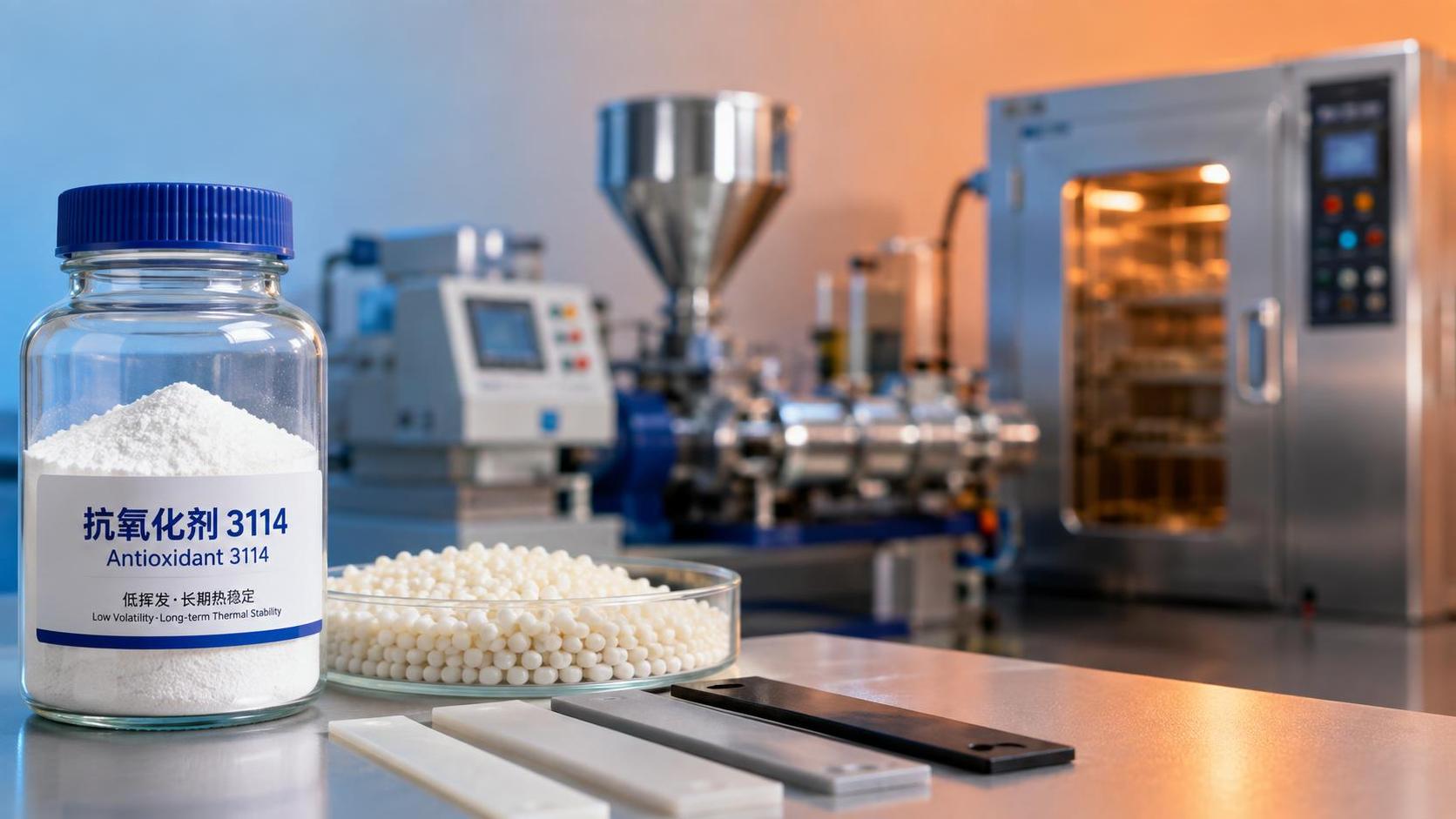
For quality-control and safety teams managing heat-exposed polymer systems, selecting the right stabilizer is rarely a minor formulation detail. A resin may pass an initial appearance check, yet still yellow during processing, lose tensile performance after oven aging, or develop brittle surfaces after months in service. These failures can lead to rejected lots, customer complaints, rework, and difficult questions about whether the problem originated in the polymer, the process, or the additive package.
Antioxidant 3114 is often considered when the requirement is not merely short-term melt protection, but durable resistance to thermo-oxidative degradation over the product’s intended life. Its high-molecular-weight hindered phenolic structure makes it particularly relevant where low volatility, low migration tendency, and sustained antioxidant activity matter.
What makes Antioxidant 3114 different in a long-term stability program?
Antioxidant 3114 is a primary phenolic antioxidant, commonly identified as tris(3,5-di-tert-butyl-4-hydroxybenzyl)isocyanurate. In practical terms, it interrupts oxidation reactions by scavenging free radicals before those reactions can spread through the polymer chain. This helps slow the sequence that produces discoloration, chain scission, crosslinking changes, odor formation, and loss of physical properties.
Its key distinction is durability. Compared with lower-molecular-weight phenolic antioxidants, Antioxidant 3114 is generally selected for its resistance to volatilization during elevated-temperature processing and for its lower tendency to migrate from the finished material. That profile can be valuable in products expected to face extended heat exposure, repeated processing, or applications where additive loss would undermine quality consistency.
The right question for a procurement or quality team is therefore not, “Is 3114 a good antioxidant?” It is: Will its persistence and compatibility solve the actual failure mode in this polymer system?
Situations where Antioxidant 3114 is usually a strong candidate
It is worth evaluating when a polymer formulation must retain performance after prolonged exposure to heat and oxygen, especially when the finished article cannot tolerate visible yellowing or premature embrittlement. Typical evaluation areas include polyolefin compounds, rubber formulations, styrenic materials, engineering plastics, adhesives, coatings, and specialty masterbatches. The final decision should always reflect the base polymer, processing temperature, other additives, and end-use requirements.
- High-temperature or long-residence processing: When material remains in an extruder, mixer, or molding system long enough for oxidation to become a processing concern, a low-volatility phenolic antioxidant can provide a more stable protective contribution.
- Products exposed to sustained service heat: Wire and cable compounds, automotive-related polymer parts, industrial rubber goods, and durable molded articles may need protection beyond the point of manufacture.
- Formulations sensitive to additive migration: Where surface bloom, deposits, or gradual depletion of the stabilizer would create visual or functional risks, the larger molecular structure of 3114 can be an advantage.
- Multiple-pass or recycled-content processing: Reprocessing places extra thermal history on the resin. Antioxidant 3114 may support a stabilization package intended to manage that additional exposure, provided performance is verified through trials.
For a quality manager, the benefit is not simply a more stable compound on paper. It is a wider process window: fewer unexpected color shifts, less variation between production campaigns, and a more defensible basis for release testing.
When it may not be the complete answer
Antioxidant 3114 should not be treated as a universal remedy for every polymer-aging problem. It is a primary antioxidant, not a UV absorber, hindered amine light stabilizer, metal deactivator, flame retardant, or processing lubricant. If a part fails mainly because of sunlight exposure, copper contact, hydrolysis, or poor dispersion, changing to a more durable phenolic antioxidant alone may not correct the root cause.
It may also be less suitable where rapid processing stabilization is the only concern and long-term retention offers limited value. In some high-temperature systems, a formulation may require a secondary antioxidant, often an organophosphite or phosphonite, to decompose hydroperoxides generated during melt processing. The primary/secondary combination can be more effective than either component used alone, but the blend must be assessed for color, odor, processing behavior, and storage stability.
Another common mistake is to judge antioxidant performance using only an initial melt-flow or color result. A material can look acceptable immediately after extrusion yet perform poorly after heat aging. Oven-aging data, retained mechanical properties, color change, oxidation-induction testing where appropriate, and comparison across realistic processing cycles provide a more reliable purchasing decision.
A practical qualification route for QC and safety teams
Before approving a new source or switching grades, start by defining the failure that must be prevented. Is the critical concern yellowing at molding temperature? Tensile loss after thermal aging? Gel formation during extrusion? Surface blooming? Each issue points to a different test plan.
- Confirm chemical identity and documentation. Review the supplier’s certificate of analysis, safety data sheet, batch traceability, packaging details, and declared physical form. Do not rely only on a trade name; ensure the material matches the required chemical identity and internal specification.
- Set incoming-control criteria. Appearance, melting range or softening behavior where relevant, volatile content, ash, assay, and particle consistency may all influence dispersion and process reliability. The exact controls should reflect the product specification and the risk level of the application.
- Run a controlled compounding trial. Compare the existing additive package with the proposed one under representative temperature, shear, residence-time, and regrind conditions. A small laboratory trial is useful, but pilot-scale confirmation is often necessary for sensitive products.
- Test aged material, not only fresh material. Evaluate color, mechanical retention, melt-flow changes, odor, surface condition, and any application-specific property after defined aging exposure.
- Review worker-handling controls. Powdered antioxidants can generate dust during charging, weighing, and blending. Closed transfer where feasible, local exhaust ventilation, appropriate PPE, good housekeeping, and training on the current SDS should be part of the approval process.
Compatibility and formulation details deserve attention
A highly durable antioxidant still has to disperse properly. Agglomerates can create uneven protection, visual defects, or inconsistent test results. Consider the additive’s physical form, feeder accuracy, mixing sequence, and whether a masterbatch route offers better distribution. In rubber systems, interactions with curatives, fillers, processing aids, and pigments should be reviewed rather than assumed.
Color-sensitive formulations require special care. Phenolic antioxidants are widely used because they offer robust oxidation control, but the full package—including phosphites, pigments, residual catalysts, and processing conditions—affects final color. Metal contamination and excessive thermal exposure can complicate the picture. A disciplined root-cause review is more useful than repeatedly increasing antioxidant dosage.
For regulated end uses, compliance must be verified for the exact grade, concentration, polymer, and destination market. A general statement that an additive is used in plastics does not establish suitability for food-contact articles, medical-related applications, potable-water components, or other controlled uses.
Supply reliability is part of the technical decision
For long-running polymer production, stability depends on more than the laboratory sample. Lot-to-lot consistency, packaging integrity, lead time, storage conditions, and access to supporting documentation all influence whether an approved antioxidant remains dependable in practice. Procurement teams should ask how batches are identified, how materials are protected from contamination and moisture, and how deviations are communicated.
Shandong JunTeng Chemical works with established upstream chemical supply resources and an organized logistics network to support customers that need traceable, timely industrial chemical procurement. For plants purchasing multiple raw materials, supply-chain coordination can also reduce the administrative burden of managing separate vendors. Its broader portfolio includes materials such as Paraformaldehyde, a solid formaldehyde source used in resin synthesis and other chemical applications, alongside products serving plastics, rubber, adhesives, and related industries.
The decision in one sentence
Choose Antioxidant 3114 when your polymer needs persistent, low-volatility primary antioxidant protection through demanding processing and long-term heat exposure—and when trial data confirms that it fits the complete stabilization package. For QC and safety teams, that evidence-based approach is the best protection against a costly surprise appearing only after the product has left the factory.
Leave A Message
If you are interested in our products and want to know more details, please leave a message here, we will reply you as soon as we can.