





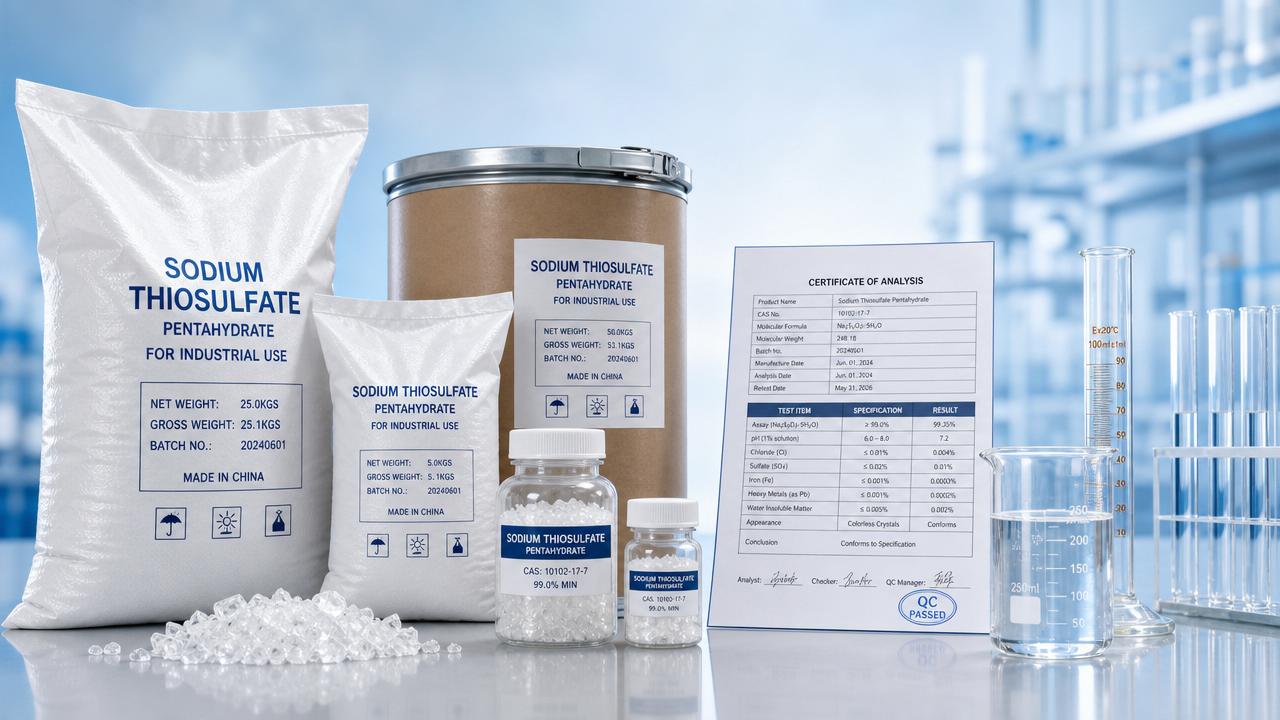
Sodium Thiosulfate specifications often vary more than buyers expect, affecting purity, stability, packaging, and downstream performance across industries. For distributors, agents, and trading partners, understanding these differences is essential to reduce sourcing risks and meet customer requirements. Backed by a reliable supply chain and broad chemical trading experience, this article explains the key factors behind spec variations and what they mean for procurement decisions.
Why do Sodium Thiosulfate specs differ so much in real procurement?
In chemical trading, Sodium Thiosulfate is not a one-line item. Different producers, process routes, application targets, and packaging standards can all change the final specification sheet. A buyer serving wastewater treatment clients may focus on assay and insoluble matter, while a pharmaceutical or photographic customer may pay more attention to impurity control, appearance, and batch consistency.
For distributors, the real challenge is not only finding supply, but matching the right grade to the right end use. If the specification is too loose, customer complaints increase. If the grade is too high for the application, margin becomes difficult to protect.
- Raw material quality and process control can affect purity, heavy metals, and side impurities.
- Hydrate form, moisture condition, and storage history can influence actual delivered content.
- Industry-specific requirements often lead suppliers to present different test items on COA documents.
- Packing format, transport route, and climate exposure can change product stability during delivery.
Which specification items usually create the biggest difference?
The table below highlights the Sodium Thiosulfate indicators that most often lead to sourcing disputes or application mismatch in the chemicals market.
For trading companies, these differences are commercially important. They determine whether the same product name can truly serve the same customer segment without relabeling risk, claim exposure, or repeated negotiation over technical documents.
How should distributors evaluate Sodium Thiosulfate by application scenario?
A practical purchasing decision starts with the end market. Sodium Thiosulfate used in dechlorination, mining, textile processing, or laboratory supply does not always require the same purchasing logic. In many cases, customer complaints happen because buyers compare prices before confirming the use case.
Shandong JunTeng Chemical Co., Ltd., based in Jinan, Shandong Province, supports this process through ten years of chemical trading experience, integrated supply chain management, qualified supplier resources, and efficient logistics coordination. This helps partners secure stable quality, sufficient availability, and timely delivery across different demand profiles.
The matrix below can be used when discussing Sodium Thiosulfate with downstream customers.
This approach is especially useful for agents handling mixed customer portfolios. One specification does not fit all channels, and a structured discussion reduces pricing pressure because the offer is tied to application value rather than only ton cost.
What should buyers verify before placing a Sodium Thiosulfate order?
A practical pre-order checklist
- Confirm the exact grade, hydrate basis, and customer application instead of relying only on product name.
- Request a recent COA and check whether test methods and reporting items match customer expectations.
- Verify packaging type, net weight tolerance, and loading method for local warehousing and redistribution needs.
- Assess storage and transport conditions, especially for long routes, humid environments, or seasonal temperature shifts.
- Clarify whether sample approval is needed before bulk shipment to reduce claim risk.
In broader chemical procurement, many distributors also consolidate other high-frequency products through one supplier network to simplify documentation and logistics. For example, demand for acids may arise from the same customer base. In such cases, buyers may also review Formic acid 85%/90%/94%/99% for applications such as organic synthesis, pharmaceuticals, rubber, leather processing, preservatives, and reducing agents, with packaging options including PE drums, IBCs, and ISO tanks.
Common mistakes when comparing Sodium Thiosulfate offers
Price comparison alone often leads to hidden costs. A cheaper Sodium Thiosulfate lot may come with looser impurity control, less suitable packaging, or inconsistent supporting documents. These issues usually appear after resale, not before ordering.
- Assuming all quoted purity values are directly comparable without checking test basis.
- Ignoring storage performance, especially for customers that hold inventory for extended periods.
- Overlooking the importance of supplier responsiveness when urgent replacement or documentation is required.
- Choosing a source with unstable lead time, which can interrupt the buyer’s own contract commitments.
JunTeng Chemical works with established domestic and international enterprises such as Luxi Chemical, Binzhou Petrochemical, Yanshan Petrochemical, Lihuayi Group, BASF Germany, Qilu Petrochemical, and Sinopec. For distributors, this kind of upstream access matters because source reliability supports more consistent supply planning and reduces the likelihood of substitute-material surprises.
FAQ: Sodium Thiosulfate sourcing questions from distributors
How do I know whether two Sodium Thiosulfate offers are truly equivalent?
Compare more than price and nominal purity. Check impurity items, test methods, packaging, moisture sensitivity, document completeness, and whether the supplier understands the target application. Equivalent pricing without equivalent specification often creates downstream cost.
What matters most for repeat industrial customers?
Consistency matters most. Industrial buyers usually prefer predictable batches, stable lead times, and clear technical communication over occasional low prices. For a distributor, repeatability protects both margin and reputation.
Should I always buy the highest specification available?
Not necessarily. The right decision depends on end use, compliance expectations, and resale strategy. Over-specification can reduce competitiveness, while under-specification increases claim risk. The best approach is application-matched sourcing.
Why choose us for Sodium Thiosulfate and related chemical sourcing?
For agents, distributors, and trading partners, the value of a supplier is measured by how well it reduces uncertainty. JunTeng Chemical combines ten years of market experience with supplier coordination, logistics execution, and one-stop procurement support across pharmaceuticals, petrochemicals, wastewater treatment, construction chemicals, food additives, fertilizers, plastics, and rubber-related industries.
You can contact us for specific support on Sodium Thiosulfate parameter confirmation, grade matching, packaging selection, delivery lead time, sample arrangement, documentation review, and quotation discussion. If your customer portfolio also includes acids and related industrial chemicals, we can help evaluate linked procurement options, including Formic acid 85%/90%/94%/99%, based on application, logistics, and supply planning.
Leave A Message
If you are interested in our products and want to know more details, please leave a message here, we will reply you as soon as we can.