





n-Propyl Acetate vs Isopropyl Acetate for Faster Drying Systems
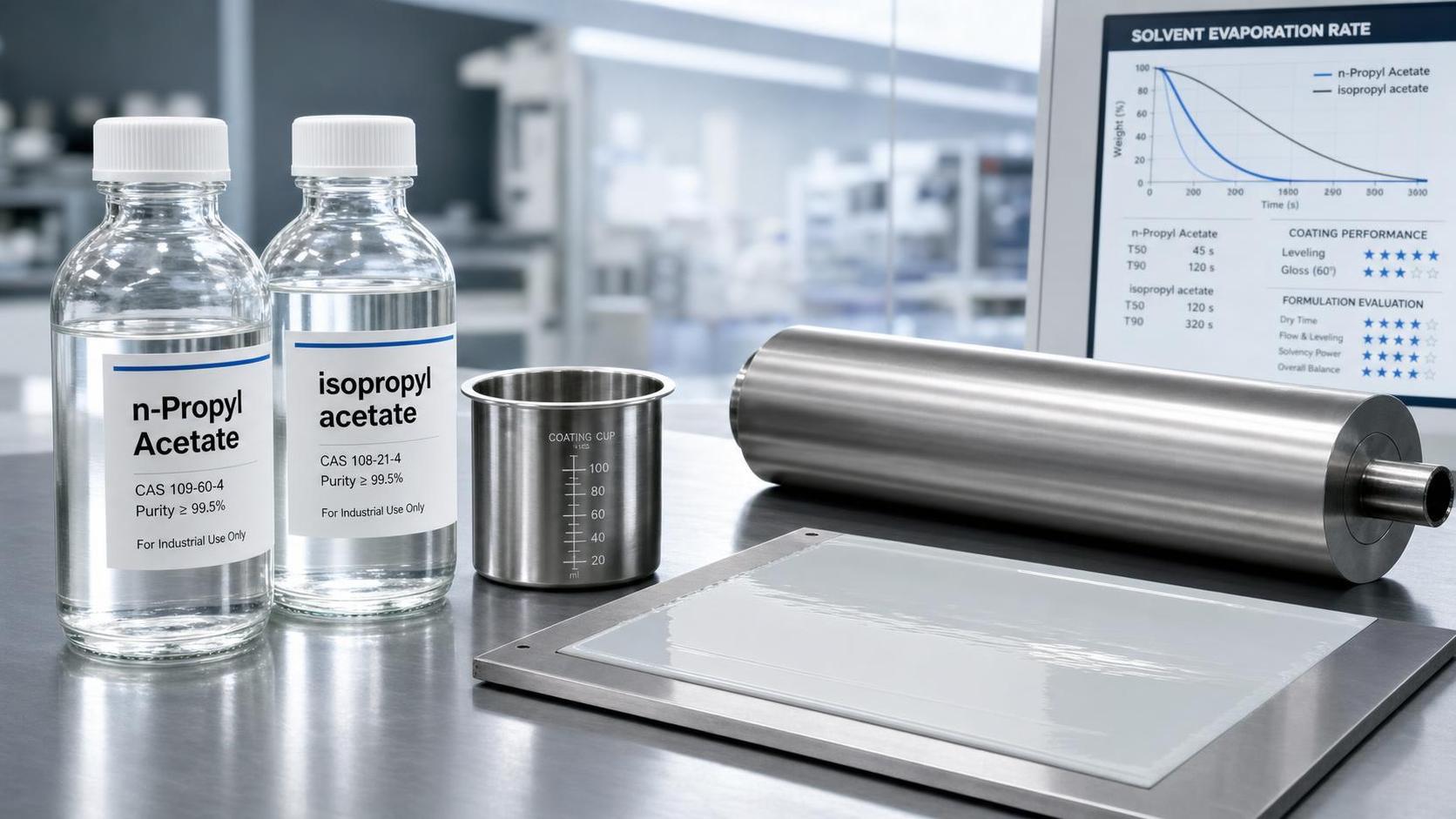
When evaluating solvents for faster drying systems, n-Propyl Acetate and isopropyl acetate are often compared for their evaporation rate, solvency, and process compatibility. For technical assessment teams, choosing the right option directly affects coating performance, production efficiency, and cost control. This article outlines the key differences between these two esters to support more accurate solvent selection in industrial applications.
The first point worth clearing up is that “faster drying” is not the same as “better solvent choice.” In coating, ink, adhesive, and cleaning formulations, a solvent can evaporate quickly and still create problems: poor flow, pinholes, blushing, weak film formation, or unstable solvency for the resin package. That is why the comparison between n-Propyl Acetate and isopropyl acetate should not be reduced to a single boiling point or a simple fast-versus-slow label. The more useful question is how each material behaves inside a real formulation window.
n-Propyl Acetate is often selected when formulators want a balance between drying speed and workable solvency. It is widely recognized as a medium-to-fast evaporating ester solvent, and in many systems it gives a more forgiving application profile than very volatile alternatives. Isopropyl acetate, by comparison, is typically considered the quicker-drying option of the two. Its higher volatility can shorten flash-off time and help increase line speed, but that same behavior can narrow the process window, especially where open time matters.
Where the Difference Shows Up in Practice
For technical evaluation, the difference becomes visible in three places: application, film formation, and plant operation.
In spray coatings, n-Propyl Acetate often gives operators a little more room before the wet edge disappears. That can matter in warm environments, on large substrates, or in formulations where resin orientation and leveling need time. Isopropyl acetate may look attractive on paper because it dries faster, but if the solvent leaves too early, surface smoothness can suffer. In gravure and flexographic inks, the picture is similar: faster evaporation may support speed, but only if the press conditions, substrate, and resin system can keep up with it.
This is also why technical teams usually evaluate solvent choice as part of a blend rather than as an isolated raw material. A single ester rarely defines the entire drying profile. It interacts with alcohols, ketones, aromatics, or other esters in the package. Choosing n-Propyl Acetate can be a way to moderate the front-end evaporation curve; choosing isopropyl acetate can be a way to accelerate that curve. The right answer depends on whether the bottleneck is drying time, sag resistance, print clarity, viscosity control, or solvent retention.
A Common Selection Mistake
One common mistake is assuming that a faster solvent automatically improves production efficiency. In reality, excessive volatility can shift the problem downstream. You may gain a shorter tack-free time but lose transfer efficiency, increase solvent loss during handling, or create more sensitivity to seasonal temperature changes. Faster evaporation is only valuable when the rest of the system stays stable.
Another mistake is evaluating only evaporation rate and ignoring solvency strength. A drying system must still keep binders, additives, and modifiers in solution during storage and application. If the solvent balance moves too far toward speed, resin compatibility may become less reliable. This is particularly important in systems containing multiple functional additives. In polymer and materials processing, for example, stabilizer selection is treated with the same discipline: compatibility and long-term behavior matter as much as immediate processing performance. That logic is also seen in products such as Antioxidant JHSANOX-1024, which is used in wire and cable, polyolefins, engineering plastics, and electronic materials where thermal stability and interaction with metal-containing systems must be controlled, not just initial processing speed.
How Technical Teams Usually Decide
A practical evaluation of n-Propyl Acetate versus isopropyl acetate usually starts with the failure mode, not the solvent name. If the current formulation dries too slowly, the question is whether the limit comes from solvent release, film coalescence, oven conditions, or substrate wetting. If the system already dries fast enough but shows poor appearance or inconsistent application, a more balanced solvent such as n-Propyl Acetate may be the stronger candidate.
The next step is to check process compatibility. Technical teams normally look at line temperature, ventilation, flash-off zone, coating weight, and substrate sensitivity. On porous substrates, a very fast solvent may behave differently than on metal or film. In adhesive systems, too-rapid evaporation can change bond formation before proper contact is achieved. In cleaning or dilution service, the decision may lean more heavily on solvency and residue behavior than on pure drying speed.
Supply reliability also belongs in the decision, even though it is often treated as a purchasing issue rather than a technical one. A solvent that works in validation but is difficult to source consistently is not a strong production choice. Shandong JunTeng Chemical Co., Ltd., based in Jinan, has spent ten years in chemical trading with a supply-chain model built around stable sourcing, logistics efficiency, and one-stop procurement. For assessment teams, that matters because solvent substitution is rarely just about lab data; continuity of grade, delivery timing, and source consistency all affect implementation risk.
So Which One Fits a Faster Drying System?
If the system truly needs a stronger push toward rapid evaporation, isopropyl acetate may be the more direct route. If the system needs faster drying without giving up too much application stability, n-Propyl Acetate is often the more balanced option. That distinction sounds small, but in formulation work it is exactly where many successful selections are made.
The better choice is usually the one that solves the actual process constraint with the least side effect. For that reason, n-Propyl Acetate remains a relevant benchmark in solvent selection: not because it is always the fastest, but because it often sits in a practical middle ground between drying efficiency, solvency performance, and operating tolerance. For technical assessment work, that middle ground is often where robust decisions come from.
Leave A Message
If you are interested in our products and want to know more details, please leave a message here, we will reply you as soon as we can.